
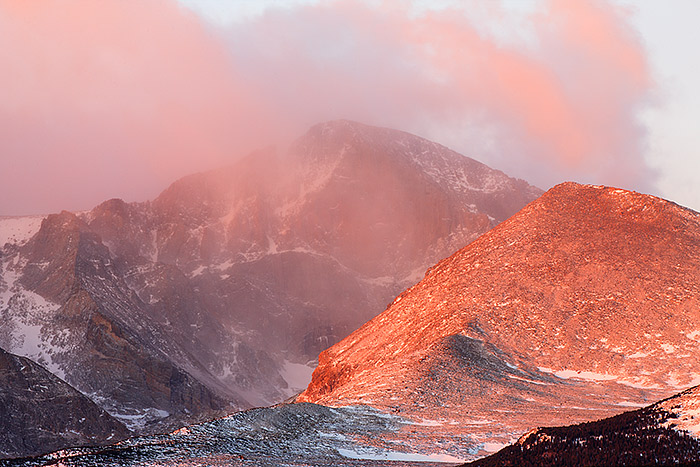
The Tahosa Valley and the Twin Sisters: Located along Highway 7, the Tahosa Valley and the Twin Sisters formation offer some of the most impressive views of Longs Peak and Mount Meeker, the two tallest peak in Rocky Mountain National Park. Hike up the Twin Sisters trailhead for impressive views of Longs Peak and it’s famous eastern face known as the Diamond.
Trail Ridge Road and The Mummy Range: The Mummy Range has a southeast facing orientation. This southeasterly orientation is ideal for capturing the winter sun which rises in the southeast this time of year. A short hike up a closed Trail Ridge Road from Many Park’s curve will result in spectacular viewpoints of Mount Chapin, Mount Chiquita and Yipsilon Mountain. It’s common to find clouds floating over the peaks of the Mummy Range which will only help to aid in capturing even more stunning light at sunrise.
Bear Lake Area: Nearly everybody favorite spot in Rocky Mountain National Park for winter activities of all sorts. There are endless possibilities for winter photography in this area. Slap on some snowshoes or cross country skies and impressive viewpoints of the backside of Longs Peak, or towering blocky summit of Hallet Peak lend themselves to your camera and lens. Dream Lake is a popular location even in the middle of winter. Images of Hallet Peak from Dream Lake are just as impressive in winter as is summer, but Dream Lake also attracts photographers looking to photograph abstract images of its icy surface. Because Hallet and Flattop mountain have a northeast orientation, late winter will provide fuller and more complete lighting of this iconic location.