Author: Tom Mangan
Vision and Gear

When I first started seriously pursuing photography back in 1994, digital photography had not entered the mindset of photographers. Film was still king and Kodachrome was still a very popular film. Fuji Velvia had surpassed Kodachrome as the go to film for most photographers, but you could readily purchase Kodachrome 35mm slide film in 25 ISO, 64 ISO and 200 ISO. Times were much different then and the limitation of your gear mostly revolved around your skills, technique and the film you chose to shoot with. At the time, a 35mm camera was basically a light tight box, used to expose film. Sure there were high end professional film bodies available then such as the Nikon F4 or the Canon Eos 1n, but a photographer with a Nikon FM2 could produce just as technically proficient of an image on Kodachrome or Velvia as could the photographer with the Canon Eos 1n.
No longer can a digital camera be viewed as a simply a light tight box in which we expose a piece of film to light. Digital cameras come in all flavors and sizes these day and the sensor and resolution of the actual digital camera can play a large role in how and image is viewed or printed. That being said the photographers vision and passion for their subject is still the most important aspect to photography. It’s easy to believe that buying a new piece of gear will make you a better photographer. While I find that new gear may add some additional motivation to head out into the field for a test run, that feeling will quickly disperse leaving me only with my vision and passion for photography to get me back out in the field. Since it dawned on my back in 1994, that photography was something I would pursue for life, I have owned many different types of gear. I have shot with Minolta equipment, Nikon equipment and for the last 17 years have shot most with a 4×5 large format system and Canon equipment. While having some of this gear and equipment has helped me to capture some of my imagery, it was the realization that formulating a vision is much more powerful than any new piece of gear
Hollowell Park, Not Visualized

It’s easy motivation to idealize and visualize what one is going to photograph on a particular expedition. The thought of capturing magnificent light at an elusive location may be what gets a photographer out of bed in the morning when the alarm clock goes off at 2:00 AM, more importantly it may be what keeps the lights turned on back at the house. It can also be what hamstrings a photographer and causes them to head out with blinders attached. When I arrived in Rocky Mountain National Park this particular morning I too was guilty of having a pre determined notion of what I wanted to photograph.
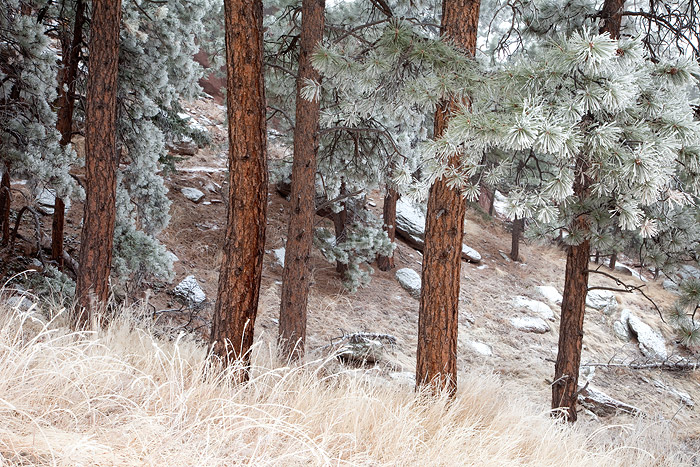
I knew that it would be overcast and snowing in the Park this morning. These are some of my favorite weather conditions for my type of photography. Weather conditions such as they were this particular morning are great for photographing trees and more intimate landscape subjects. I headed over to the Hollowell Park trailhead knowing there were some nice Ponderosa pine groves in the area. I was intent on photographing Ponderosa pine trees covered in fresh snow as I had done many times before. I have photographed Ponderosa’s many times in conditions such as these. A funny thing happened as I set out from the trailhead.
As I walked along the stream, and further up the trailhead, the willows along the bank of the stream caught my eye. I have hiked past these willows many times before and never felt the motivation to photograph them. This morning was different. With the snow falling moderately and the Willows along the bank of the stream subtlety glowing red and orange, I had to get my camera out and capture the scene unfolding before me. I quickly setup my equipment, forgot about photographing the Ponderosa’s and began to photograph the willows. The soft light and snowfall combined with the red’s and oranges of the willows along the creek helped to create an almost impressionist like image. The bottom line, visualizing what you want to photograph is good, but make sure you keep your senses tuned and your eyes and mind open.
Unsetteled in Moraine Park

The past few days have seen a typical unsettled weather pattern moving affecting the eastern side of Rocky Mountain National Park. Storms moving through the Colorado from the Pacific have been dropping a few inches of heavy wet snow every few days. Heavy wet spring snow coats the conifers lining the slopes of Rocky Mountain National Park, and fog drifts in and off the peaks periodically. The weather causes diffused lighting conditions. I spent the last week photographing the Moraine Park area as these storms would pass through Rocky and came away with many unique images. I love how the lighting conditions render the scene with a cooler blue hue and the pine trees in Moraine are weighed heavily with fresh spring snow. It was a good week for photography and I would certainly welcome another week of unsettled weather. I promise, before you know it I’ll be posting images of pristine Alpine lakes reflecting majestic peaks, its just not going to be today.
Bobolink Spring

The lower elevations around Boulder are starting to show signs of life as the grasses are starting to green and some of the early bloomers are sprouting buds. People who follow my photography know that one of my favorite subjects are trees. I find the form and shape of trees fascinating. They make for great subjects for photography but learning to compose and arrange successful photographs and images of trees can be very difficult to achieve. When photographing trees, one of the first things one must do to capture a successful image is to learn to arrange the chaos into a cohesive image. It’s just as important in photography to learn what to exclude from and image as it is to understand what elements should be kept in the scene. This could not be more true when photographing trees.
Often when I make a successful image of trees, the scene grabs my eye as I walk by a location. These photograph is no exception. I was hiking on the Bobolink trailhead which is part of Boulder, Colorado’s beautiful Open Space and Mountain Parks system. I was interested in the budding bushes that were growing along the creek in a classic Colorado riparian habitat.
These bushes on their own were not compelling me to setup my camera and make images. It was an overcast day, which are the conditions I favor when shooting more intimate photographs of trees and landscapes. Photography is about capturing light, and the soft diffused light of an overcast day helps to evenly light a scene and prevent harsh shadows from obscuring details. Soft diffused light helps to create a more painterly scene and allows for all the subtle detail, shapes and colors to shine. As I walked by this scene, the combination of the budding flowers and this beautiful Cottonwood tree caught my eye. It was quite a challenge to arrange the chaos present in this scene into a cohesive image. After many lens changes, multiple tripod setups and compositions I was finally able to arrange a pleasing composition. I eventually settled on using a telephoto lens to help compress the scene and isolate the bending branches of the cottonwood trees amongst the budding bushes.
Spring on Flagstaff Mountain

I took advantage of a late season April snow storm to head up Flagstaff Mountain just outside of Boulder. Flagstaff Mountain is one of my go to locations. For me it’s a short drive to the mountain and access to some classic Colorado scenery. I love the diversity of the area. Flagstaff Mountain is dotted with Yuccas, Ponderosa Pines, Bluestem grasses and Granite boulders. These make for great photography subjects when covered in snow and fog. No matter how many times I photograph on Flagstaff Mountain in weather conditions such as these, I never cease to find new compositions and limitless opportunities to create unique and original imagery.
Almost Closed – Sprague Lake Sunrise

This morning was a little different. When I went to bed the night before, our politicians were bickering and grandstanding attempting to settle our 2011 budget crisis. If the budget was not settled within a few hours of my going to bed early in order to wake early for sunrise, there would be a government shutdown. One of the casualties of the shutdown was going to be the National Park and the National Park Service. Of the countless times I have visited Rocky Mountain National Park, it had never occurred to me that it would be possible to have access restricted and the Park closed. I regularly visit and photograph Rocky Mountain National Park impressed that those who have come before me, had the foresight to protect this beautiful area as well as to keep it open to the public.
When my alarm went off at 2:30 AM the first thing I did was check to see if I would be able to access Rocky Mountain National Park. I had gone to bed feeling disgusted and disappointed over the fact that Washington politicians could not do their job and complete a budget. Not only was it possible that I would not be able access Rocky Mountain, but it was possible that thousands of employees would be out of work and furloughed. Luckily a budget was agreed upon and the National Park Service did not have to close or restrict access to the National Parks.
Because I was unsure of what I would be doing this morning, I took a wait and see approach to my photography. Normally I like to plan where and what I will be photographing. On my drive up to Rocky Mountain I could see that clouds were present to the east, but not to the west or over the Continental Divide. I needed to find a location where I could setup and hopefully catch those clouds off to the east light up as the Sun rose. I knew that Sprague Lake has a nice unencumbered view to the east. I also figured that Sprague Lake might be starting to thaw out and that I may be able to find some open patches of water to catch a reflection of the clouds if the sunrise worked out as I had hoped. I arrived at Sprague Lake to find almost all of it still covered in snow and ice. There was however, a small area on the west end of the lake with a thin layer of ice, not covered by snow. The eastern horizon was showing promise and the clouds were showing hints of pink and magenta. I quickly setup the camera and was not disappointed. To think I almost missed out on this beautiful sunrise.
Tahosa Valley Morning

There are lots of great photographs to be had of Longs Peak but one of my favorite views is from the areas around the Tahosa Valley along Highway 7. While the views of Longs Peak and Mt. Meeker are spectacular from the floor of the Tahosa Valley, a hike up the Twin Sisters trailhead helps elevate the view providing an even cleaner perspective of Longs Peak and Mt. Meeker.
This morning, the trailhead was still packed down with snow. Snowshoes were not necessary but my indispensible Yaktrax helped keep a firm footing while hiking. There were lots of clouds floating around the area this morning but the larger groups of clouds stayed north of Longs Peak. I managed to get some nice pastel light on the peaks just prior to Sunrise. I really like to photograph subtle light such as seen in this photo. I certainly have photographed Longs in much more dramatic light than I captured on this morning but even so I find the color palette pleasing.
Opening Day

For Photographers, the time around Opening Day also signals a change. New opportunities will soon present themselves. Snow draped pine trees and peaks will soon begin melting. Leaves will start to bud on Aspen trees and Maples. Grasses in the Meadows will begin turning from brown to green, and sooner than later will begin to yield the first wildflowers of the year. It’s also a time to pull out the map book, do some research and start planning where our Summer photo expeditions will take us. Hope does indeed spring eternal on this day. Excitement builds not only for what the Baseball season holds, but for what new opportunities, trips, circumstances and places the budding new photography season holds. Lets go Yankees!.
Bad Weather,Great Images

When the weather is less than ideal and I decide to head out into the elements I try to stay local. I often stay local for a few reasons, but one of the important reasons to photograph locally is that I have a better understanding of how the weather will affect my area. Furthermore, instead of additional travel in adverse weather, staying local allows me to focus my resources and my vision on areas that I have a greater familiarity with. This familiarity of my local geographic area as well as how local weather phenomena will affect the landscape, allows me to be more productive with field time.
So the next time your alarm clock goes off at 3:00 AM on a snowy winter morning, don’t hit the snooze button. Instead, use your knowledge and experience of your own local area to create unique imagery in less than ideal weather conditions.