A few hardy stragglers cling to the upper reaches of these Aspen tree's in Boulder's Gregory Canyon. I hiked into this location hoping to find these Aspen trees near peak but to my dismay, Autumn was nearly over. After my initial disappointment at finding the grove past peak, I went about making images of a forest in transition. I walked away very pleased with the images I had made. While not what I had expected, shooting this grove a past peak, created a special mood of changing seasons. Technicial Details: Canon 5D Mark II, 70-200mm F2.8 LIt’s getting to be that time of the year awful quickly. Wildflower season has passed and Colorado’s fall color season is quickly fading away. Were heading into the dreaded ‘photographers offseason’. The circled dates on the calendar are running out, no trips planned to far flung reaches of the state to hunt down the best wildflower patches or to find peaking golden aspen groves.
All photographers and artists will go through ebbs and flows of creativity. Many of us seem wired to be affected by the changing seasons. This is evident in our moods and reflected in our creative output. It’s beneficial for photographers to recharge their batteries, take inventory and unwind from field work a bit. It’s ok to spend a weekend working on a backlog of images while sipping on one of Colorado’s finest microbrews.
It’s also important at this time of the year not to get to complacent. Celebrate your wins, update your portfolio, print and frame some of your best shots from these last months of creative bliss. It’s also important at this point to keep your goals in view, and your skill set sharp. Make sure to continue to get out in the field to shoot and discover subjects. This will help keep your eye trained and your senses alert. Dedicate yourself to a new project and make sure you keep getting out into the field regardless of the weather or the subjects closet at hand. Even if you dial your creativity and photograph back a bit, stop the cobwebs from forming and the dust from settling. Before we all know it, wildflowers will be blooming once again.
Clouds from Colorado's active monsoon season party ways as the first rays of the day breach a hole in the cloud cover to the east. The active and wet monsoon season is making for some great lighting conditons. Technicial Details: Canon Eos 1dsIII, 24mm TS-EF3.5 L III try to avoid returning to the same locations on consecutive days if possible. That’s not to say I do return to the same location over and over again in an attempt to capture a scene under varying lighting conditions. You only have so many sunrises and sunsets, so I try to keep the line moving. I had previous commitments on Saturday and Sunday that prevented me from heading up into the high country or to Rocky Mountain National Park in search of images so I stayed local in Boulder.
We continue to have a very wet summer here on the Front Range of Colorado, and the monsoon has really kicked in full force. Most afternoons we are getting very strong thunderstorms and rain. This has made for some great sunrises the past few weeks. Clouds from the previous nights thunderstorms have been hanging around at dawn accompanied by good size breaks in the clouds on the eastern horizon out over the high plains. This particular sunrise of the Flatirons from Chautauqua park was particularly nice. Further north, over Rocky Mountain National Park the sunrise looked to be even more intense. Hopefully some other photographers captured that display, I was glad to be able to sneak in this image.
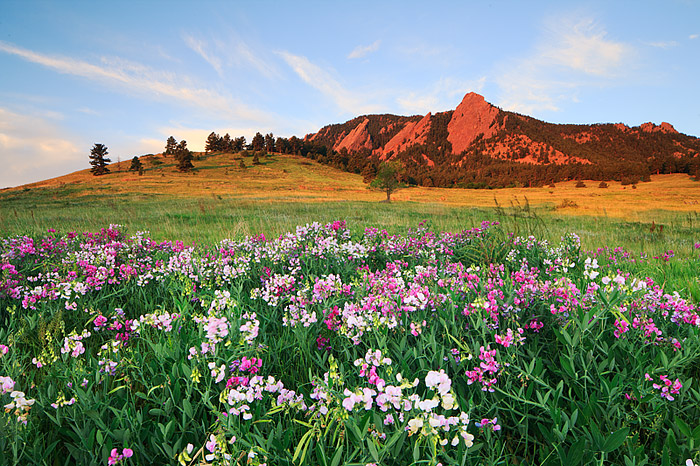
A banner year for Sweet Pea in the meadows below the Flatirons make for a great sunrise image of this iconic Colorado location. Technicial Details: Canon Eos 1ds III, 24mm TS-E f3.5 L IIIt’s been awhile since I’ve posted an image from Chautauqua park of the Flatirons, so I figure were due for one. The meadow around Chautauqua park in Boulder is the place to be for the classic iconic image of the rock slabs that help make Boulder famous. Chautauqua park is a great photographic location in any season, but from spring through mid-summer its hosts a great display of wildflowers on good years.
Starting in early May the meadows below the Flatirons will host a display of varying wildflowers. On a good year, the meadow seems to produce flowers in a near scheduled pattern. Yellow Golden Banner is usually the first flower to make their appearance in the park, followed next by Wild Iris and Arrowleaf. Purple Lupine will cover the fields by mid June and the season will start to wind down with the addition of Sweet Pea in the area near and around the Ranger cottage. While the Sweet Pea makes for a beautiful display when used to frame the Flatirons, it really shouldn’t be there. Sweet Pea is actually considered an invasive species and was planted by some of the first settlers in and around Boulder. Even though we’d prefer these magenta, pink and white flowers found other areas to habituate, they do make for a point of interest for the photographer. Throw in some screaming morning light, some high cirrus clouds, viola! you’ve got yourself an iconic image of the Flatirons.
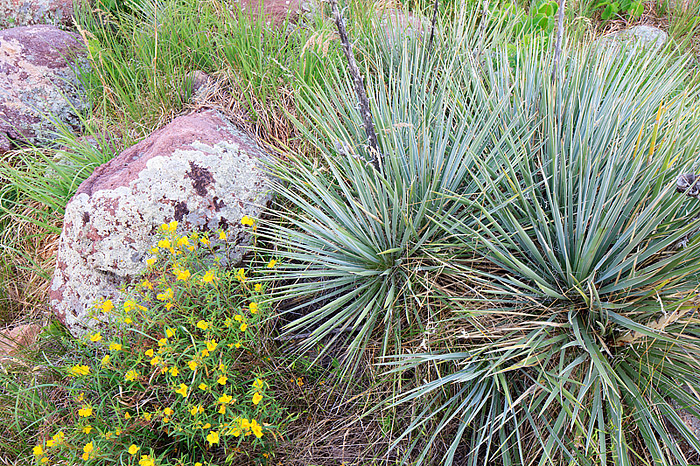
Shrubby Cinquefoil blooms amongst the Yucca's and rocks near South Boulder Creek and the Mesa trail. Technicial Details: Canon Eos 1ds III, 24mm TS-E II f3.5 LSuccessful photography is about presenting the complex in an orderly, coherent fashion. Successful landscape photography is not about how much one can include in the frame, but instead using your vision to include only compelling and interesting elements. This is a basic photography concept and one that allows the viewer eye to travel through the image without being overwhelmed or distracted. Although it’s a basic photography concept, we can often be overwhelmed in the field with visual stimuli. Because of this, many photographers will fail when it comes to creating compelling imagery because they may be unable to create order from chaos.
Typically when I head out in the field to create images, I like to have an idea of what I want to shoot and where I want to go. I believe it to be important however, to keep both your mind open and your options open. I was recently reading and interview with a photographer who’s work I greatly admire discussing his inspirations. The Photographer purposefully avoids viewing other photographers work when possible. This is not done in an elitist fashion, but because he wants to stay true to his own vision and create original and unique imagery. He feels viewing other photography dilutes his own vision and prevents him from creating imagery unique to his vision of natural places. While I don’t subscribe to his idea to such an extreme and find viewing other photographers work inspirational, I greatly respect his desire to stay unique.
This morning I headed up the Mesa trail from the South Boulder trailhead. I was not feeling inspired to photograph anything in particular and in fact was simply enjoying a peaceful morning hiking with my dog, Jackson. Clouds obscured the sunrise this morning and the soft diffused light is some of my favorite lighting to photograph in. This time of year, mornings break often under ‘severe clear’ conditions, Boulder, Colorado is unique in that it is the junction between two competing eco-systems, that of the high plains and the Rocky Mountain foothills. The South Boulder trailhead and Mesa trail are great in that they wind through Bluestem grasses, Yucca’s and Ponderosa forests.
Early on in the hike, the many Yucca’s growing along the slopes caught my attention. They are starting to bloom in many of the areas along the Mesa trail. While looking for a good composition of blooming Yucca’s, this particular scene caught my eye. The red rocks, typical of this area combined with the Yucca leaves and flowering Shrubby Cinquefoil could be interesting if I could blend all the elements together. When photographing images such as these, it’s of the utmost importance to know what to include and what to keep out. At the same time, your not able to physically move trees, flowers and rocks so you have to work within the parameters nature has given you. Sometimes the flowering Shrubby Cinquefoil does not want to bloom far enough away from other distraction objects, and sometimes it does,
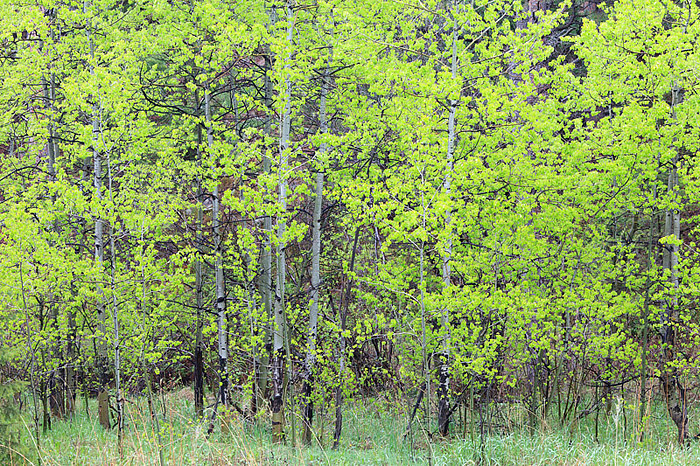
Aspen trees along Green Mountain in Boulder, Colorado display their spring foilage and a misty but beautiful spring day. For a short period of time, Aspens in the spring take on this brilliant green hue. Technical Details: Canon 5D II, 70-200mm F4 IS, Circular PolarizerIn keeping with the Aspen tree theme, here’s a recent example of an Aspen grove along the northern flank of Green Mountain in Boulder, Colorado. Were still inching along towards summer here but finally I can see signs of life and spring in our lower elevations. Most photographers enjoy making images of Aspen trees during the fall when their leaves turn a golden yellow. There is however, a short window during the spring, shortly after the trees ‘bud out’ when the Aspen trees put on just as interesting a display of color. Shortly after Aspen trees begin to display their recent spring foliage, Aspen leaves take on a translucent key lime like hue. It’s a short window between the key lime look and the darker summer green leaves. Under the right lighting conditions, the green Aspen leaves literally appear to glow.
I’ve been spying this small Aspen grove on the side of Green Mountain in Boulder for some time. Boulder, Colorado does not have many Aspen groves, but there are a few dispersed areas of Aspen trees here and there amongst the Evergreens. Because of the heat and lesser amounts of moisture, they tend to grow in smaller, less impressive groves than other areas of Colorado. I passed this grove the day before but it was sunny and the lighting conditions where much too harsh to capture the detail and make the key lime spring leaves ‘pop’. I returned a few days later after a light rain had been falling on the area. The leaves looked great under the diffused lighting and I spent some time wandering around the trees. It was an awesome feeling being outside, under a light mist with the organic smell of life, and spring in the air and grove. Periodic claps of thunder could be heard in the distance but I was loving every minute of it. This was spring renewal at its best for me. I was revitalized with thoughts of what the future holds and opportunities to come.
Yuccas and Ponderosa Pines are coated with fresh snow in May. I photographed this scene this week on Flagstaff Mountain in Boulder, Colorado. Technicial Details: Canon 5D Mark II, 17-40mm F4LAt the risk of boring everyone to death, I will avoid digressing more on how we have yet to see springtime here on the Front Range of Colorado. I will only say that in the last week I have been able to photograph lots of wintry type scenes on and around Flagstaff Mountain in Boulder. It’s fairly safe to assume that by mid May, most of my photography has shifted from winter like scenes, to views of Golden Banner blooming in Chautauqua meadow amongst the green grasses. Enough of the belly aching, regardless of the fact I am looking forward to warm sunny days, I’m quite pleased with the end results. I’ll let the image speak for our weather this week.
Flowers bud along the base of a Cottonwood tree along the Bobolink trailhead in Boulder, Colorado.Technical Details: Canon 5D Mark II, 70-200mm F4 ISEven with the mild winter we’ve had this year, the transition into spring from winter never seems to occur at a pace we would like. It can often feel like were taking one step forward with a warm spring day and then two steps back when you wake up to find snow on your car in the morning .
The lower elevations around Boulder are starting to show signs of life as the grasses are starting to green and some of the early bloomers are sprouting buds. People who follow my photography know that one of my favorite subjects are trees. I find the form and shape of trees fascinating. They make for great subjects for photography but learning to compose and arrange successful photographs and images of trees can be very difficult to achieve. When photographing trees, one of the first things one must do to capture a successful image is to learn to arrange the chaos into a cohesive image. It’s just as important in photography to learn what to exclude from and image as it is to understand what elements should be kept in the scene. This could not be more true when photographing trees.
Often when I make a successful image of trees, the scene grabs my eye as I walk by a location. These photograph is no exception. I was hiking on the Bobolink trailhead which is part of Boulder, Colorado’s beautiful Open Space and Mountain Parks system. I was interested in the budding bushes that were growing along the creek in a classic Colorado riparian habitat.
These bushes on their own were not compelling me to setup my camera and make images. It was an overcast day, which are the conditions I favor when shooting more intimate photographs of trees and landscapes. Photography is about capturing light, and the soft diffused light of an overcast day helps to evenly light a scene and prevent harsh shadows from obscuring details. Soft diffused light helps to create a more painterly scene and allows for all the subtle detail, shapes and colors to shine. As I walked by this scene, the combination of the budding flowers and this beautiful Cottonwood tree caught my eye. It was quite a challenge to arrange the chaos present in this scene into a cohesive image. After many lens changes, multiple tripod setups and compositions I was finally able to arrange a pleasing composition. I eventually settled on using a telephoto lens to help compress the scene and isolate the bending branches of the cottonwood trees amongst the budding bushes.
A late spring snowstorm coats the yuccas and granite near the summit of Flagstaff Mountain in Boulder, Colorado. Technical Details: Canon 5D Mark II 17-40mm F4 LOne of the common weather jokes in Colorado refers to the constantly unpredictable weather conditions. People here in Colorado often joke that there are two seasons, winter and August. Though in reality Colorado does have four seasons, spring and fall can teeter between summer like weather and winter like conditions. Spring on the Front Range of Colorado can be very unsettled and snow is a common theme. By April were all ready for summer like conditions and a cold drink by the pool. Mother Nature usually has other ideas and April is Colorado’s third snowiest month. This spring has been dry on the Front Range so some late season snow is appreciated. For photographers the snow will help bring spring wildflowers which will soon appear.
I took advantage of a late season April snow storm to head up Flagstaff Mountain just outside of Boulder. Flagstaff Mountain is one of my go to locations. For me it’s a short drive to the mountain and access to some classic Colorado scenery. I love the diversity of the area. Flagstaff Mountain is dotted with Yuccas, Ponderosa Pines, Bluestem grasses and Granite boulders. These make for great photography subjects when covered in snow and fog. No matter how many times I photograph on Flagstaff Mountain in weather conditions such as these, I never cease to find new compositions and limitless opportunities to create unique and original imagery.
Moraine Park Aspens. Snow was falling at a pretty good clip when I arried in Rocky Mountain this morning. Using the heavy snow to isolate this grove, allowed me to create a unique image of an often photographed location. Canon 5D II, 70-200 F4 ISSome of my favorite photographs have been taken during in less then ideal weather conditions. Weather can make or break creating great imagery. Often times, it is tempting to want to get out in the field when the weather is nice and predictable. While I’ll take being out in the field any day, sometimes we as photographers need to push ourselves to get out and shoot in weather and light that on the surface appears uninspiring but in fact leads to creating dynamic and unique imagery.
When the weather is less than ideal and I decide to head out into the elements I try to stay local. I often stay local for a few reasons, but one of the important reasons to photograph locally is that I have a better understanding of how the weather will affect my area. Furthermore, instead of additional travel in adverse weather, staying local allows me to focus my resources and my vision on areas that I have a greater familiarity with. This familiarity of my local geographic area as well as how local weather phenomena will affect the landscape, allows me to be more productive with field time.
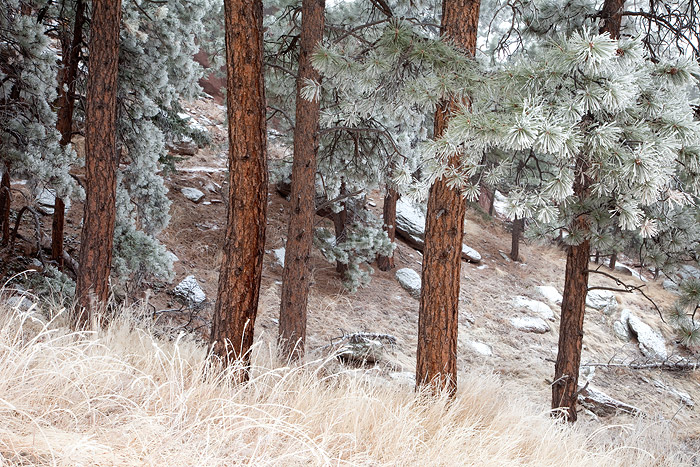
So the next time your alarm clock goes off at 3:00 AM on a snowy winter morning, don’t hit the snooze button. Instead, use your knowledge and experience of your own local area to create unique imagery in less than ideal weather conditions.The Ponderosa trees on Flagstaff Mountain just outside of Boulder are one of my favorite subjects to photograph. When we get upslope type condtions I will often hike up Flagstaff Mountain in order to capture the conditions. From experience I know that hoar frost and rime ice will coat often coat the trees and grasses. These conditons allow me to capture these beautiful trees and their surroundings in conditions that better represent my vision. Canon 5D II, 24-105mm F4 IS
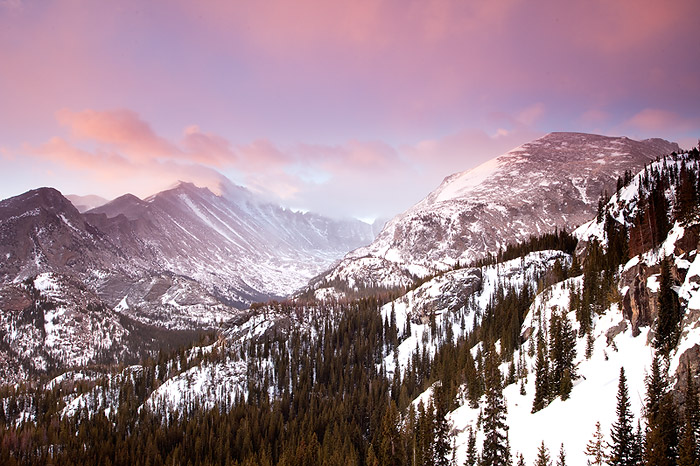
Longs Peak and Otis Peak greet a new morning at Rocky Mountain National Park. This was my third attempt this winter to capture this scene. I had envisioned shooting a scene like this but my previous two attempts resulted in less the ideal atmospheric conditions. Canon 5D II, 24-105mm
‘Winning’. The word is simple in meaning, but often more complex to define what actually constitutes a win. It has become a popular catch phrase of late because of its frequent use by a popular celebrity. While I wont use this blog to explain the many beneficial uses of acquiring ‘tigers blood’, winning as it pertains to photography is not so easily defined.
From my point of view, I register a win each time I am lucky enough to get out into the field with my cameras and photograph. Many times, I may head out into the field and encounter circumstances such as poor weather, or poor lighting that may prevent me from actually capturing any images at all. Though I am grateful to be spending time out in the field regardless of the underlying circumstances, there are times when I may return from a shoot feeling at a loss or unsatisfied with my results. Even when all the stars align, human error may prevent a photographer from successfully capturing an image. For a photographer, using your vision to execute successful photographs can be challenging and difficult but also very rewarding when it all comes together for you in the field.
Snow and fog drift along the base of Boulder's Flatirons formation. I often photograph this area under simmilar conditons. From experience, I hiked up Flagstaff mountain. This experience, allowed me to sucessfully execute this image. Canon 5D II, 70-200mm F4 IS
Many of the photographers I greatly admire often state that capturing only a handful of images each year that portrays their vision constitutes a success. While I tend to agree with this line of thinking, I find there are some landscape photographers who are able to spend a short amount of time in the field and return with more than just a handful of portfolio worthy images. Those photographers may of course feel their efforts and results were all in vain.
Snow and Fog begin to lift away from the flanks of the Flatiron's formation. It was snowing when I first arrived at the base of Flagstaff mountain. As I hiked towards the summit, the weather began to change and I had to drop my pack quick and setup my tripod to catch this scene. I was about 2.5 miles up the mountain when this occured. It was purely by chance that I happend to be in this location when this scene unfolded. Sometimes you just get lucky. Canon 5D II, 70-200mm F4 IS
When attempting to ‘win’ at landscape photography, perspective may be the most important trait. Each time I venture off into the field, it important to value that time to hone my skills, improve my craft and hopefully capture some compelling imagery. As the old saying goes, ‘a bad day in the mountains is better than a good day at the office’.