
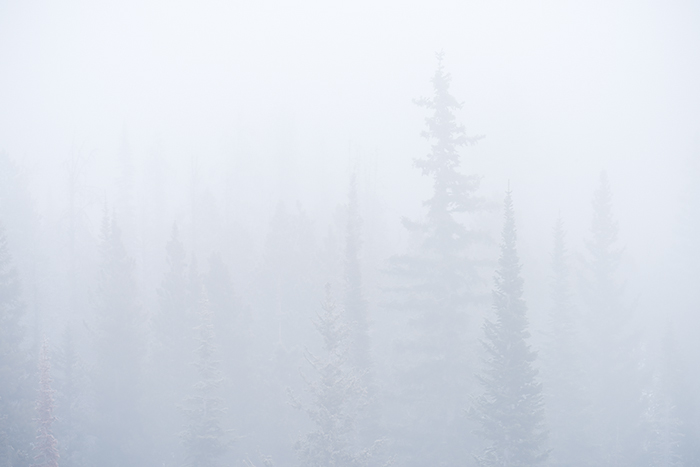
For some landscape photographers, cloudy days can be the bane of their existence. Combine cloudy days with your typical winter doldrums and some landscape photographers may avoid heading out to photograph all together. Cold weather, lack of a dramatic sunrise or sunset and subjects like streams and waterfalls frozen over narrows down the amount of options one has in the field to work with. While I cant argue it can be more difficult creating compelling images, cloudy and grey winter days still can produce dramatic, moody and unique images if one keeps and open makes sure to get the camera out of the bag. Here’s some ideas for those less then optimal grey winter days.
Go where the snow is. Cloudy gray days with no fresh snow are very challenging to photograph in. The weather here in Colorado during the winter months can vary greatly over a short distance. Much of our winter weather is determined by both elevation as well as which side of a mountain range your on. Depending on locations of weather systems, one side of a mountain range may be more optimal for producing snow then another. Here on the Front Range we are typically on the leeward side of the mountain range. This means that while it may be snowing very heavily on the windward side of the range only a dozen or so miles away, the leeward side has little in the way of clouds or snow. This is common here in the winter months of Colorado with snow falling heavily on the west side of the Continental Divide while little snow and mainly winds occurs on the east side of the Divide. This scenario will reverse often act in the inverse when ‘upslope’ conditions are occurring on the east side of the Continental Divide. On days like these it’s best to either head over to the west side of the Continental Divide, or head higher up in elevation on the east side of the Continental Divide where blow over from the storm may be causing snow to fall. The downside of staying on the east side or leeward side of these conditions is that it’s likely to be very windy. 
Head out on days when inversions or a low lying cloud layer form either during or after a storm. Sure it may be cloudy and gray with little to no snow down along the lower elevations of the Front Range, but you may have fog and snow and higher elevations if conditions are more favorable a little higher up the mountainsides. Typically inversions occur along the Front Range when we have ‘upslope’ conditions or winds that are blowing in a north easterly direction. A couple of positive outcomes may occur if you head out into the cloud layer caused by and inversion. First you may be lucky enough to actually get above the cloud layer and into clear or sunny skies. Obviously the ability to get above the cloud layer creates all sorts of opportunities for dramatic landscape photography. Secondly, even if your unable to get above the inversion layer, you may be able to get at or near the transitional zone where fog, snow, and hoar frost are occurring. Snow, fog and pines coated with ice or hoar frost can lead to limitless possibilities for photography. Personally, this is one of my favorite kinds of weather conditions to photograph in. Familiar landscapes take on a anonymous like quality. Suddenly iconic locations, photographed time and time again are incognito and allow for new viewpoints and photographic interpretations. When conditions are like this, the landscape truly transforms into a winter wonderland.
Lastly on cloudy and grey days I’ll parrot the advice I consistently give to photographers not just on cloudy and grey days, but anytime they are out in the field creating images. Pay attention to the details and look for the little things. Study the bark of a Ponderosa Pine to see if the details, patterns and colors warrant a deeper look?. Look for subtle transitions in color such as the red willows along a creek or stream. Take a look down at your feet and study those ice fractures and patterns on the surface of a frozen lake or stream. Fractures and patterns on the ice will never look the same. Each inch on the surface of a piece of frozen ice will be different and unique. Even the coloration of the ice will vary greatly depending on your locations, the depth of the water and the location of the water which is frozen.
It’s going to be more difficult making dramatic images on cloudy grey days, especially in winter. Even so, remember that while the lighting is less dramatic on grey days, the soft diffused glow of a cloudy day on the landscape allows photographers the opportunities to explore and revisit compositions that may not be feasible on sunny days when the lighting is more direct and harsh. The longer I photograph the more I desire and appreciate cloudy days and soft diffused grey light which they bring to the landscape. So even if its cloudy and grey, grab your camera bag and head outside to make some images. Your imagery may be more subtle, but its also likely to be more original and unique as well.