Fall color season is Rocky Mountain National Park is well underway. We are just about to enter primtime as it pretains to photographing the glorious autumn colors that grace RMNP each September and October. I photographed this color grove of aspens trees on the west side of Rocky Mountain National Park late last week. Now’s as good a time as any to get out an photograph the fall colors of Rocky. Technical Details: Nikon D810, Sigma 150-600mm f/5-6.3 DG OS HSM C
How quickly time seems to fly. Seems like only a few weeks ago I was lamenting a late spring blizzard in Rocky that dumped 3 feet of snow on the park while awaiting summer. While that late season May blizzard dropped a load of snow on Rocky it was only a temporary obstacle to the oncoming summer season in the park and all the glorious beauty that comes along with the thaw out of the high country. Now here I am lamenting the fact that summer is already on its way out and the autumn season and fall colors that grace Rocky Mountain National Park each season are quickly nearing their peak.
Of course lamenting is not really the right word as the transition from summer to fall in Rocky leads us into my favorite time of the year in the park as well as one of the most fruitful times for any photographer visiting Rocky. The only issue most photographers have with the fall season is that like the summer seasons its too short so one needs to take advantage of every opportunity as you may or may not got a second chance with the fleeting and frenetic nature of autumn in RMNP.
As of this writing, many area of Rocky are just starting to dawn their fall colors. There are some areas of Rocky Mountain National Park that are currently at peak but for the most part the color show will really start unfolding starting this week.
A few area of aspens on the west side of Rocky are at peak. Those include the groves near the west entrance of the park at Grand Lake, and the hillsides below the Never Summer Mountains. The tundra grasses have taken on their red hue and many of the small ground plants and brush near timberline are now peaking.
On the east side of Rocky the autumn colors are just starting to look good at the higher elevations. The areas around Bear Lake which tend to peak right around the 20th of September (give or take a few days on either side) now are showing color. The Bierstadt Moraine is showing hints of color though we have at least 10 days to go before peak. The area around Boulder Brook is starting to get some nice color but should remain fruitful for the next two weeks.
As a reminder the fall color in Rocky Mountain National Park tends to peak in the higher elevations first and then will move its ways down to the lower elevations which include the meadows and parks. One can easily photograph fall color in Rocky from about September 15th all the way through mid to late October depending on temperatures, snowstorms, and cold temperatures so its important to keep an eye on the weather and remain flexible.
So get outside and enjoy the autumn season in Rocky Mountain National Park because like summer, it wont last long and its only a matter of time before the snow starts flying and accessing some locations in RMNP become a lot more difficult.
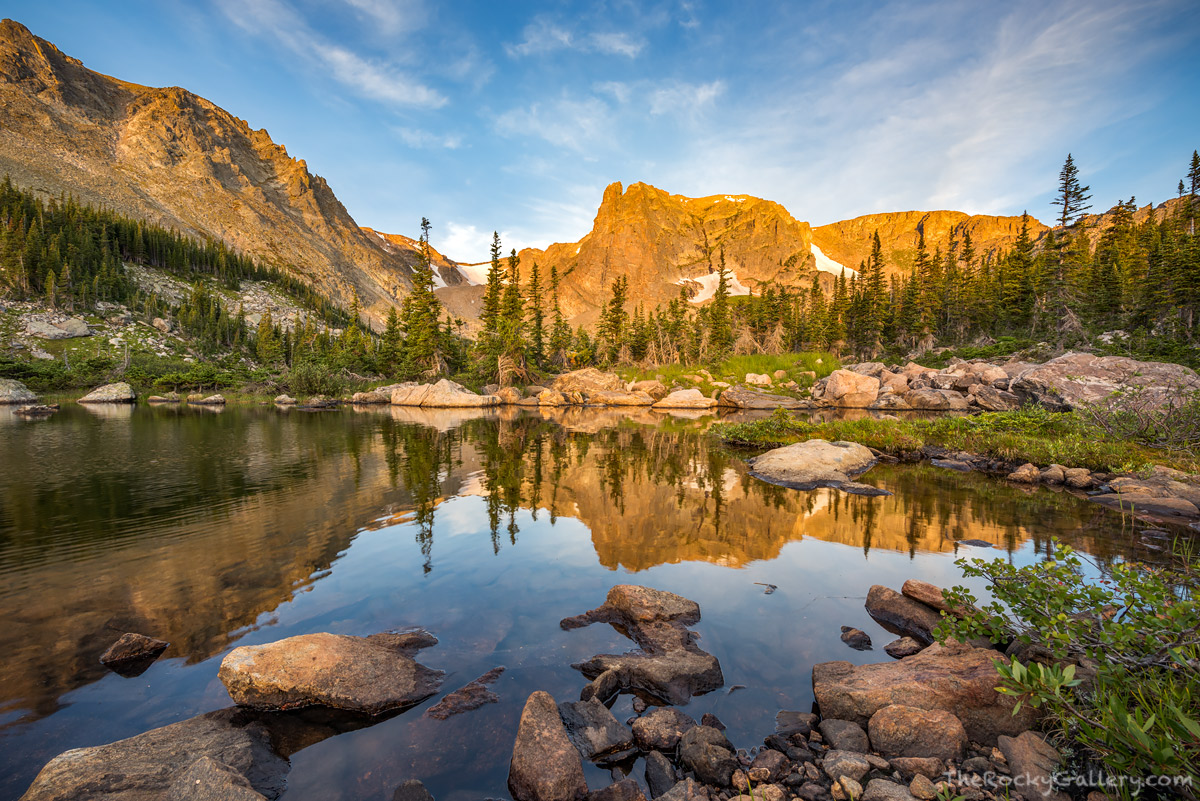
Photographing sunrise on Notchtop Mountain from the area around Lake Helene is always a thrilling experience in Rocky Mountain National Park. Last week I guided a client up to this area for a beautiful sunrise in one of Rocky’s most special areas. Technical Details:Nikon D810, Nikkor 14-24mm F2.8 AF ED
Notchtop Mountain is one of Rocky’s most iconic features. While Notchtop can be seen from portions of Trail Ridge Road and Bear Lake Road it takes a little more effort to view and photography it up close and personal. The best way to view and photography Notchtop is to hike the moderate three plus miles to the area around Lake Helene from the Bear Lake trailhead.
This area around Lake Helene is filled with potential for photographers. Besides the spectacular views of Notchtop Mountain from Lake Helene, there are many other beautiful more secluded locations to photography both Notchtop Mountain, Grace Falls and the Odessa Gorge.
I often recommend this hike to photography tour clients who are both fit and looking to explore off the beaten path. It’s a great destination in Rocky Mountain National Park for sunrise and most of the time you will be the only photographer within miles. Last week I lead a client up to the area near Marigold Ponds for a beautiful sunrise shoot. As always the area did not disappoint and Notchtop looked glorious as the sunlight and high cirrus clouds filtered onto the dramatic face of the peak.
A great July morning over Hanging Valley from atop Trail Ridge Road at sunrise. I’m a sucker for inversions and fog and if these conditions exisit in Rocky, there is a very good chance I’ll be out photographing them. This morning in late July there was just a small break in the cloud cover which allowed the sun to peak over the fog and clouds. It was actually raining as I made this image and the light lasted only a few minutes before it was gone for the day. But as I always say ‘just give me a minute of light like this and I’m good for the day’. Even with all the great conditions this July its hard to believe we are already into August. Technical Details: Nikon D810, Nikkor 24-70mm F2.8 ED AF
As is always seems to be the case here in Rocky, summer is progressing at a pace much more quickly than I am comfortable with. Summer always takes awhile to take hold here in the mountains and once it does it can feel like a mad scramble to try and take advantage of each day to the fullest extent. Add on days when the weather just does not want to cooperate and a busy schedule guiding clients in the field and summer really begins to fly by.
I always figure one can catch up on sleep and socializing when the first snow starts to fall but summer in Rocky Mountain National Park is about maximizing your time in the field and taking advantage of these beautiful days when the high country is easily accessible and the conditions for us photographers are prime.
This time of year I’m out in the field five to six days a week either shooting for my own portfolio or guiding other photographers around Rocky Mountain National Park. When you are lucky enough to get out that often you get to experience and observe Rocky on an acute basis. The weather conditions ebb and flow and often we have a few days laced together with great sunrise and sunsets with stretches of less interesting or more bland conditions. Less interesting conditions in Rocky being clear blue sky days with few or no clouds to add additional elements to one’s photographs.
July started off on the tame side. Many of the higher elevations in the park had lots of snow remaining even into the start of the month. Conditions were fairly tame to start the month of July but as the month ramped up and the monsoonal flow began to strengthen, the conditions got much more interesting. The back end of July blessed us with some great sunrise and sunset conditions, a good amount of rain showers and some a few nice mornings of fog and inversions.
All in all no complaints for me regarding July. I was lucky enough to get some great conditions for photography as were many of my clients I had in the field this month. The only thing I can complain about is that July in Rocky Mountain National Park is just too darn short, and unfortunately that holds true for August as well.
Could anybody ever get tired of this view?. Of the hundreds of times I’ve visited Dream Lake it never gets old. I visit Dream Lake mostly with photography tour clients now but when conditions are perfect like they were this past Saturday, it’s hard to not break out the camera and feel that same excitement I did the first time I photographed Dream Lake back in 1998. Technical Details: Nikon D810, Nikkor 24-70mm F2.8 AF ED VR lensWhat can I say about Dream Lake that has not already been said. It’s one of the most iconic locations in not only Rocky Mountain National Park but also Colorado. It’s one of the top requests my clients make when book a photography tour with me and if you hike the trail during the summer months you will quickly see its one of the busiest locations in all of Rocky not including roadside areas.
In the 19 years I’ve been photographing Dream Lake I’ve been at the lake in just about every kind of weather and lighting. Windy, snowy, rainy, sunny you name it and I’ve been on the shore trying to compose an image. I’ve shot my Nikon and Canon 35mm film bodies loaded with Kodachrome 25 and Fuji Velvia 50 here, used my 4×5 Large Format camera here, exposed my first digital images with a Canon D60 at Dream (yes that’s the correct model). Heck, I’ve even been lucky enough to compose a few images at Dream Lake that I’ve been pleased with.
Of the hundreds and hundreds of times I’ve been up to Dream Lake both alone or with clients I never tire of this magnificent location. It’s the one location in Rocky Mountain National Park I personally identify with more than any other location in the park where my passion and desire for landscape photography was stoked.
I don’t often head up to Dream Lake most mornings unless I have photography tour clients with me. There are just too many locations in RMNP to photograph and I need to use my time wisely and try to get to these other locations when I can. I most often visit Dream Lake now with photography tour clients. It still thrills me to watch my clients faces as we near the bridge over the outlet of Dream Lake and they see Hallett Peak and Flattop Mountain towering over this beautiful lake for the first time. It’s a feeling I remember like it was yesterday so its still a treat to watch peoples reaction on their first visit to Dream Lake.
While Dream Lake is still one of my favorite locations in Rocky, it takes quite a bit these days for me to get that original feeling back like I did when first visiting Dream Lake back in 1998. That feeling was back last week when I arrived with my client lakeside to find a layer of fog breaking over Dream Lake. I always put my client needs first, but once my client was settled in and setup I had to break out the camera and tripod to capture this magnificent moment. I may have been the guide this morning but I can tell you without a doubt I was just as excited photographing Dream Lake this morning as she was.
In my opinion one of the most beautiful spots in all of Rocky Mountain National Park, The Loch at sunrise. I photographed this scene last week and you can see all the snow still present along the side of the outlet to the Loch. In fact I’m standing on snow in the middle of the outlet, a spot that in a few weeks will be the middle of the stream. Technical Details: Nikon D810, Nikkor 16-35mm F4 VR ED AF lens
Going on my third year of providing photography tours of Rocky Mountain National Park, I’ve got a pretty good idea of what most clients number one request is when visiting Rocky and heading out to photograph landscapes. Without question most of my clients are looking for the classic image of a mountain peak reflecting in the serene and placid waters of a mountain lake. Like my clients these are also some of my favorite scenes to photograph in Rocky Mountain National Park as well.
June is not only when Rocky starts to see visitor numbers skyrocket but its also the time when local business and the town of Estes Park really start to hum along and enter the summer season. This is true for me as well as lots of photographers come out of there winter hibernation and are taking summer vacations looking to dust off the camera and get outside to take photos.
Most visitors to Rocky as well as most of my photography tour clients are coming from lower elevations and locals that have been moving toward mild summer like weather months earlier than the high altitude lakes and peaks of RMNP.
So with clients booking June dates and late season snow storms like the one we had in late may, many of those classic iconic Rocky images of iconic peaks reflecting in a still lake are just melting out. The good news is with warm, summer like weather the past week the delayed melt out is now on a brisk pace.
Clients visiting from out of state last week were a bit surprised to be hiking on lots of snow on the way up to Dream Lake and even more surprised to still find some small pieces of ice floating around on the surface of Dream Lake at sunrise.
Experiencing the huge snow drifts on Trail Ridge Road or hiking on snow to Dream Lake in mid June are part of the experience that makes Rocky Mountain National Park so an awesome place to visit and photograph. So if you head out with me in the next week or so don’t be surprised if I tell you to pack some winter gear and micro spikes to get a first hand experience of late spring or early summer in RMNP.
Using light to capture your subjects in a dramaitc fashion is a key tenant to landscape photography. Contrary to what some believe, all light on the landscape is good.Knowing how to take advantage of the lighting conditions well help you capture and convey your subject based on that knowledge. On Friday I hiked up the Bierstadt Moraine in Rocky Mountain National Park to photograph sunrise on Otis, Hallett and Flattop Mountains. Understanding that the northeast orientation of these peaks means the lighting improves as we move towards summer helped to capture this image. Technical Details: Nikon D810, Nikkor 24-70mm F2.8 AF ED lensGood light vs. bad light. Is there even such a thing as bad light?, take that a step further is there really such a thing as good light when it comes to landscape photography?. I would say there is not. Lighting on your subject is certainly one of the most important tenants to landscape photography. The misnomer here is that certain lighting is better than other lighting. In reality, all light is good, it’s understanding how and when to utilize lighting to render you subject in a way that best represents the message you want to convey.
Dramatic sunrise and sunset lighting is what most landscape photographers strive to capture of which I can be counted amongst. Is dramatic sunrise and sunset lighting always the best kind of lighting on a landscape subject?, nope. At the same time does a rainy, cloud day mean you should just pack up your gear and head home with all hope lost?, nope.
Both dramatic early and late day lighting can produce exceptional photography. But guess what?, cloudy, rainy and gray days can also produce equally stunning results if you use the flat but even and diffused lighting to properly illuminate a subject. As always it comes down to understanding how and when to use certain types of lighting based on what mother nature is serving that day. Understanding lighting is as important as composition and exposure and its important to use the lighting that best suits your subject and conveys the message or storyline you as the photographer are seeking to present to your audience.
So what’s the reasoning behind discussing light?. Lets just say the combination of being out in the field photographing, combined with the realization summer is just around the corner has beset me with a case of spring fever.
Most of the iconic and well known locations for landscape in Rocky Mountain National Park are best lit during the summer months. This is because the mountains and peaks around the Bear Lake area of Rocky Mountain National Park’s east side have a northeast facing orientation. Whether it be the Diamond of Longs Peak, Hallett Peak or Notchtop Mountain all of these famous icons of Rocky photograph best as the sun moves north in the sky as summer approaches.
Photographing sunrise from the side of the Bierstadt Moraine on Friday really helped to drive home that not only is spring a few days away, but summer is rapidly approaching. So while I’m happy that lighting in Rocky is again favorable for many of the iconic locations, it’s important to remember that all light is good. Figuring out which kind of lighting on your subject best conveys the message you are seeking to present is the harder part.
This morning in Rocky did not break exactly the way I thought it wood. I arrived hoping to photograph freshly fallen snow on the landscape but instead found most of the roads in Rocky Mountain National Park were closed. I had to make due with limited access and ended up photographing these two trees along the side of the road. I’ve passed these two trees thousands of times before and never given them any thought. But conditions and access forced me to take a second look and find beauty in limitation. Technical Details: Nikon D810, Nikkor 70-200mm F4 AF ED VR
Photography for me is constantly evolving process. Technologies change, equipment change and subjects change. Personally, I find the longer I photograph the more refined my vision has become. After years of trial and error you begin to think you have a good idea of what works and what doesn’t work when it comes to creating images. Overall, I believe this progression and refinement is a positive development in one course as a photographer. Having a good idea of what kind of images you want to create and understanding what works and does not work for your particular style is evolutionary, but it comes with a catch. Whats the catch?, blind spots.
Discernment works well until it doesn’t. Being particular and deliberate in your compositions and locations are great as long as you make sure that you are not ignoring and closing your mind off to less seen compositions or subjects that may also help to improve your creative style. There is fine line between being discerning or ignoring potential.
I found myself guilty of this sin last week while out photographing Rocky. Snow had fallen the night before I headed up to the park hoping to capture snow capped peaks and snow covered pines. Like most photographers, I check the weather, study the predictive infra-red satellite maps all in an attempt to anticipate conditions in the field the next morning. I’ve written many a time how difficult photographing classic winter conditions in Rocky Mountain National Park can be, but this morning looked like one that might hold some potential.
Estes Park had received over a foot of snow in the past 24 hrs and Rocky Mountain National Park had even more snow, especially in the higher elevations. I was feeling pretty confident when I arrived at the Beaver Meadows Entrance station to Rocky in the predawn hours. As I headed up the road into the park I could see from the tracks in the snow that an NPS snowplow had already made its way up the road and into the park.
As some visitors to Rocky might be aware, they don’t typically plow the roads in Rocky Mountain National Park between 7:00 PM and 7:00 AM so the appearance of a plow this early appeared to be a positive development. While I have a 4 wheel drive vehicle and am confident driving in winter conditions and unplowed roads, the frequent winds in Rocky can turn that foot of snow on the road to a 4 ft drift all the while looking fairly benign through the headlights of a vehicle at 5:00 AM. I head up to Rocky in the winter to photograph, not spend hours trying to dig my vehicle out of a snow drift at 5:00 AM so I was happy to see a plow was already out working.
As I made my way past Bear Lake Road I could see the plow had turned left and headed up that way. The plow had closed Bear Lake Road so access to the entire portion of the park was not an option now. Not a big deal I thought to myself, I would just head up Trail Ridge Road and photograph from there. While I blasted through a couple of pretty good sized drifts cutting the first tracks on the road that morning, I arrived at Deer Ridge Jct. to find the Park Service has closed Trail Ridge Road up to Hidden Valley and Many Parks Curve. A little bit of panic started to set in. I now had only a very small portion of Rocky that I would be able to photograph and furthermore as so often is the case the high peaks were shrouded in clouds.
I was beginning to feel a little sorry for myself at this point. I had drive up to Rocky on snow covered mountain roads early in the morning anticipating beautiful winter landscapes only to find I may come away with very little to photograph. I parked in one of the roadside pull-offs and watched as some nice color began to form in the skies to the east of Rocky in anticipation for sunrise.
I might not have a lot of options and while conditions where not exactly how I had anticipated them being, I was now determined to find something to photograph. I thought to myself that ‘any photographer worth his salt could find something to photograph on this beautiful morning’. I grabbed my backpack, got out of my truck and started heading down the road towards a grouping of trees. I figured there has to be something to photograph here and at the minimum the skies are going to be spectacular.
Trudging around in the deep snow I kept looking for a composition of trees and sky that would work. I was getting frustrated when I started looking at two small pine trees located right off the road. I’ve driven by these two pines thousands of times and never given them a second look as they are right off the road and for the most part are unremarkable in appearance.
This morning I had few other options and I was determined to find something to photograph. I set up my tripod on the unplowed road and watched as the sky turned red and orange behind these two pines. A snow squall moved past and as I tripped the shutter on my camera I began to see some potential in the composition and landscape covered with fresh snow.
I had driven by these two trees so many times and never considered photographing them. In my mind the location was pedestrian and there wasn’t much reason to stop and survey the location in the past. Because of the conditions and lack of access to other locations in Rocky, I had to make due with what I was given and not what I though fit my style or preconceived notions for this morning. Being stuck in this location forced me to take inventory of the surroundings and more importantly check your blind spot.
The last sunrise of 2016 was a colorful one over the Mummy Range of Rocky Mountain National Park. While most of the skies over Rocky this windy morning were cloudless, a nice set of clouds clung to the top of Ypsilon Mountain adding some nice warmth to the cool morning. I’m looking forward to new pursuits and images in 2017 after a great 2016. Technical Details: Nikon D810,Sigma 150-600mm f/5-6.3 DG OS HSM C
Welcome to 2017!. 2016 seemed to just zoom right on past and its hard to believe another year is in the history books. Each year as we pass from one year to the next it’s fun to reflect on the previous year while looking forward to what the New Year will bring.
Almost like clockwork each year, the holidays, shorter days and colder weather slow some of my photography pursuits down and throw me off routine. People who know me well know that I’m a creature of habit and my routines keep me grounded, focused and motivated. I like socializing and sipping a little eggnog as much as the next guy but after a month of festivities, parties and interruptions to my normal daily routines, I’m ready to get back on the horse and start moving forward again.
Photographically speaking 2016 was a very productive year for me. I was able to spend a lot of time in the field photographing new locations in Rocky Mountain National Park and adding to portfolio of images. Furthermore, I had a great season guiding photography clients to all corners of Rocky Mountain National Park and I’m already looking forward to guiding clients in the field again in 2017.
I feeling refreshed and renewed. I have lots of plans for 2017 and cant wait to get out in the field crafting new images to fill my 2017 folders with. While it’s been very windy and mostly mild in Rocky Mountain National Park the last month, I’m keeping my fingers crossed that we will have favorable winter conditions over the next few months. Cheers and here’s and to wishing you a happy and successful 2017.
Fall color season is underway in Rocky Mountain National Park with some of Rock’s aspen trees starting to turn golden in ernest. I photographed this grove of fall aspens just above Bear Lake yesterday. There are still only small pockets of fall color to be found in RMNP right now but look for autumn color to being to occur more rapidly now as we move through September. Technical Details: Nikon D810, Nikkor 16-35mm F4 AF VR ED
A quick update on fall color change in Rocky Mountain National Park as we head into the weekend. During a typical season one can find fall color in different locations of Rocky Mountain National Park from late August through late October depending on weather and wind. The changes typically start at the higher elevations of the park with the tundra grasses changing over from green to brown and red, followed by some of the small ground cover in different locations of the park.
Aspen tree’s which is what most people and photographers are interested in when it comes to fall color in Rocky Mountain National Park will have a few outliers here in there which begin to change in August but the first real significant signs of fall color amongst the aspens of Rocky typically happens as we move into the second week of September.
During this second week of September, aspen trees will start turning in ernest in locations around Bear Lake, Glacier Gorge as well as some of the groves on the west side of Rocky Mountain National Park near Grand Lake. As the weeks progress, locations such as the Bierstadt Moraine will peak concluding with lower elevations like Moraine Park, Beaver Meadows and portions of Horseshoe Park.
As of today, there is noticeable change occurring in and around Bear Lake. The aspens on the hillside above Bear Lake are still probably a week or so out from peak. That being said, some of the aspens above Bear Lake along the Flattop Mountain TH/Fern Lake TH have turned. Some areas near the Glacier Knob’s are at peak but overall there is still a lot of green trees.
I also visited the Lake Helene area yesterday with a photography tour client and only small portions of the smaller brush surrounding the lake shore had turned. It’s probably another 5 days or so before the brush around Lake Helene peaks.
Overall there is now perceptible color changes occurring in Rocky Mountain National Park. As a rough estimate I would guess we have about 15-20% color change occurring with the majority of it occurring at elevations over 9000 ft. Photographers can certainly find color to photograph now in Rocky but for the most part it will be more intimate scenes as the large landscape type views are still lacking when it comes to large amounts of color change.
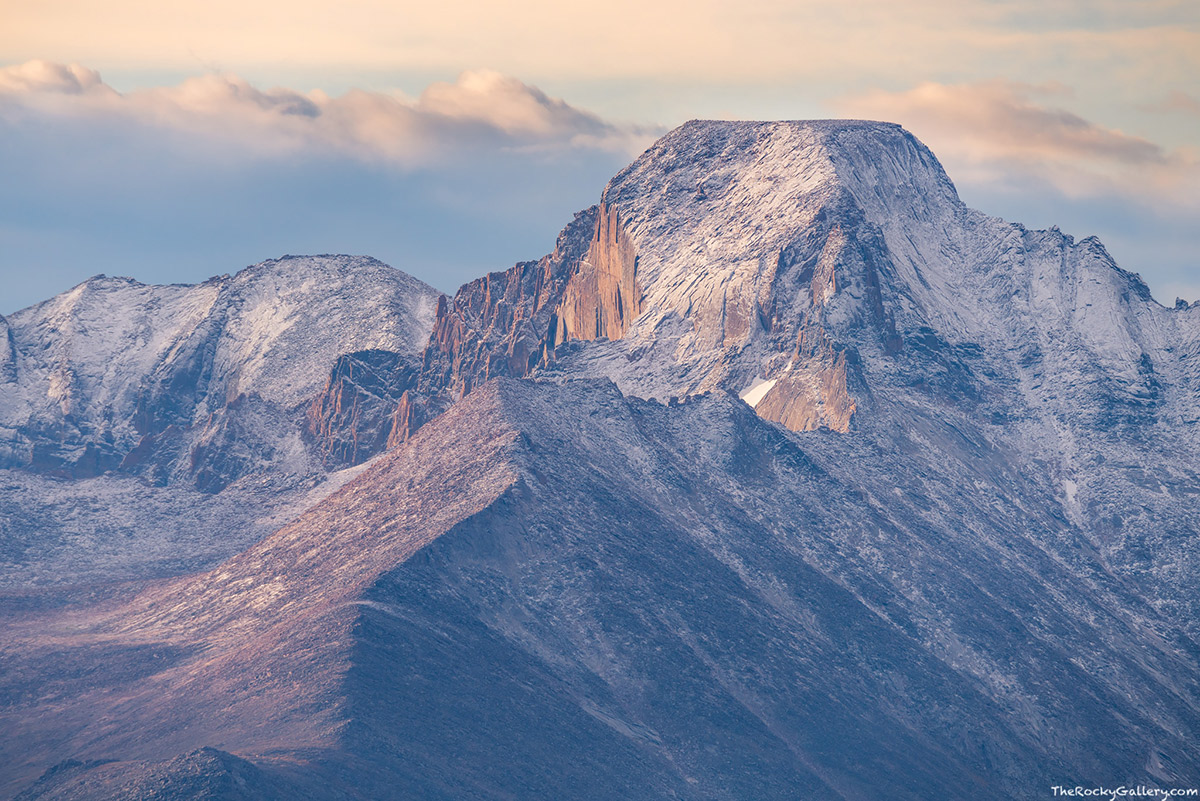
The date on the calendar says August 26th, but the conditions in Rocky Mountain National Park on this morning seems more like those found in winter. I arrived in RMNP this morning to find the landscape above 11,500 ft covered with a nice dusting of fresh snow. Longs Peak looked great covered in snow as seen in this view from Trail Ridge Road and the Rock Cut. Technical Details: Nikon D810,Sigma150-600mm 5-6.3 DG HSM OS C lens
No sooner had I finished writing and posting my previous blog post about current conditions in Rocky Mountain National Park and the subtle changes in the seasons before the weather in RMNP does what it’s famous for, change dramatically again.
True to form, not only are there signs of autumns impending arrival, but the weather in Rocky Mountain National Park on Friday morning decided to remind us that not only is fall right around the corner, but so is winter. While rain had fallen overnight in most elevations of RMNP on Thursday night, it was cold enough to put a light but healthy dusting of fresh snow on the landscape above 11,500 ft.
I drove up Trail Ridge Road early Friday morning looking to see if there would be any breaks in the cloud cover that morning for sunrise. Approaching the Forest Canyon overlook I could see it was more than just droplets of dew on the grasses and tundra and that there was a light dusting of snow right near timberline. Taking a moment to take a good look at Longs Peak in the predawn light, I could see it was also coated in fresh snow. While its a little early, snow in late August on the high peaks is fairly common. Heck it makes for some nice photographs as well so I’m certainly not complaining, I mean whats better than photographing 3 seasons all in the course of a couple of days?
So lets recap the current conditions in Rocky Mountain National Park. It’s still summer. Most of the park is still green, lakes are free of ice and trails are clean and clear. Signs of autumn have started to rear their head in the nooks and crannies of RMNP. A few aspen trees here and there are showing some color and some of the smaller ground foliage has turned red and orange. Lastly, even though it August, we can and do get occasional snow events covering the summer landscape with a winter like cloak.