In Like A Lion Or In Like A Lamb?

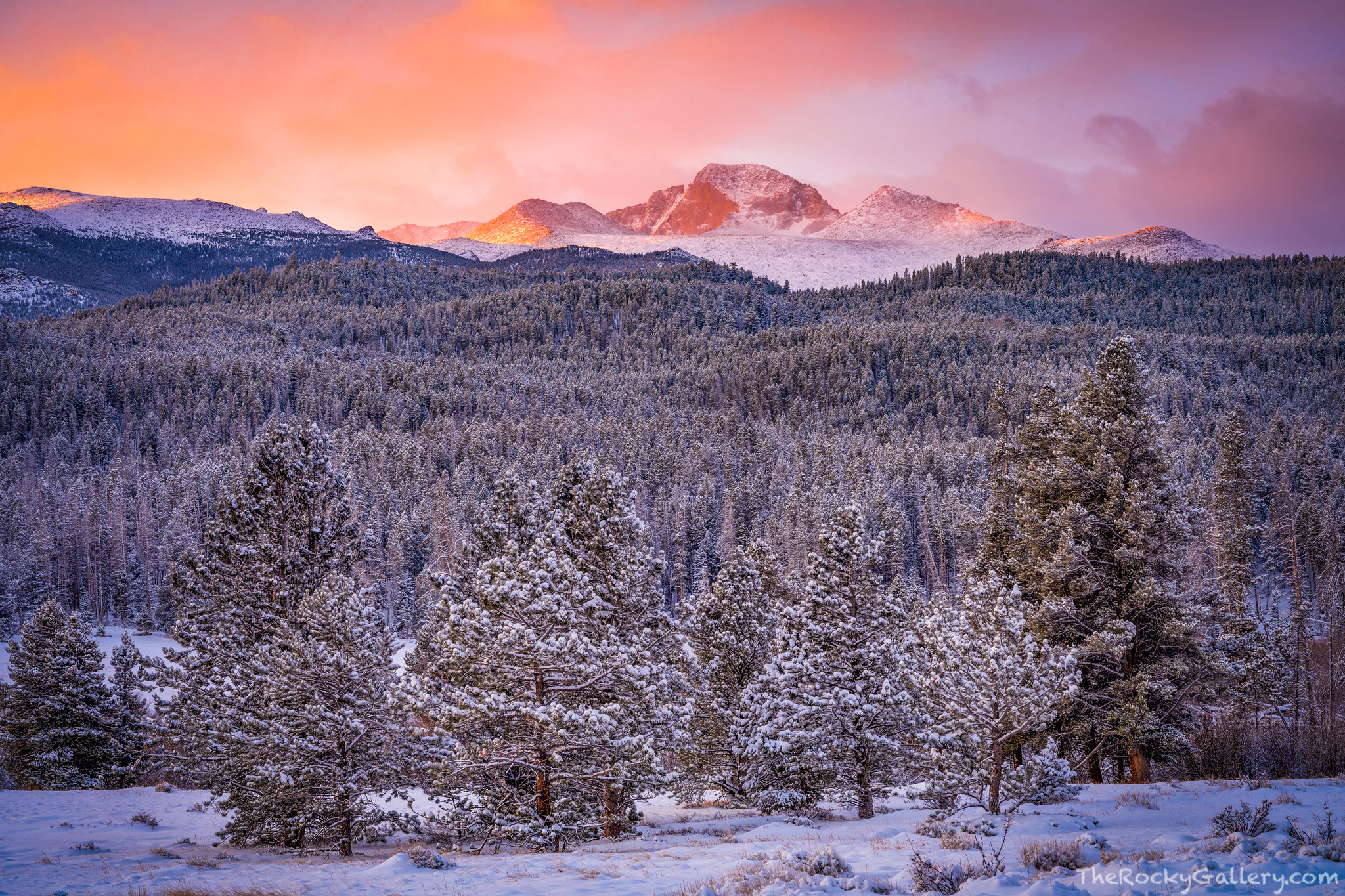
March is already here and 2021 is moving right along at a breakneck pace. Is March coming in like a Lamb or a Lion?. So far its been quiet but March is one of the best months to photograph winter landscapes in Rocky Mountain National Park. While I shot this image of Longs Peak from Hollowell Park last week, weather conditions and improved lighting as the sun moves north all make March a great month to photograph in RMNP. Technical Details: Nikon Z7, Nikkor 24-70mm F4 S Lens

I cant believe its already March. Winter is flying by and summer is tangible with it right on the horizon. March is an interesting month here in Rocky Mountain National Park. It’s our snowiest month and one of the best time of the year to hunt for winter landscapes and fresh snow. You can get a taste of all four seasons in March but the one is more likely to get the full brunt of a winter powder dump in March than any other time of the year.

So far March 2021 in Rocky Mountain National Park has come in like a lamb. They early weather pattern looks fairly mild over the next week with a few chances for some light snow. We need the moisture here in Colorado and we have slowly been working our way back towards normalcy as winter winds down. Snowpack in Rocky is at about 90% of what it should be right now. Thats pretty decent considering how dry its been since the fall.

Even if we get some of our classic March blizzards and snow dumps we are still going to have a very difficult time getting our snowpack back to 100% for this season. Because March is our snowiest month, catching up to at or near 100% normal snowpack will be very difficult as we would need a lineup of large storms to really dump on the area in an above average pattern.

Still we can remain positive knowing we have made up some of the deficit and while I would say it’s likely we enter the summer months at a slight disadvantage, we should still be looking better than we were at the start of 2021.

More importantly, it’s a good time to plan a trip to RMNP if one is looking towards capturing winter landscape images. The storms this time of year tend to be packed full of moisture but they also tend to move out quickly which opens up opportunity for snow covered landscapes, fog and dramatic lighting if one’s in the right place at the right time.

One other benefit to capturing the snow covered landscapes this time of year in Rocky is that the lighting angles on the east side of the park are really improving. Many of the classic Rocky Mountain National Park landscapes have peaks that face north and east. As the sun rises further north on the horizon each morning as we head towards summer, the lighting gets better on the northeast face of Longs Peak, Hallett Peak, Taylor Peak and Notchtop.

Contrary to the middle of winter when the sun is rising at its southernmost point, these iconic locations will be getting nice frontal lighting now. In the middle of winter mountaintops such as Longs Peak and Hallett Peak will be mostly in shade or side lit when the sun rises leading to long shadows and often poor lighting.

Keep an eye on the weather and be prepared for just about anytime of weather this time of year. If you want winter landscapes to add to your photography portfolio, March and April are the months to circle your calendar and keep your winter gear tucked in the back of your vehicle. With a little luck we can improve the snowpack and our winter portfolios all in one shot. Good luck!.

You Only Need A Little

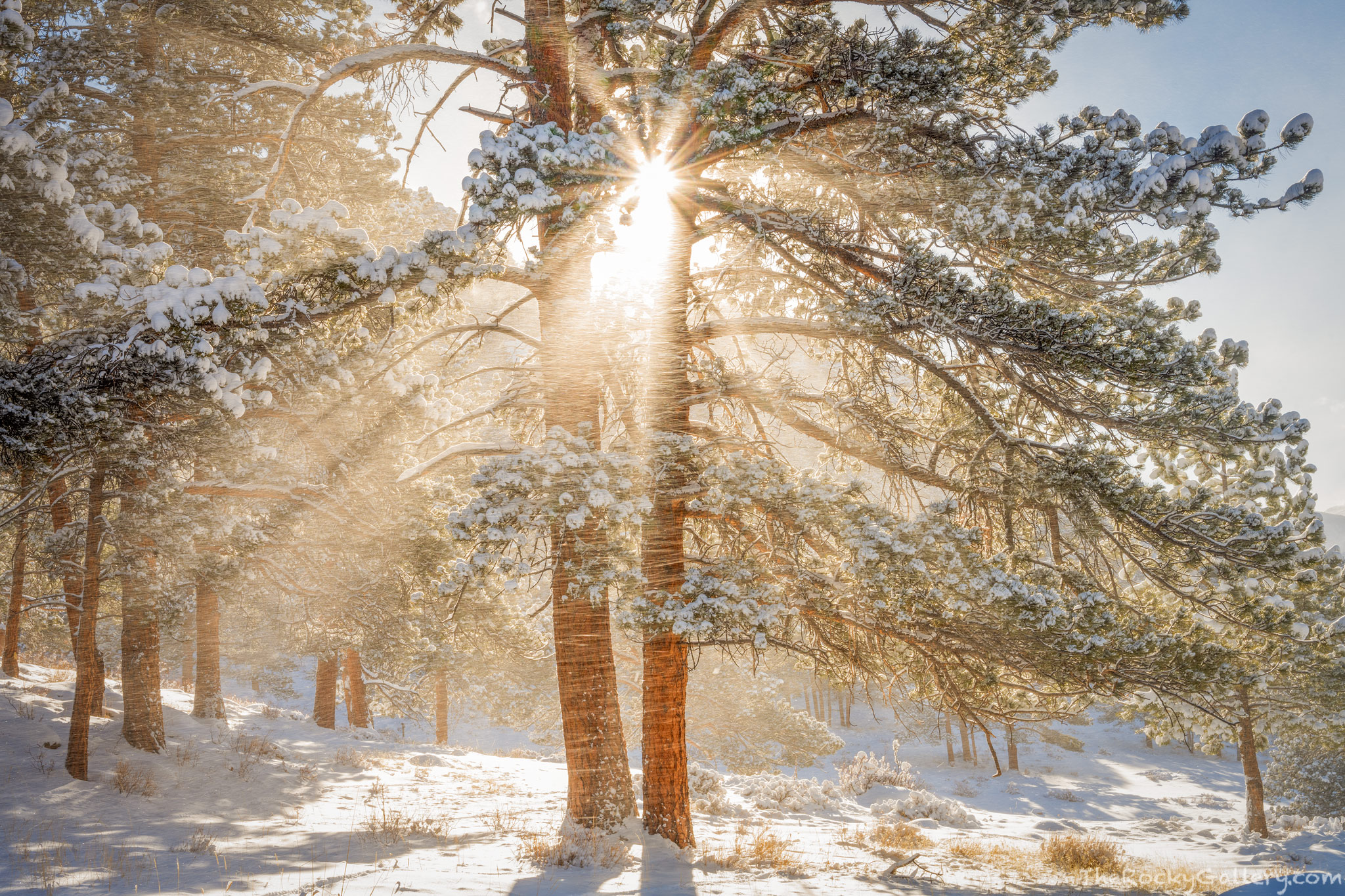
A lot of people and landscape photographers always get caught up on getting out to photograph after a huge snow dump. The reality is one does not really need huge winter storms that dump feet of snow in Rocky Mountain National Park to make compelling landscape images. This morning in Rocky saw about 6 inches of snow fall in the lower elevations of the park. It was just enough to make travel easy enough but keep the landscape and trees covered with snow and allowing for the appearance of a winter wonderland. 2 ft of snow might have meant that unplowed roads would be closed in Rocky or traveling even short distances from ones vehicle would require great effort. Technical Details: Nikon Z7, Nikkor 24-70mm F4 lens

I’m a big fan of landscape photographer Michael Frye. I’ve been reading his articles in Outside Photographer and blog for a long time now. Michael’s skill as a landscape photographer are second to none and his ability to teach and educate are also top notch. Much of what Michael states resonates with me and in many way our approaches and philosophy on photography seem very similar. I’ve never had the pleasure of meeting Michael in person, but from following along as a fan for a long time now, I’ve come to believe we have similarities.

When reading his blog a couple of weeks back he was discussing a recent outing to Yosemite National Park to get out and photograph one of the recent snow storms that had moved through the valley. Michael spends as much time photographing Yosemite as I do Rocky Mountain National Park so he has great insight into photographing locations over and over again in different conditions as I like to think I do.

Frye commented in his blog post that ‘Photographically, it’s not the amount of snow that matters. I’ve made most of my best Yosemite snow photographs with just a few inches of new snow on the ground. For me, other factors are more important, like having fresh snow still in the trees, and some mist to accompany that snow. It’s fun to see a big snow dump, but all that snow makes it difficult to get around, and it’s not necessarily more photogenic’

I’ve had this thought many times, and when I reading Michaels blog post thought to myself ‘at least I’m not the only one who thinks this way’. Sometimes I feel like a bit of an imposter when posting winter imagery from Rocky Mountain National Park because of the fact that big snowstorms are not required to make beautiful winter images of Rocky.

People are obsessed with how much snow there was and how hard was it to travel and get around. The truth is in landscape photography, 2 inches is just about as good as 20 inches of snow is. As long as it covers the trees and the landscape with fresh powder the weather conditions such as wind, clouds, fog and of course composition and light will all be more important in determining how impactful the landscape photograph is.

Secondly, snowshoeing in 2 feet of fresh snow is much harder than walking in 2 inches. Driving in 2 feet of fresh snow on unplowed roads is much harder than driving in 2 inches of fresh snow. The point being here that you don’t need to wait for big storms to hit a given location to make great images. You need weather, light, atmospherics and most importantly great timing and vision to make it all come together. When looking back on images 10 years from now you wont remember if the storm dropped 2 ft of snow or 2 inches, you will just remember how great the light and conditions were that day.

Bouncing Around Boulder

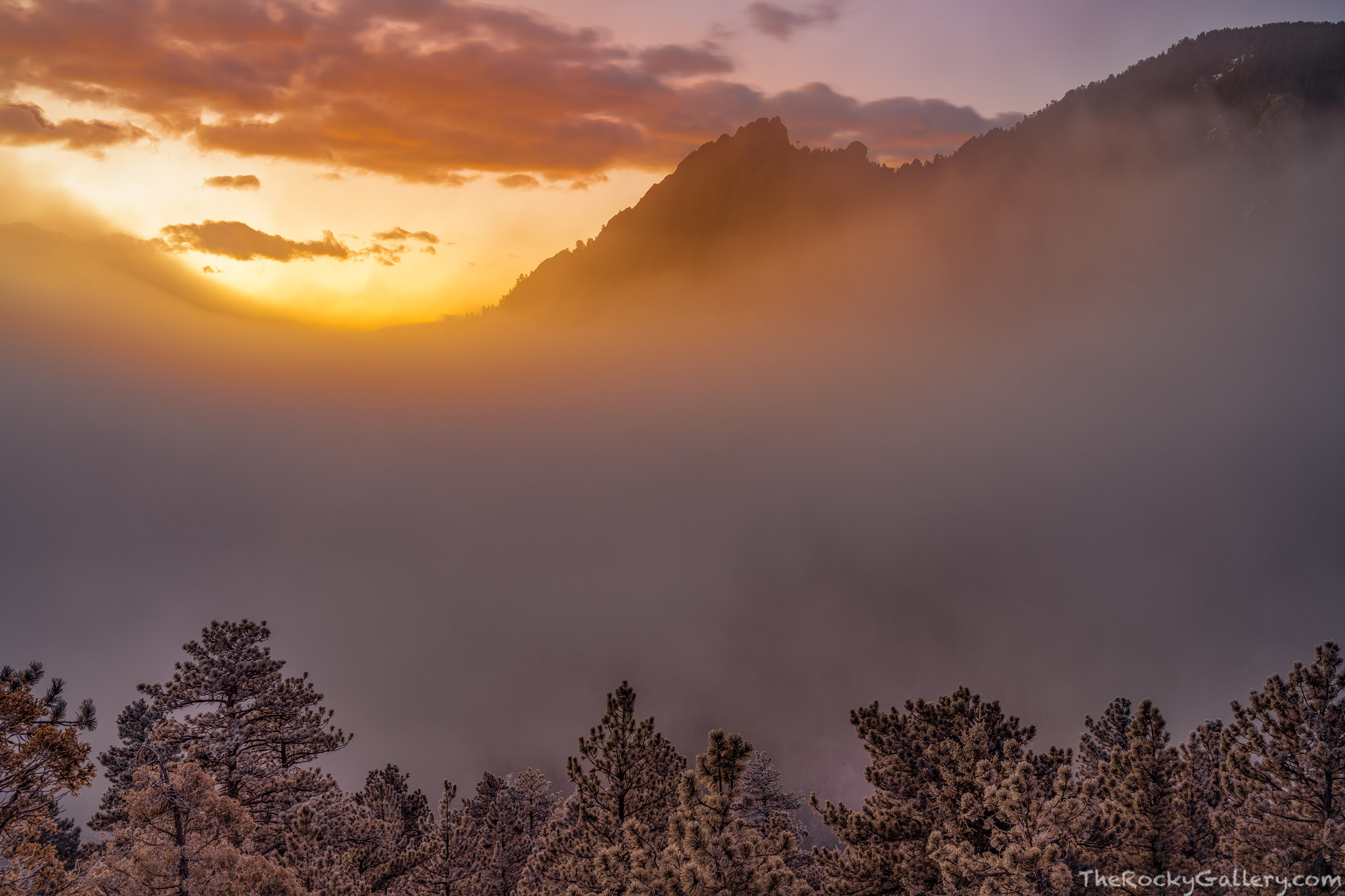
Artic cold has settled in over the Front Range of Colorado this week. While its chilly out, the change in weather has really opened up opportunities to photograph some dramatic conditions for a change. I’ve been out all week trying to get myself in the most favorable locations based on the weather and cloud layer. This particular morning, Walker Ranch above Boulder was a perfect spot to photograph the inversion layer and the backside of South Boulder Peak. Technical Details: Nikon Z7, Nikkor 24-70mm F4 S lens
As I sit here in my office and write this post its currently a chilly one degrees fahrenheit outside. A cold arctic blast has settled over the Front Range of Colorado bringing winter roaring back. While i’d prefer to see it a little warmer out, I can really complain about the change in weather for two reason.

For one, we’ve barely had much of winter here on the Front Range to speak of. It’s been mild and dry and we really need to start playing catch up on our moisture and snowpack. Secondly, the change in weather brings with it great opportunities for photographers looking for dramatic conditions and spectacular light and atmospherics. All those mild and dry days we’ve had so far this season have made for so ho-hum lighting conditions in what is typically a difficult season to photograph as is.

When the weather changes around here and the dominant weather pattern changes to an upslope flow on the Front Range, winds out of the east northeast bring with them snow, fog and inversions.

Fresh snow on the landscape with clouds and fog will spice up any landscape photographers day but get yourself in the right location in regards to the inversion of clouds caused by the upslope flow and you are all set to take the drama up another notch.

When chasing and photographing inversions on the Front Range of Colorado, the important part is figuring out at what altitude the cloud layer or inversion is at, and then figuring out how to get yourself in a position to be just above the layer of clouds. You can have ideas where you want to shoot and you may have a checklist of locations you want to shoot when conditions are right, but the weather is ultimately going to determine where you end up.

Some days when I’m out chasing the weather and trying to get above the inversion of clouds, the elevation of the inversion puts me high up in Rocky Mountain National Park. Other mornings, the layer is lower and I’m bouncing around the foothills just west of Boulder working on getting above the clouds so that I can see and photograph the light when the sun rises above the horizon.

The following day after photographing at Walker Ranch, the cloud and inversion layer settled a little lower than the previous day. This particular morning, Walker Ranch was free of fog and clouds but a little lower down Flagstaff Mountain was looking good. About 3 miles up Flagstaff Mountain just above downtown Boulder, I was able to get above the inversion layer again and photograph the north side of the Flatirons with Gregory Canyon covered in fog. Technical Details: Nikon Z7, Nikkor 24-70mm F4 S lens
With the big changes this week we had a couple of good days of inversions, fog, snow and rime ice on the trees. So far this week the weather has been such that the best locations have not been up in Rocky Mountain National Park but in the lower elevations and foothills just around Boulder. The inversion did not creep up the the foothills high enough to reach RMNP this week and most mornings settled between 6000 and 7000 ft.

This put Walker Ranch as the best area to photograph one morning, and Flagstaff Mountain just west of downtown Boulder as the best place to photograph the second morning this week. While Rocky had some snow, the winds were mostly out of the west at higher elevations obscuring the mountains and pushing the upslope flow with east northeast winds below Estes Park and back up against the high plains of Colorado.

This arctic weather is going to stick around for a few more days. Every morning I’ll be out checking web cams and trying to figure out where the best spots are going to be and if I can even get above the cloud layer for dramatic photography. Regardless, it’s great to see some moisture and change and typically speaking, this pattern tends to strengthen more as we had towards spring. Either way, these mornings albeit cold, can make for some great photography if you can get yourself in the right location.

New Views

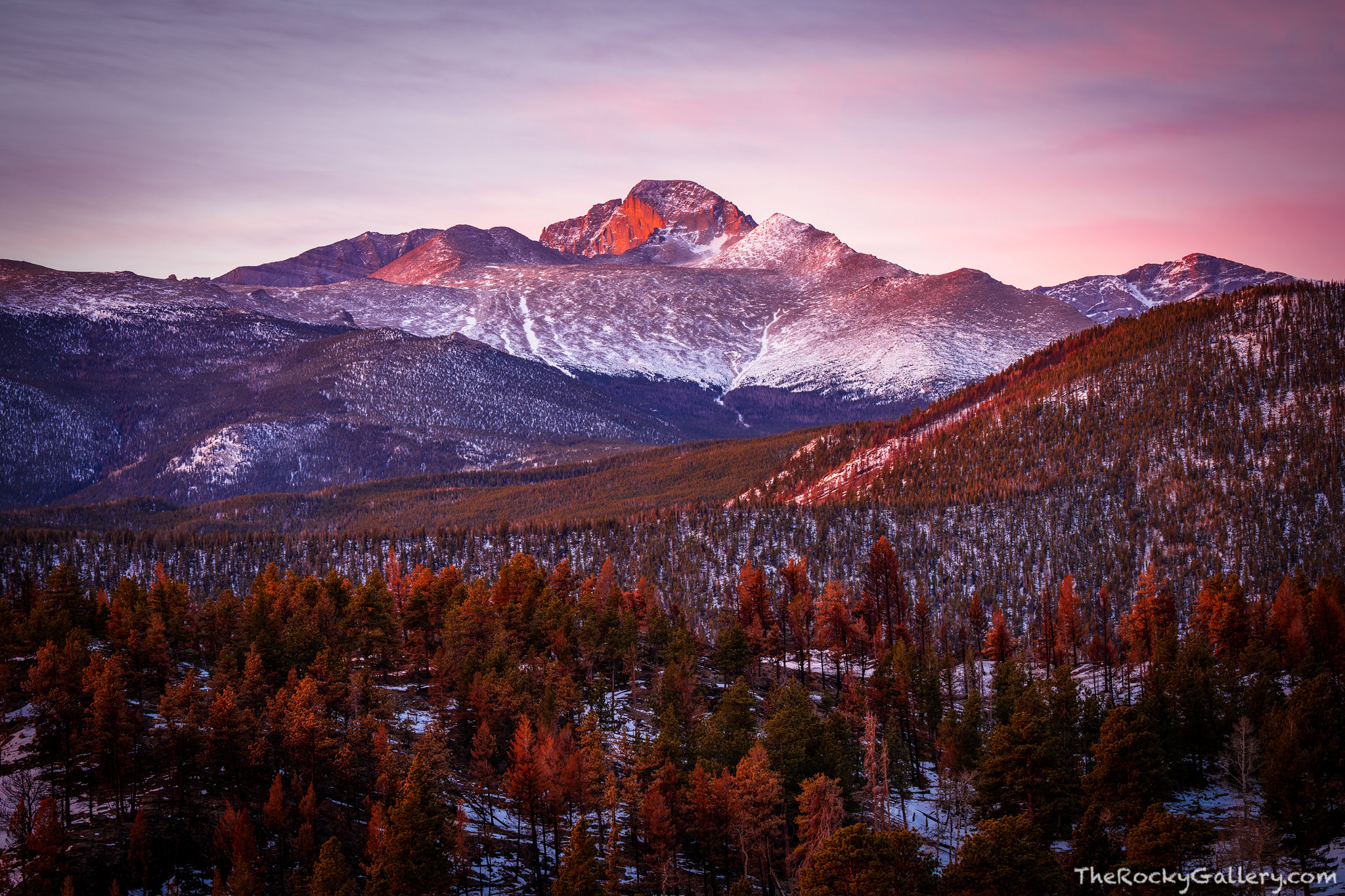
Winter keeps rolling along here in Rocky Mountain National Park though you almost wouldnt know it. It continues to be a mild and placid winter so far in 2021. The mild winter has made traversing many parts of Rocky easier then in previous years as there is a lack of snow on many of the trails below 9000ft. This lets me easily get out and explore areas withouth having to trudge through snowdrifts or wear snowshoes. This view of Longs Peak is along the burn scar from the East Troublesome Fire. The golden pines on the middle ridge are actually burned. This view has been opened by the fire and I’m hoping to get back here after a fresh dusting of snow. Technical Details: Nikon Z7, Nikkor 70-200mm F2.8 S lens
Things are quite here up in Rocky. We are almost half way through the winter season and it still feels like we’re awaiting its arrival. While its not uncommon to have dry January and Februarys, the lack of snow and interesting weather seems more pronounced this season then previous seasons. Most of our moisture will arrive as we move towards and into spring. So I’m looking forward to what is usually the best time of year to photograph winter scenes in Rocky Mountain National Park.

So as a landscape photographer how do you keep yourself busy while waiting for some weather to arrive?. For me I try to get out and explore no vantage points and locations in the park. I want to be ready when when some exciting weather and light arrives and have a handful of new locations that I can parse through and photograph when its primetime.

With the lack of snow in RMNP right now, its pretty easy to travel around the park on foot, especially in the lower elevations of the park in which conditions are much more like autumn than mid winter. There is no need for snowshoes or spikes in lower elevations as of this writing, no snowdrifts to posthole through and no head scratching moments when you lose the trail in the snow and spend 10 minutes getting yourself back on course in the pre-dawn light.

It’s easy sledding right now (pun intended) in Rocky Mountain National Park for photographers looking to be mobile in the middle of winter. I used the easy trekking to head into Upper Beaver Meadows again to look for some new compositions post fire.

While almost all the areas in or near the burn area from the East Troublesome Fire are still closed, the trails through Upper Beaver Meadow are open and skirt right along the boundaries of where the fire came down Spruce and Fern Canyon and down Beaver Mountain into the meadows burning the hillsides and in the process opening up some new locations and views.

There is a lot of potential for some new vantage points, especially looking south towards Longs Peak. I had a decent sunrise while out exploring but will need to get back to these spots after some snow or fog graces us with her presence. Until then, I’m going to keep exploring, hope for some good weather and most importantly some good light.

Charred

Rocky Mountain National Park was hit with two large wildfires this summer. Both the East Troublesome and Cameron Peak wildfires burned large parts of RMNP. Most of the burn areas remain off limits but some small areas such as Upper Beaver Meadows allow limited access to the burn zones. I hiked into Upper Beaver Meadows earlier this week to explore some of the damage and look to capture some of the beauty that can be found even amongst the destruction. The charred husks of the Ponderosa Pine trees made for an interesting subject as the wildfire had turned the normally red trunks to metal husks full of detail. Technical Details: Nikon Z7, Nikkor 24-70mm F4 S lens
Rocky Mountain National Park experienced two of its most devastating wildfires congruently this summer. The Cameron Peak Fire and the East Troublesome wildfire were the two largest wildfires to hit Rocky Mountain National Park in years. The last large fire was the Fern Creek Fire in 2012, followed by the Ouzel Fire in 1978.

Many places in Rocky Mountain National Park have gone hundreds of years without being touched by wildfire and combine that with drought, beetle kill and low humidity and common high wind speeds it was only a matter of time before additional parts of RMNP were affected by wildfires.

While the East Troublesome Fire and Cameron Peak fires burned nearly 30,000 acres within the park, the actual impact of these fires wont be known for years. With the exception of part of a portion of the East Troublesome Fire burning through the Kawuneeche Valley and up the North Inlet and over into Spruce Canyon and the Fern Lake area, many of the more popular areas of Rocky Mountain Nation Park remained untouched.

Access to the burn areas is off limits at this time. The plan is for the NPS to get back into burn areas when the snow melts and clear downed timbers and rebuild the trail system where its been damaged so that visitors may return to these areas. The park service is optimistic that much of this can be done throughout this summer though it remains to be seen at this point when one will be able to safely visit areas where the Cameron Peak Fire and East Troublesome fires burned.

Snow falls on a downed tree in the forest along the edge of the meadow in Upper Beaver Meadows. The contrast of charred wood and freshly fallen snow crystals made for a new subject to photograph. Technical Details: Nikon Z7, Nikkor 24-70mm F4 S lens
One small area that was just recently reopened to access is Upper Beaver Meadows. While much of the area just west of Beaver Meadows remains closed, one can now hike into Upper Beaver Meadows along the closed road or trails and wander through a very small portion of the burn area.

I headed back into the area early this week to not only get out on the trail for a bit, but to get a better glimpse of some of the damage as well as to try and find some subjects to photograph that would convey the damage and destruction of the wildfire but also to document what is an important part of the natural cycle that forests experience.

The sub alpine area of Upper Beaver Meadows consists of sub alpine stands of Ponderosa Pines, some spruce and aspen trees. Many who follow my blog know the striking red trunks of the Ponderosa Pine is one of my favorite subjects to photograph in the park. Wandering through burned out husks of beautiful Ponderosa’s was unnerving but it was also proved to be therapeutic as well. While the damage is striking, the trees and forest will return healthier than before for generations long after I’m gone.

Only a small portion of red bark remains on this Ponderosa Pine tree in the burn area in Upper Beaver Meadows. The rest of the tree appears frozen in steel. Even amongst all of the damage of the East Troublesome Fire along the meadows edge in Upper Beaver Meadows, concentrating on the small details and beuaty found in those details allowed for some interesting subjects to photograph. Technical Details: Nikon Z7, Nikkor 24-70mm F4 S lens
the charred husks which looked like molten steel was enjoyable as well. I’ve spent time photographing in the Fern Creek burn area scar after the fires, and once you get past the destruction and loss, there are interesting patterns, shapes and colors to photograph that where not present prior to the fires.

Would I prefer that neither of the two fires that rolled over RMNP this summer hadn’t occurred?. Of course I would. The untold damages, damages to houses, personal property, wildlife and forest will most likely never be replaced. Documenting the damage and trying to find beauty in some of the natural destruction that took place is as much a part of the process of observing a place as is watching the transition from summer to fall. It’s not my most favorite subject to photograph currently in the park, but walking the burn zone gives photographers some new subjects to incorporate into their portfolios as well as something we hopefully don’t have to repeat for a long time.

Working Around Cloudless Winter Skies

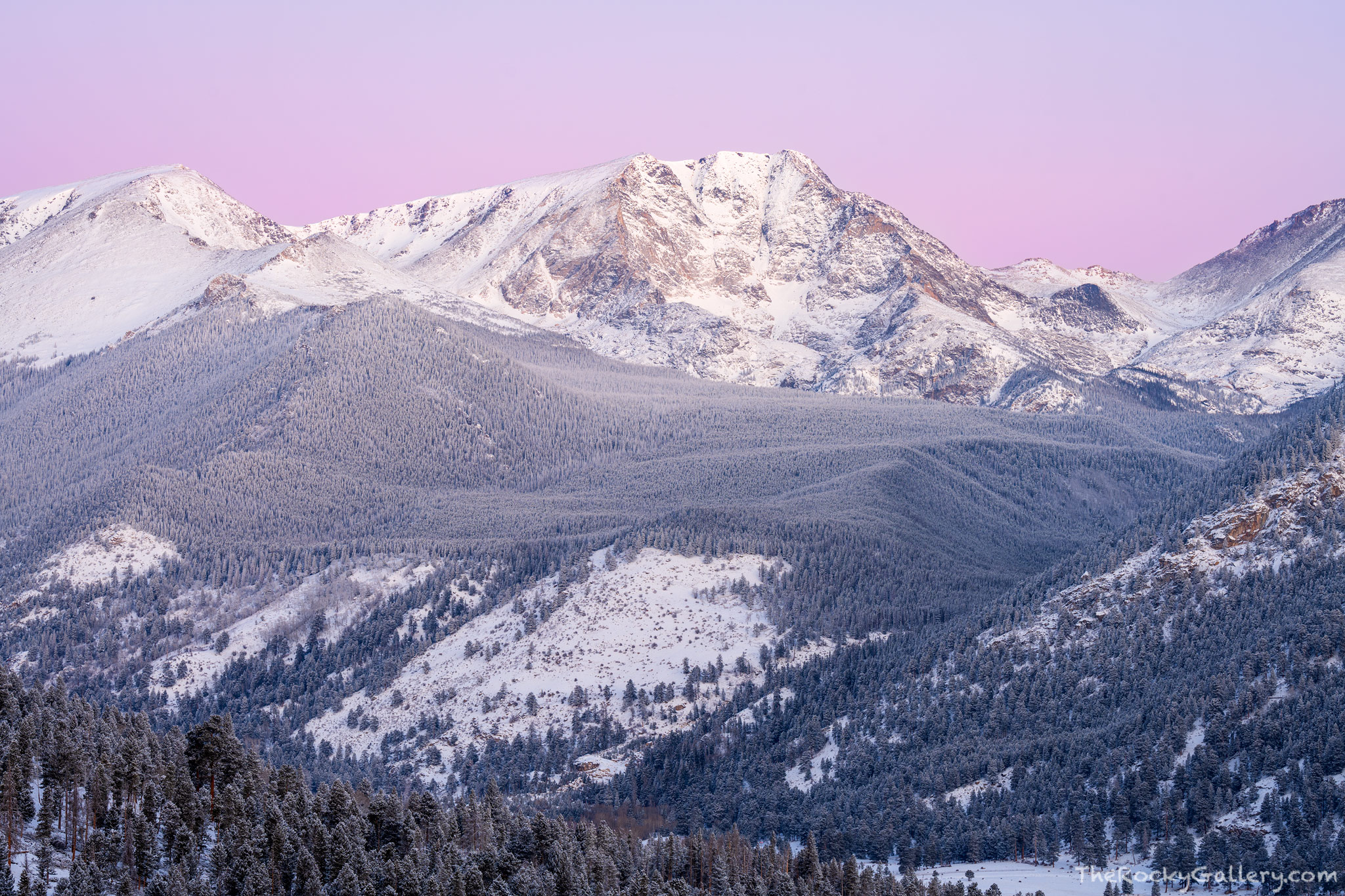
Its been mostly quiet on the weather front in Rocky Mountain National Park for the start of this winter season. Saturday night however, we did get a few inches of fresh snow falling on the park. Like other landscape photographers, capturing RMNP after fresh snow has fallen on the landscape is something I always look forward to photographing. Capturing clouds in the skies at sunrise is a bit more difficult than one would think. Here I photographed the Earth Shadow or The Belt of Venus as it is known to capture and add some color to the skies over the Mummy Range, and Ypsilon Mountain just before sunrise. Technical Details: Nikon Z7, Nikkor 70-200mm F2.8 S lens

Fresh snow on the mountains always gets the juices flowing for this landscape photographer. Mountains covered thick with fresh powder and pines covered in the white stuff can make for that perfect winter image.

As I’ve detailed in pervious blog posts, living in Colorado and photographing Rocky Mountain National Park, both clients and other photographers assume that capturing beautiful wintry scenes is like shooting fish in a barrel. If you’ve been a reader of my blog for any length of time you know that on the Front Range of Colorado, and specifically RMNP, its much easier said than done.

Photographing winter in Rocky is challenging for a host of reasons including high winds that often fill in on the backside of storms as the exit the region, a few breaks of sunshine here and there which will quickly melt and drop the snow from the pines and tree branches, and lastly clear blue cloudless skies which often can be found the morning after a snowstorm moves out of Rocky Mountain National Park.

This can be frustrating for the landscape photographer who gets up early, heads up to the mountains on snow covered roads and then heads out long before dawn in the winter cold to be in the right place at the right time.

One only get so many chances each season at capturing the beauty of Rocky Mountain National Park after a good dumping of snow, so you really want to maximize your chances of coming away with an experience and an image you are proud of.

While you may first wake up to the skies being filled with clouds, more often than not you will find much if not all the clouds in and around Rocky will have a way of dissipating shortly before sunrise. Being left in the lurch with cloudless skies after all that work to be in the right place at the right time can be frustrating.

One trick and tip I like to give clients is not to panic when you watch the skies clearing at a breakneck speed right as you are arriving on location. ‘The belt of Venus’ or the ‘Earth shadow’ will produce a nice magenta glow on the horizon a few minutes prior to the sun actually rising.

If you arrive to clear skies and before you decide to forgo that hike out into the backcountry of Rocky with the mercury hovering around zero degrees, turn off the car heater and get on site before dawn to capture the subtle but beautiful hue created by The Belt of Venus or the Earth Shadow. Doing so will allow you to both take advantage of photographing Rocky Mountain National Park in one of its most beautiful states after snow has covered the park, and capture a dynamic and beautiful landscape not only covered with snow, but also with some added color and beauty.

Bridge To Summer

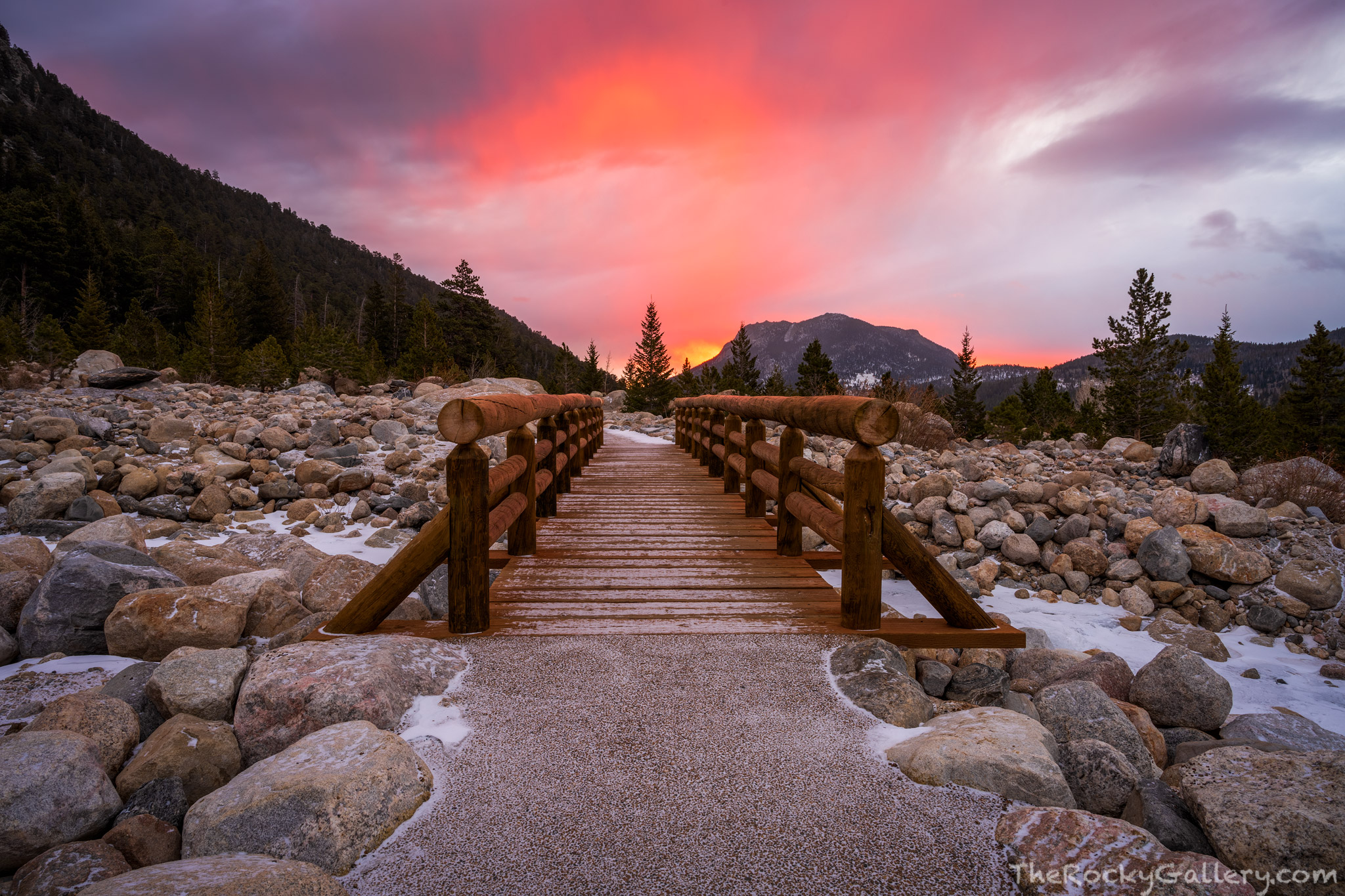
Just a day removed from the winter solstice and trying to find subjects to photograph this time of year in Rocky Mountain National Park can be a challenge. This time of year, I spend a lot of time photographing locations and subjects in RMNP that I would be less likely to photograph during the bountiful summer and autumn months. The newly completed bridge over the Roaring River at the Alluvial Fan was one location I was photographing a spectacular sunrise at last week. This beautiful new 54 ft. wooden bridge might not be the most sexy subject in RMNP, but it’s been on my list of subjects to photograph and this beautiful off-season morning in the park was the perfect time to do so. Technical Details: Nikon Z7, Nikkor 24-70mm F4 S lens

One day removed from the winter solstice and you’re getting an itch to get out in Rocky and do some winter photography. You have some time off from work, maybe you scored a new piece of gear during the black Friday sales or you’re just trying to get out in nature and enjoy a few hours on the trail.

Now you have to figure out what you want to photograph during the offseason in RMNP. It’s not as easy as it will be six months from today when a short hike up to Dream Lake would lead you to one of Colorado’s and Rocky Mountain National Park’s most spectacular and iconic locations.

Drop your camera at Dream Lake in late June and you are likely to have a wall hanger. Maybe it’s not quite that easy but you get my point. This time of year it’s a little more difficult to jump out of bed on a cold and windy morning and get motivated to get out in the field. Cold, snow, and wind are waiting for you right on the other side of the front door.

Once you get done fretting about the weather and get done scraping the ice of your vehicle, the next step is figuring out where and what to photograph in Rocky. Getting out far into the backcountry like one would in the summer requires dedication, physical endurance, knowledge own winter safety and avalanche protocols and proper equipment to ensure you are prepared for the weather and difficult conditions often found in the mountains this time of year.

So maybe your not gung-ho about heading out into the backcountry but still want to get out and get some winter photography done and kick off the rust thats accumulated since the last aspen leave fell this past fall.

The good news is there is always something to photograph in Rocky, especially when the light is good. Even better, Rocky Mountain National Park gets some of its most dramatic light in the middle of winter.

There are plenty of subjects to photograph in Rocky even during the short days of late December. My strategy this time of year is to take the time to photograph subjects and locations I would likely not be photographing during the summer and fall. Many of these locations are also short hikes from the trailhead or vehicle which is welcome on chilly mornings in the park.

Favorite locations and subjects for me this time of year are any of the lower elevations in the park such as Horseshoe Park, Moraine Park (access currently limited), and Beaver Meadows. It’s also a good time to photograph some of the man made structures and objects this time of year as well.

Even with the brown and white landscape and the short, cold days found this time of year in Rocky, there is plenty to see and photograph to keep ones creative juices flowing. Concentrate on the light and compositions this time of year more than just the drama found in the landscape and you should be able to satiate your photography appetite and come away with some images that will hold you over until your next winter adventure.

Icy and Brown

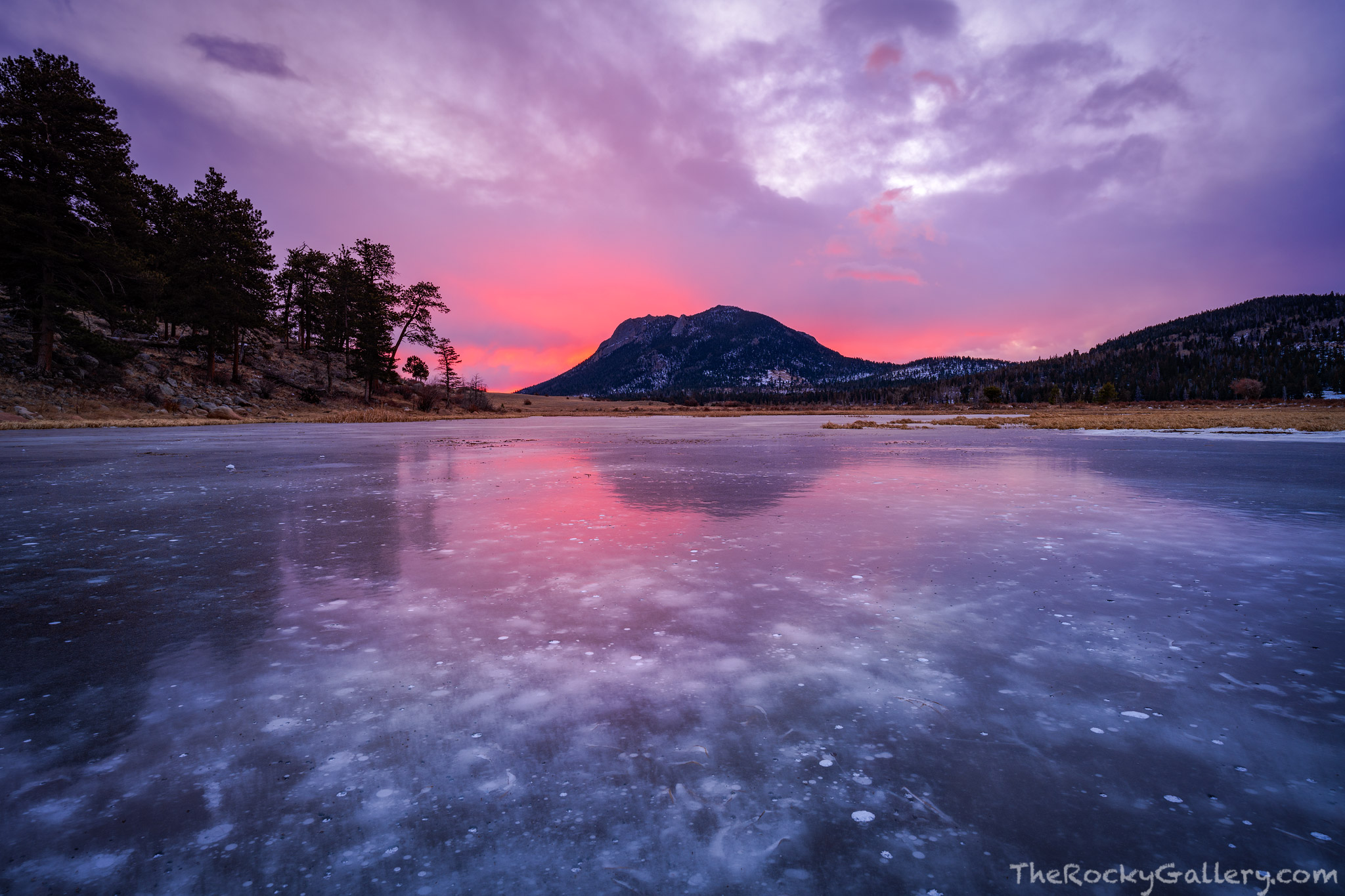
December has been a very quiet month so far in Rocky Mountain National Park. Little in the way of snow or interesting weather has visited Rocky of late. With cold temperatures at night and mild days, the landscape remains frozen and brown. This sunrise from Sheep Lakes last week in Horseshoe Park is indictive of the current conditions. Frozen and snow free water, and brown grasses. A colorful sunrise helps to bring the landscape to life but we would certainly welcome a few good snowstorms here in the coming weeks. Technical Details: Nikon Z7, Nikkor 20mm F1.8 S lens

Icy and brown. That’s the current state of the season in Rocky as I write this. Nights have been clear and cold and days mild and sunny. Our stretch of dry and mild weather has continued right into December now.

While there is some snow on the higher portions of Rocky Mountain National Park right now, the lower elevations are mostly just brown. Nights are cold enough that most of the lakes and streams have frozen over. Overall, Rocky is immersed in its early winter slumber.

I keep checking the weather looking for dramatic sunrise or the hope of a few good days of snow but so far no dice. Dry Novembers and December are not uncommon in Rocky, but one can usually bet on some colorful sunrises and sunsets this time of year. Wild wave or lenticular clouds are often common when the winds pick up, as are some colorful sunrise on account of high clouds over the region. So far, neither of these scenarios have come to fruition.

So it remains quiet and calm here in Rocky Mountain National Park as the park enters its winter slumber. We could use both the moisture and some dramatic weather to spice things up, hopefully the pattern shifts shortly and the drama awakens the slumbering and brown landscape for us photographers.

Grin And Bear It

The NPS was finally able to reopen Bear Lake Road last week inclduing some of the trailheads in the area after the East Troublesome Fire subsided. Getting up to Bear Lake once again for sunrise was something no photographer should take for granted. Portions of Bear Lake were still free from snow even in the middle of November which helped to make for a nice composition at sunrise of Hallett Peak reflecting in the ice on the east shore of Bear Lake. Technical Details: Nikon Z7, Nikkor 20mm F1.8 S lens

Rolling into the Bear Lake parking lot long before sunrise always brings excitement. So many of Rocky Mountain National Park’s most scenic and beautiful locations emanate from the Bear Lake Trailhead. Bear Lake itself is a classic iconic Colorado location in itself and its only a few hundred yard walk from the parking.

As somebody who photographs RMNP a lot, its really easy to take the accessibility and beauty found in the Bear Lake area of Rocky for granted so after the entire area was closed for the past few weeks due to fire activity from the East Troublesome Fire, it was great to be able to get back up to Bear Lake for a sunrise.

Even better than getting back up to Bear Lake for sunrise was fining a small portion of Bear Lake with open water and clean ice. Normally by the end of November Bear Lake would be covered with snow and lots of footprints.

Warm weather had kept a small portion of the east side of Bear Lake open and free of snow making for a nice welcome back and a short trip from the parking lot. As I write this snow is falling on Bear Lake so it will now remain covered until late spring when the thaw starts.

While access is still limited on many of the trails around Bear Lake, including the Fern Lake section, its good to see snow falling on the dry landscape and access to Rocky Mountain National Park opening back up once again.

Loner

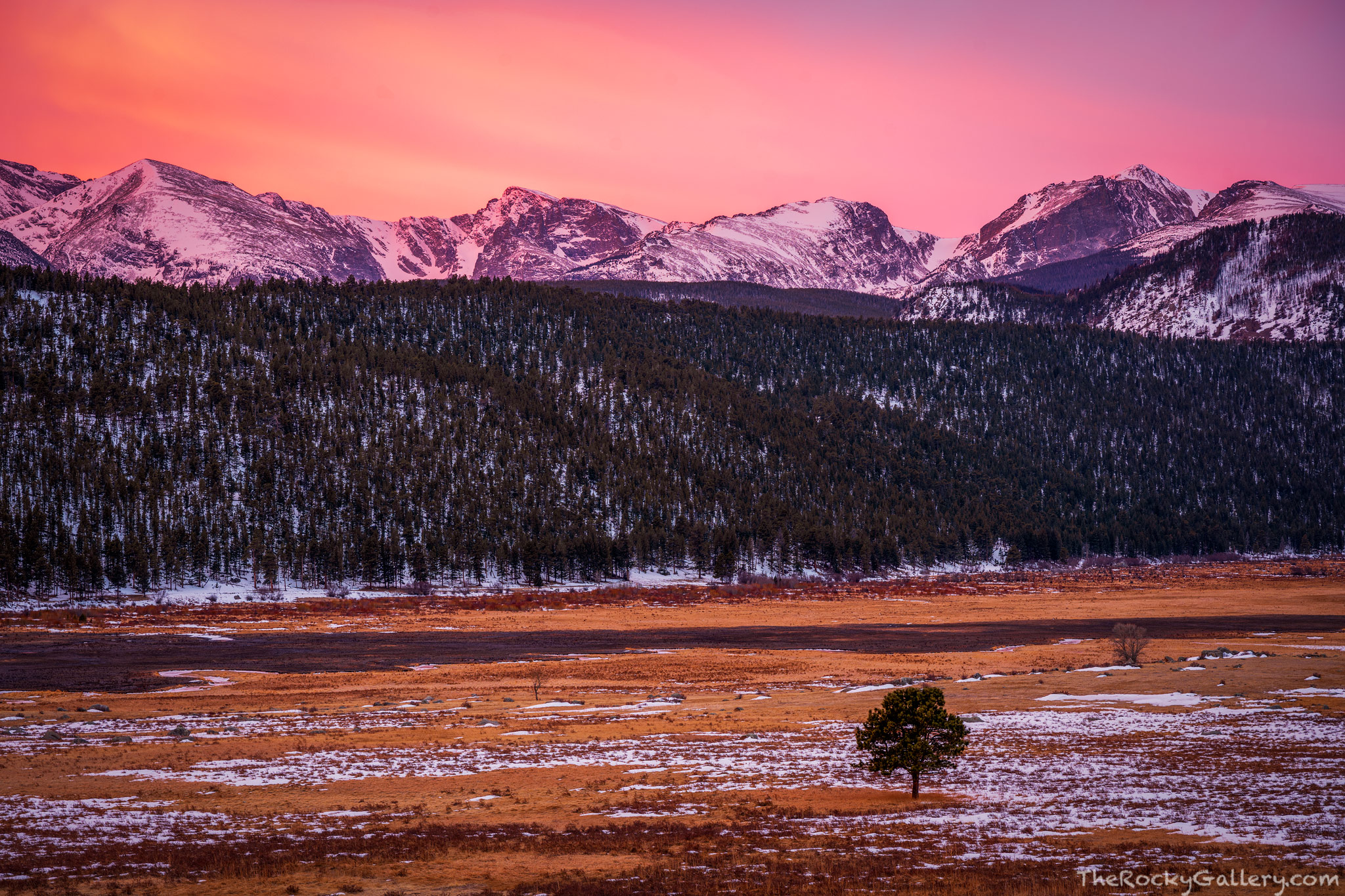
Some more areas of Rocky Mountain National Park opened up this week providing the opportunity to work on some compositions and locations the previously were difficult to access. With it being brown season in the park and with so many areas of Rocky still closed due to the fires, its just nice to head out and work on some more subtle images. A colorful sunrise this morning provided a nice backdrop for this lone pine I’ve been eyeing near Lower Beaver Meadows. Technical Details: Nikon Z7, Nikkor 24-70mm F4 S lens
A few more areas of Rocky Mountain National Park have opened in the past week. On the west side of Rocky, the East Inlet Trailhead is now open. All of the west side of RMNP was previously closed as of last week as they recover from the East Troublesome Fire so its great to see a small but spectacular portion of the west side of Rocky reopen.

On the east side, the portion of US 36 from the Beaver Meadows entry station to Deer Ridge Jct is now open. The caveat here being that the construction project to improve pullouts and repave the road is still ongoing. This project was to be completed in September but still has a small portion of the road to complete.

Bear Lake Road remains closed so the most popular part of the park is still inaccessible and Trail Ridge Road is closed at Many Parks Curve for what I have to believe will be the remainder of the season even though NPS still is calling it a temporary closure.

Regardless of the fact that its both now the brown season and many parts of Rocky remain inaccessible its still fun to get back out in the grove of things and kick the rust off the cameras. The weather remains very moderate and the pattern other than for high winds has remained tame for the most part.

I’ve been using this time to work on some other projects and look to find locations and compositions I’ve previously not photographed prior. While I’ve scouted out this location awhile back, this morning the skies and sunrise looked like it might be a good time to revisit this composition in Lower Beaver Meadows now that the road has reopened and access is a little easier.

I’m a sucker for twisted and tortured trees and given the fact that the one has very limited options with the restricted access in the park, I was happy to hike out to this spot and enjoy the colorful sunrise with this ‘loner’. Sometimes having fewer options is more preferable to having more after all.