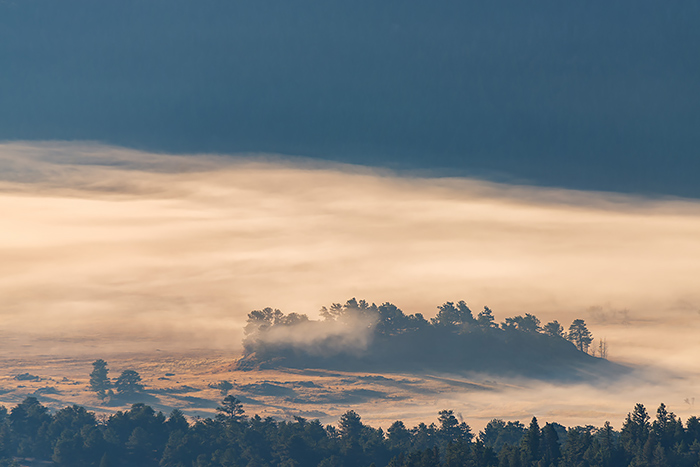
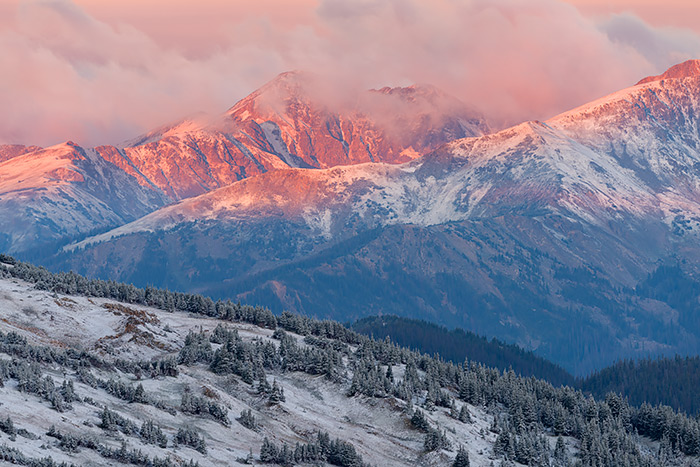
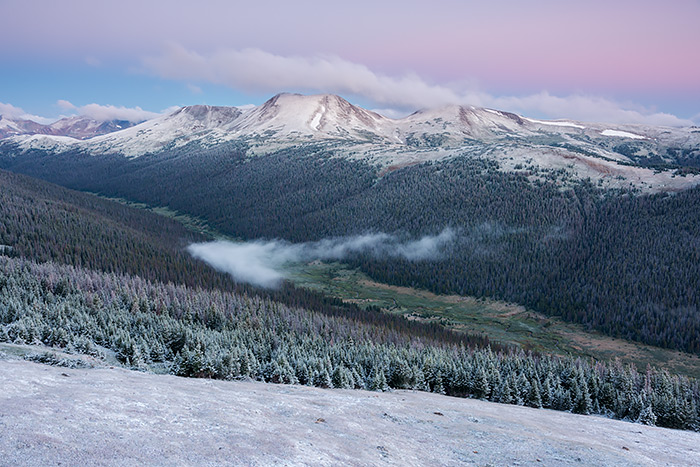
With the recent addition of a Sigma150-600mm 5-6.3 DG HSM OS C to my lens kit, I’ve been putting it’s longer focal lengths to good use when photographing landscapes in Rocky Mountain National Park. I purchased the lens to use primarily for wildlife in Rocky but have found the longer focal lengths to be very useful at compressing and isolating portions of the landscape. I found this to be the case when photographing low lying fog in Moraine Park from the Many Parks Curve overlook along Trail Ridge Road. Using the 600mm focal length on the lens, I was able to isolate this portion of Moraine Park as the fog moved out. Technical Details: Nikon D810, Sigma150-600mm 5-6.3 DG HSM OS C lens
Which lens or focal length to use when photographing a particular scene or image is a vital function to creating to compositionally coherent image. Browsing through my landscape image catalogs it’s apparent that approximately 75% of my images are taken between the focal length range of 16mm and 105mm. This is more or less in line with my style of photography and works well to convey and translate my vision of the landscapes I enjoy photographing.
With that being said I still look to put my longer lenses to good use whenever possible. While many of my photographs have been created with wide to moderate focal length lenses, some of my favorite images have been taken with longer focal lengths which allow for the isolation or compression of the subject or landscape.
I recently purchased a Sigma150-600mm 5-6.3 DG HSM OS C lens for my Nikon system. I purchased this lens primarily to be used to photograph wildlife in Rocky Mountain National Park. With the Elk,Big Horn Sheep, and Moose rut approaching I was hoping I would get a few opportunities to photograph wildlife at longer focal lengths. While most of my photography revolves around the landscapes of Rocky Mountain National Park, I do enjoy photographing wildlife when the opportunity presents itself.
Ironically, I have not had as many opportunities to use this lens on wildlife as I had previously hoped. At the same time I have found more opportunities to use this lens for landscape photography then I had previously anticipated. I’ve found the long end (300-600mm) range of this lens can help to foster unique and creative images. I plan on continuing to experiment and employ the longer focal lengths for both wildlife and landscape photography in the future. The caveat with this lens of course is that is both large and heavy so it’s not a piece of equipment I plan on backpacking around the backcountry with. Even so, I’ve been impressed with both the image quality of the lens and the new opportunities it’s affording me when in the field photographing landscapes.
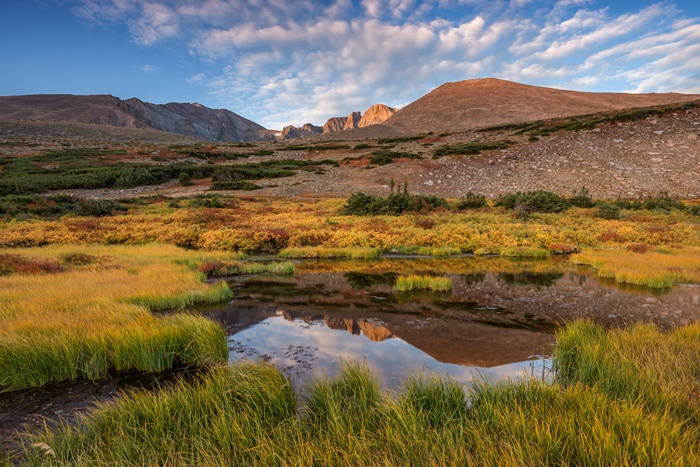
Landscape photographers will flock to Rocky Mountain National Park this time of year to capture the autumn in all her glory. Most photographers will be looking to photograph golden hillsides of aspens trees. Dont overlook the beautiful autumn color currenlty unfolding at or near timberline in Rocky. I photographed these beautiful fall colors just below Longs Peak on the alpine tundra yesterday. Our mild nights have allowed for the colors to really pop in the higher elevations of the park. Technical Details: Nikon D810, Nikkor 16-35mm F4 ED VR
Peak fall color season is upon is here in Rocky Mountain National Park. After a beautiful late summer that was for the most part warm and dry, the signs of autumn are everywhere in the park. With the exception of the lower elevations of Rocky Mountain National Park, most locations at the mid to higher elevations are at or just a little bit past peak. No need to panic, there is plenty of fall color to be found in Rocky right now and I suspect that will be the case for at the least the next two weeks.
As stated above, we have had a very warm and mild late summer in Rocky and that pattern looks like it’s going to continue through next week. The mild weather appears to be not only enhancing some of the fall color in Rocky Mountain National Park, but it is allowing for the color to linger. Colorado is famous the world over for it’s beautiful stands of aspens which turn golden in autumn. It’s what many visitors to the area come to see. While Rocky may not have some of the large towering stands of aspens that some of the famous western slope towns of Aspen, Crested Butte and Ridgway boast, there are still plenty of them to admire and photograph.
With that said regarding the hillsides of golden aspens don’t overlook all the more subtle foliage that are currently resplendent in their autumn glory throughout the park right now. The color at or near timberline in the park is currently as colorful and beautiful as I can recall. The warm days have allowed for beautiful reds, yellows and orange hue’s. I hiked up to timberline just below Longs Peak yesterday and was astounded by how colorful and beautiful the autumn conditions are. The scenes are reminiscent of autumn on the Alaska tundra.
There are too many potential locations to list right now which hold great potential for fall landscape photography in Rocky. The usual suspects such as the Bierstadt Moraine and the Bear Lake area all look great as of this writing. But if you want to avoid the crowds as well as other photographers, head for the higher elevations while the warm temperatures last and enjoy the colorful show currently unfolding near timberline.
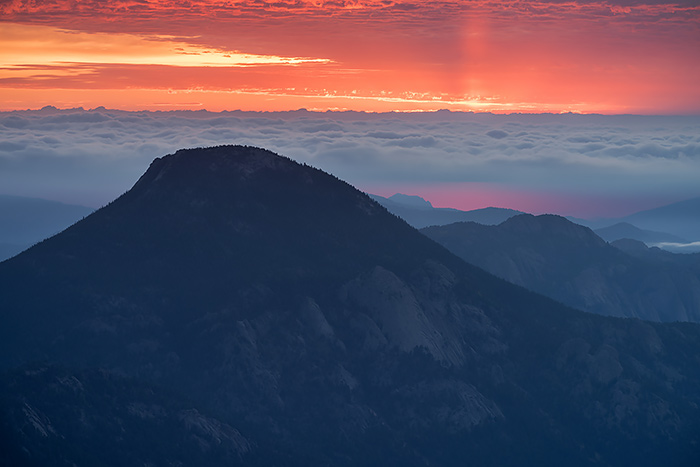
As photographers we often have preconceived notions of how and what we want to photograph. Often the weather conditions will not cooperate with our plans. When photographing in Rocky Mountain National Park its important to be willing to throw convention out the window and be willing to look both figuratively and literally in the opposing direction. There was an inversion over the eastern plains of Colorado this morning. Only a few clouds hung over the sky to the east of Rocky. While I did not plan on photographing from Rainbow Curve along Trail Ridge Road, weather conditions dictated that this would be where the best lighting at sunrise would be. Technical Details: Nikon D810, Nikkor 70-200mm F4 ED VR AF
There are expectations and then there is reality. In photography this is especially true when I look back at the end of the week and review how I did and what kind of images I was able to create. It’s always fun at the start of a new week to browse the weather forecasts and try to guess if its going to be a productive and dynamic week for photography. Sometimes the weather cooperates and you can get three, four or even five days of beautiful sunrises, clouds in the sky or other elements like rain and snow to help with your image making. Other times you may go four or five days with nary a cloud in the sky to help out. Usually I find that you end up somewhere in the middle. Never as many dynamic mornings as you would like, and often you can get at least one or two better than expected sunrises.
Last week in Rocky Mountain National Park fell more or less on the tame side of dynamic weather and conditions. For the most part last week mornings were clear and cloudless in Rocky Mountain National Park. These are beautiful conditions for visitors and hikers, but not exactly the kind of conditions photographers hope for in Rocky. It’s hard to get motivated to get out there in the field if it looks as if there is not a cloud within 800 miles of Rocky Mountain National Park. Even with conditions less than ‘photographer perfect’ one should still be able to capture some dynamic images. With a bit of planning, some luck and a few clouds floating in the right location things may break your way.
While last week was more difficult and less productive than I would like, I was still able to come away with images I was pleased with two of the three mornings I managed to get out in the field. On those two productive mornings clouds were present in the sky but not over the high peaks and continental divide. This is a fairly typical setup for Rocky Mountain National Park. In fact, if I had to venture a guess I would say well over 60% of the time one is more likely to have clouds to the east of Rocky then over the high peaks and continental divide. This is an important fact to keep in my when photographing Rocky Mountain National Park.Sunrise on the morning of Labor Day was spectacular from the shores of Bierstadt Lake. That is if you photographed looking towards the east as clouds had not yet moved over the high peaks and continental divide and blue skies would have prevailed. Technical Details: Nikon D810, Nikkor 16-35mm ED VR AF
I stress this in my blog often and also do so when out with other photographers or students on photo tours in the park. While its true that many of the iconic images in Rocky Mountain National Park are of locations where clouds over the peaks benefit the image, more often than not mother nature and the weather will hand you lemons of which you will need to make lemonade. In this case you need to make lemonade by losing preconceived notions of what you want to photograph and do the following. Look at whats going on behind you or the east of your preferred morning location. If you are going to successfully photograph in Rocky Mountain National Park you are going to need to incorporate images that may not include some of the well known iconic peaks such as Longs and Hallett Peak. Remember, more than likely your going to have clouds and dynamic lighting east of your location.
By all means head out to Rocky with the intention of photographing clouds over the iconic peaks and mountains. This is Colorado after all and we all aspire for images of brilliant clouds floating over jagged peaks while reflecting in mirror like lakes below. The reality of photographing Rocky Mountain National Park is that these conditions are difficult to achieve often but with a backup plan and willingness to throw convention out with the trash, photographers can make stunning imagery with an open mind and a willingness to point the camera opposite of the icons. On what otherwise would have been an unproductive week of photography, this strategy worked well for me last week as it would have for others.
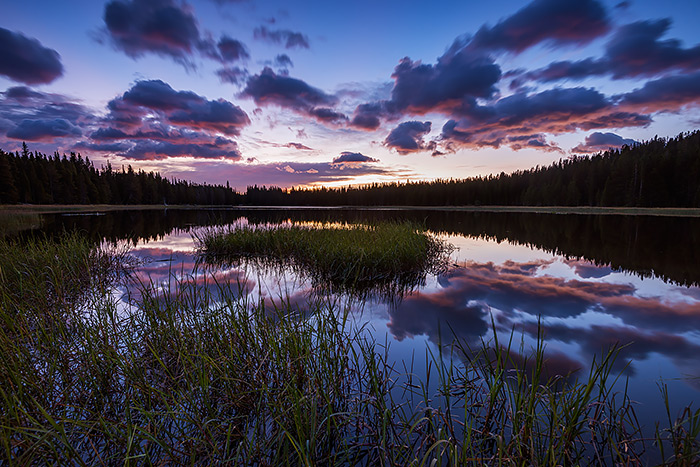
This time of year one has many options when photographing in Rocky Mountain National Park. With the seasons transitioning from summer to fall one can chose to photograph summer like scenes as well as scenes more representative of autumn. Of course the trick this time of year is doing so before the weather sets in and alters ones plans. Last week I was able to photograph this summer like sunrise at Ouzel Lake in Wild Basin, while at the same time photographing some early fall color as well. Technical Details: Nikon D810, Nikkor 16-35mm F4 ED VR lens
It’s happening one again. The seasons of change are sweeping over Rocky Mountain National Park and our summer season is transitioning towards autumn. Whether it be the sounds of a bull elk bugle in a meadow or sets of aspen leaves turning golden yellow it’s becoming more apparent by the day that summer in Rocky Mountain National Park is nearing it’s conclusion.
For photographers this is both and exciting time of year as well as a hectic time of year. For many landscape photographers, fall is their favorite time of years. The changing seasons, the vibrant fall color, shorter and cooler days all tend to energize and inspire landscape photographers to get out and create images.
While this transition season is an exciting and inspiring time of year, it’s also hectic. Speaking for myself I find that I am both trying to extend the summer season and anticipate the coming fall season. Access to Rocky’s backcountry is still easy before snow and freezing temperatures set in allowing for me to continue to work on summer like images and access much of the park. At the same time I’m keeping an eye on the subtle and not so subtle changes associated with the onset of fall. It’s certainly great to have a lot of options at hand, but it creates stress in that decisions need to be made on what subjects to photograph. On the hike out of Ouzel Lake I was able to find quite a bit of fall color in the forests of Wild Basin like this group of aspen trees. Technical Details: Nikon D810, Nikkor 24-120mm F4 VR ED lens
One would think that having lots of options would be a good thing, and for the most part it is. What makes the decisions difficult is not having options, but trying to time and guess just how long one will have these options available. Timing is everything this time of year and one early season snowstorm or cold snap can quickly alter both your options and your plans.
A cold snap, wind storm, or snow can strip the leaves from the trees, cover the trails in snow and cause the surface of the lakes to freeze. In one fell swoop both your options to photograph summer like scenes as well as autumn scenes and fall color can vanish for the year. This urgency to beat out the unknown is what makes the transitional season from summer to autumn so tricky to time out and photograph.
Worrying aside, right now is about as good as it gets to photograph in Rocky Mountain National Park. Leaves are starting to change on aspen trees, streams are flowing freely and access to Rocky’s backcountry as well as Trail Ridge Road is unfettered. It’s time to take advantage of this great time of year and make the most of the photographic opportunities.
I’ll keep one eye to my cameras viewfinder and the other on the weather reports and fall color reports. As always it will be hectic, stressful, fun and a productive time to photograph in Rocky. But as they say in sports, it’s crunch time.
Storm clouds roll off the high peaks of the aptly named Never Summer Range in Rocky Mountain National Park. The calendar says its August 19th, but the conditions in Rocky this morning appear more winter like. While it can snow at anytime in Rocky Mountain National Park, this is the earliest I’ve been able to photograph a healthy dusting of snow on the high peaks. Technical Details: Nikon D810, Sigma C150-600mm F5.6-6.3 DG OS HSM lens.
This time of year photographers are always anticipating the upcoming autumn season. For many photographers this is their favorite time of year. Trips are planned, notes on locations are exchanged with other photographers and topographic maps are scoured in an attempt to find new vistas and locations to photograph. Typically by mid August there is a detectible change in the air in Colorado. While it’s still quite warm during the day, the nights begin to cool quite a bit. The sun rises and set’s a little earlier each day, grasses begin to turn from vibrant greens to browns and golds. The Elk begin to migrate back towards the lower elevations in anticipation of the ‘Autumn Rut’ and the sounds of bugling in the meadows increases in frequency. Even the quality of light begins to noticeably change. The shadows grow longer in the valleys and canyons while the sunlight burns a little warmer lower in the sky. If your paying attention this slow turnover of seasons becomes readily apparent.
I’ve been watching this change play out in Rocky Mountain National Park over the course of the last few weeks. An aspen branch here turning yellow, and Elk Bugle off in the distance there followed by a hard frost here or there. I did not expect however, to be greeted by a nice dusting of snow in Rocky Mountain National Park on the morning of August 19th!. Sure it’s possible to get snow in Rocky Mountain National Park pretty much any month of the year. I’ve seen a light dusting of snow before near the summit of 14,259 ft Longs Peak in both July and August but typically it’s hardly noticeable and it melts off well before the sun even reaches the mountainsides.The Earth’s shadow paints the sky over Specimen Mountain and The Poudre River in pastels after and August 19th snowstorm has coated the mountains and hillsides with snow. Techncial Details: Nikon D810, Nikkor 24-120mm F4 AF VR lens
So imagine my surprise when in the predawn hours of August 19th, I rounded the sharp curve near the Forest Canyon Overlook on Trail Ridge Road to see the hillsides coated in what looked like snow. My first reaction was to do a double take. I thought to myself, ‘that cant be snow, its mid August?’. It had rained hard during the night and the temperature in Estes Park was thirty-seven degrees fahrenheit when I made my way through town but it was after all still August. I then thought to myself that must just be dew on the grasses and small pines at this elevation. After a night of rain, pines take on a silvery like sheen when wet, surely thats what this had to be. Confirmation that it was snow quickly arrived as my tires began making the unmistakable crunching noise tires make when driving on granular frozen snow and ice.
After thinking to myself thats its just to darn early for snow, I next had to decide where to shoot. Trail Ridge Road was slick and dicey as it was covered with snow and ice above Forest Canyon. Typically the National Park Service would have closed Trail Ridge Road at either Rainbow Curve or Many Parks Curve when they expected snow or icy conditions early in the morning from a previous nights storm. I have to believe much like myself, The National Park Service was not expecting snow this early in the seasons either and Trail Ridge Road remained open.
This created what I’d consider a rare circumstance. While Trail Ridge Road was icy and slick, it remained open which would allow for images that typically would be nearly impossible to capture. When the NPS was anticipating dangerous road conditions on Trail Ridge Road because of incoming weather. The road was open and I should with some careful driving by able to get to whichever overlook was yielding the most dynamic conditions.Rare and beautiful all at the same time. A fresh August 19th snowstorm coats the Never Summer Range in Rocky Mountain National Park. Technical Details: Sigma C 150-600mm F5.6-6.3 DG OS HSM lens.
The overlook that appeared to be yielding the most favorable conditions was Medicine Bow Curve. Specimen Mountain as well as The Never Summer Range had a good coating of snow combined with some residual clouds that still remained. Furthermore the pines in this area had nice dusting of snow and there was some fog still hanging above the Poudre River valley below. So after diligently navigating Trail Ridge Road I setup my tripod and camera and worked the compositions as the light and clouds rapidly changed with the approaching sunrise.
It was a cold morning standing at the Medicine Bow Overlook. Certainly much colder than one would typically expect during the month of August in Rocky Mountain National Park. The cold fingers were certainly worth it and it will be a morning in Rocky I wont soon forget. Hopefully were now back to Summer and I cant start dreaming about what I want to photograph in Rocky when Autumn arrives much sooner than later.
The summer photography season in Rocky Mountain National Park is currently in full swing. To borrow a golf phrase we are entering summer’s back nine in Rocky. Wildflowers still look great in the park and now is the time to get out and hike to your favorite backcountry destination. I photographed this beautiful sunset last week on the west side of Rocky Mountain National Park. The beautiful colors of sunset reflect in the placid waters of the Colorado River as seen from the Kawuneeche Valley. Technical Details: Nikon D810, 16-35mm F4 ED VR
I apologize for the recent lack of postings to my blog in recent weeks. It’s full on summer seasons here in Rocky Mountain National Park and it’s been keeping me quite busy. Between guiding clients on photography tours, or getting very early morning starts to head up and out to some of the lakes far in the backcountry it’s been difficult finding sometime to sit down and write up a blog post.
In a nutshell Rocky Mountain National Park is absolutely spectacular right now. Rocky is still very green from all the moisture we had this spring and early summer and the wildflowers in the higher elevations are still looking very good. Wildflowers such as Columbines and Paintbrush look spectacular in the higher elevations and I highly recommend getting out and searching for them while you still can. It may be hard to believe but I’ve already seen frost on the grasses in the higher elevations above treeline and on the alpine tundra already. This means it’s only a matter of time before the wildflowers bid adieu for another season.
Sooner than later autumn color will start to settle into the park and the Elk rut will be underway. Any day now somebody is going to post an image of an aspen tree turning yellow early and make a proclamation that fall season is underway early this year. As is the case every year there is always one or two trees that will begin to show their autumn colors early in Rocky Mountain National Park. So before the autumn season settles in and we begin to lament just how quickly summer comes and goes I highly recommend that you get out into Rocky Mountain National Park and enjoy the back nine of the summer season.
Sometimes certain locations fail to inspire us on our first or second visit. For whatever reason this locations may not click with landscape photographers. Sometimes we have our own preconceived notions on how locations should look and photograph. Essentiall we attempt to exert our will on the landscape instead of allowing the landscape to speak to us. I had previously had this very experience at Gem Lake in Rocky Mountain National Park. Learning to relax and let go of the way I thought Gem Lake should photograph allowed me to open up to all the possibilities present. Technical Details: Nikon D810, Nikkor 24-120mm F4 AF VR
I’m guessing that most landscape photographers can relate to this phenomena. You arrive at a naturally beautiful location but have difficulty conveying the location through your images. In other words, the place is just not speaking to you. Two things may occur when this happens. You end up trying really hard to photograph the location only to feel disappointment once you review your images back home. Contrary to the first approach, the second approach may be that you feel completely uninspired by the location, never take your backpack off and you leave your camera packed never to see that light of daylight at said location. Both approaches often leave you feeling frustrated, neither are right or wrong approaches.
I’m a big believer in both visiting a location without a camera when possible as well as an advocate that even if you’re feeling uninspired by a location you should take your camera out and make an attempt to photograph something. It may be difficult to do but sometimes just going through the process of examining and composing fires one’s creative juices and you will find yourself again inspired.
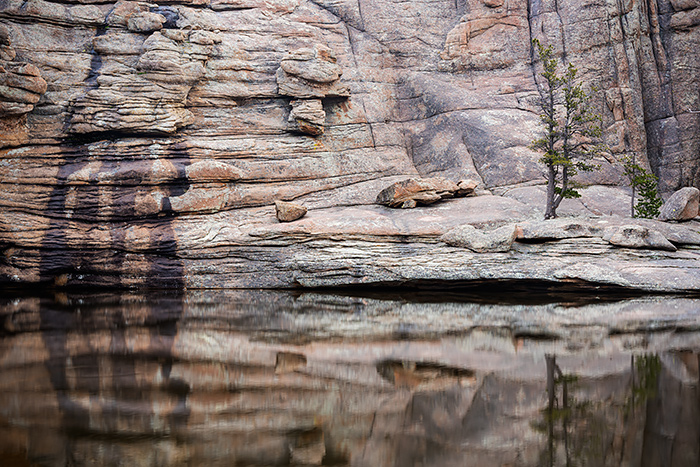
Gem Lake in Rocky Mountain National Park has been one of these locations for me. Gem Lake rests of a small shelf 1.7 miles from the start of the Lumpy Ridge trailhead. It’s a beautiful location in it’s own right and it’s one that many visitors to Rocky Mountain National Park will visit. Gem Lake is very close to Estes Park and the 1.7 mile hike is a fairly easy one. Guidebooks and locals will often recommend this hike to visitors because of the beauty, location and elevation that is lower than many of the other lakes in Rocky Mountain National Park. I often get asked by clients if I have images of Gem Lake in my portfolio for sale, of which I did not. This is because I personally find Gem Lake a difficult location to photograph. While not your typical grand landscape, the rock walls of Gem Lake offered endless possibilities for photography. Technical Details: Nikon D810, Nikkor 24-120mm F4 AF VR
Earlier this week there was a nice low layer of fog hanging over Estes Park before sunrise. I decided to hike up along Lumpy Ridge to get above the fog layer and photograph Longs Peak at sunrise rising above the fog and the town of Estes. I’ve been waiting quite awhile for conditions like this and it’s a fairly uncommon occurrence to get a fog layer low enough to cover Estes Park, but not high enough to obscure Lumpy Ridge. So I was fairly excited as I took off up the trail in the fog. As I’ve written before, fog is one of my favorite conditions to photograph in, but fog is a fickle friend. Minute changes in temperature or wind can cause the fog to move or dissipate so it’s always a gamble trying to figure out where to photograph from.
More often than not fog is not going to do what you want it to do. That was the case this particular morning. By the time I was up above town, most of the fog had cleared off from west to east. Fog remained over Lake Estes and I was even able to capture some moody images of the Stanley Hotel as the fog moved eastward. Beautiful clouds hung over the divide and although I was not going to be able to photograph Longs Peak rising above the fog, I was still able to capture a beautiful sunrise, just not the one I had envisioned. The light on the peaks lasted only about 10 minutes or so before it disappeared again behind some clouds. I was about 1/2 mile from Gem Lake at this point and I decided to continue onward and hike up to Gem Lake if only for an excuse for some more exercise and time outdoors.
I arrived at Gem Lake with no intention of taking off my backpack or photographing the lake. For starters the light was fairly blasé as it was now overcast and about an hour after sunrise. Secondly I had visited Gem Lake numerous times in the past with the intention of photographing this popular location and had come away with less than inspiring results. When I arrived at the lake I did what I normally do when I’m out exploring and hiking. I sat along the shoreline, surveyed my surroundings and just enjoyed the quite and solitude.The unique coloring and striations of the rocks around Gem Lake are unlike any other found in Rocky. Technical Details: Nikon D810, Nikkor 24-120mm F4 AF VR
For those that have not visited Gem Lake it’s a unique location in Rocky Mountain National Park. It’s located on the top of a shelf and surrounded by rocky walls that rise up from its sand and gravel shoreline. It has neither and inlet or outlet stream and is essentially a shallow pool of water in a sandy depression. As I sat on the shoreline relaxing I started to study the rocky walls that rise up out of Gem Lake. The striations, colorations and patterns on the rock is unique and each small section of rock had beautiful and intricate patterns. I started to see potential images everywhere and within minutes had my camera and tripod out and I was now inspired and entrenched, photographing the surface of the lake and the rocky walls that rise above its shore.
So after arriving with no intention on breaking out my camera, I was both busy photographing Gem Lake and inspired. This in a location where I had previously found little to photograph. The combination of lowered expectations combined with time spent on locations relaxing and enjoying the scene instead of trying to photograph allowed a breakthrough so to speak. I’ve experienced this many times in the past and found that being able to relax as well as releasing any preconceived notions of how the scene should look and photograph can allow for a creative breakthrough. Although it may sound somewhat corny to some, sometimes you need to let the location speak to you, not the other way around in order to truly see the beauty and uniqueness these natural places all have.
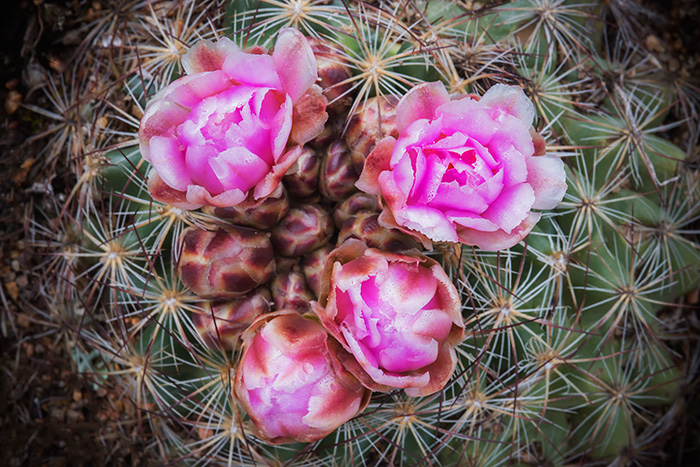
While it may be a little early in the season for wildflowers in Rocky Mountain National Park, flowers are starting to sprout if you take the time to look for them. Currently Mountain Ball Cactus are blooming in the lower elevations of Rocky Mountain National Park. Technical Details: Nikon D810, Nikkor 105mm f2.8 Micro AF.
Spring keeps settling into Rocky Mountain National Park and were as we move through the first week of May. Of course that means it must be time for a winter weather advisory and some heavy snow this weekend. As I write this post it looks like Rocky Mountain National Park, especially the higher elevations above 8000 ft are looking good for some heavy snows over this Mother’s Day weekend. I’m ready for summer and while Rocky is certainly making the transition towards summer, May snowstorms are in fact, common. So with that being said, why not discuss early season wildflower opportunities in the Park.
Rocky’s climate varies tremendously and when people joke about experiencing all four seasons over the course of a few hours in Rocky they are in fact stating a real possibility. One of the things I find most interesting about Rocky Mountain National Park is not only it’s wildly changing weather and temperatures, but the flora and fauna that must endure and exist in this climate 365 days a year. Late spring tends to bring the biggest snowstorms to Rocky Mountain National Park along with some of it’s most unsettled weather. Even with the threat of large snowstorms and large temperature swings one can find some of Rocky’s early season wildflowers on display if they look closely enough.Pasque flowers are some of the earliest bloomers in RMNP. Look around the base of Ponderosa pines to find them. Technical Details: Nikon D810, Nikkor 105mm f2.8 Micro AF
Some of the first and hardiest bloomers in Rocky Mountain National Park are the Pasque flower and the Mountain Ball Cactus. Pasque flowers tend to be the first wildflowers to appear in Rocky Mountain National Park. Typically they can be found in shady areas at or near the base of Ponderosa pine trees. They grow in small groups and their lavender coloration is subtle and much more understated then their summer wildflower brethren. It’s easy to walk right past a Pasque flower without even noticing it’s there. Pasque flowers which are aptly known as ‘Easter Flowers’ tend to start blooming as early as late March right through April. Pasque flowers can still be found in the park though we are nearing the end of Pasque season.
Another early wildflower bloomer is one of my personal favorites, the Mountain Ball Cactus. When we think of Rocky Mountain National Park the first thing that comes to mind is cactus right?, probably not. When most of us think of Rocky Mountain National Park we think of high mountain peaks, alpine tundra, majestic lakes and snow, not so much cactus. Two forms of cactus actually exist in Rocky Mountain National Park, the first being the Prickly Pear Cactus, and the second being the Mountain Ball Cactus.
The Mountain Ball Cactus can also be found in the lower elevations on the east side of Rocky Mountain National Park. Mountain Ball Cactus tend to bloom in late April through mid May when the cactus springs back to life after going dormant for the winter. Mountain Ball Cactus are small plants and again are fairly easy to overlook. They tend to grown on southern facing slopes and some one of the best places to find them are in Upper Beaver Meadows and along the south facing slopes of Deer Mountain. Mountain Ball Cactus blooms are small but they produce a very colorful and beautiful pink bloom. Isolation of the subject is one of the reasons I look using Macro lenses for the early wildflowers such as this Pasque flower in Horseshoe Park. Technical Details: Nikon D810, Nikkor 105mm f2.8 Micro AF
Photographing Pasque flowers and Mountain Ball Cactus can be challenging. Many photographers will simply ignore these wildflowers, preferring to wait for the summer blooms. When photographing Mountain Ball Cactus and Pasque flowers one has to work a little harder to be creative and capture images that display these wildflowers understated beauty. Unlike the summer wildflowers, one is not going to find fields or large groupings of either of these flowers. You are also not going to be able to create classic near/far compositions of wildflowers in the foreground and mountains in the background. Photographers will need to concentrate on the flowers themselves to create compelling imagery.
I personally like to use a dedicated Macro lens to photograph these blooms. While I don’t often use a dedicated Macro lens when photographing wildflowers, I find these understated wildflowers conducive to Macro photography. Using a dedicated Macro lens in the 100mm range l allows for photographers to eliminate distraction and uninteresting portions of the scene. I like to experiment with my aperture, often using smaller f-stops and apertures to blur the background and allow the focus to be on the wildflowers themselves.
I’m not advocating using only a dedicated Macro lens to photograph these wildflowers, by all means experiment with other lenses in your kit. I am however, advocating to keep an eye out for some of the more subtle and understated beauty in Rocky Mountain National Park. Yes it’s still early in the season for wildflowers but even so there are small pockets of beauty to be found if one just takes the time to look for it.
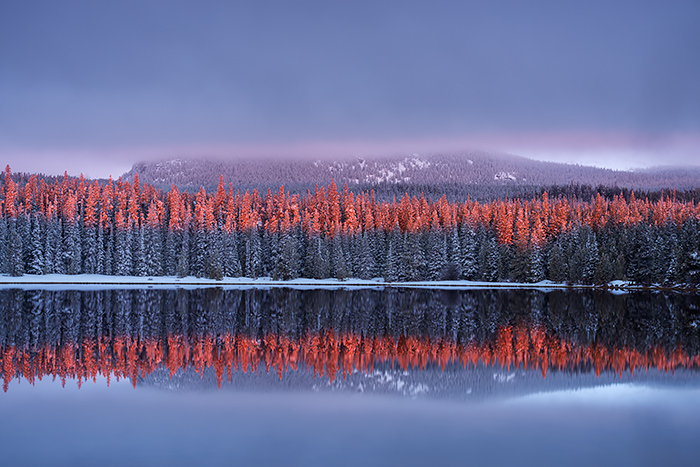
Springtime is a loosely defined term in Rocky Mountain National Park. Spring in Rocky Mountain National Park can mean warm weather and thawing lakes it streams. It can also mean snow, rain or a likely combination of both. This image of Bierstadt Lake from last week is a good example of spring in Rocky Mountain National Park. Snow had fallen the previous two days on Bierstadt Lake but the lake remained open and free of ice. Just a small sliver of the sun at sunrise pierced the horizing making the snow caked pines glow red in the beautiful but brief light show at dawn. Technical Details: Nikon D810, Nikkor 16-35mm F4 ED VR
After what seemed liked a mostly mild winter followed by an above average month of precipitation in April, spring and the coming approach of summer are becoming readily apparent in Rocky Mountain National Park. This time of year in Rocky is not only transitional, but dynamic and greatly varied.
Stretches of mild and warm days in Rocky can be quickly followed by weather systems that bring cold and snow back to the park. Conditions also vary greatly based on elevation right now. The lower elevations of the park such as Moraine Park, Horseshoe Park and Beaver Meadows are all but free of snow. The Big Thompson as well as Fall River are starting to run swiftly with the spring snow runoff. Grasses are greening in the lower elevations and some wildflowers are just starting to bloom.
Move on up in elevation to places like Dream Lake and spring is not quite as apparent in the higher elevations of Rocky Mountain National Park. Currently about half of Dream Lake is covered under a sheet of ice. The remaining layer of ice should start to melt of quickly moving forward but unsettled weather all week is likely to slow progress. The east inlet of Dream Lake is open though much of the shoreline is still covered in snow. Nymph and Bear Lakes are still mostly covered with ice while lakes such as Sprague Lake, Bierstadt Lake and Cub Lake are now open and free of ice. More signs of spring with Cub Lake thawed and green grasses growing along the edge of Cub lake. Soon the Pond Lillies that adorn Cub Lake during the warmer months will begin to grow and bloom.Technical Details: Nikon D810, Nikkor 16-35mm F4 ED VR
National Park Service crews are busy working on Trail Ridge Road clearing all the snow from the winter. With a little luck from the weather, Trail Ridge should be open again by May 22nd if there are not any major setbacks from late spring snowstorms. Having Trail Ridge Road back open not only signals the start of the summer season, but it opens up a lot of new opportunities for photography.
So as of right now, many seasonal changes are taking place in Rocky Mountain National Park. Lakes are thawing, grasses are greening and wildflowers are beginning to bloom in some of the lower areas of the park. Keep in mind that conditions can and do change quickly this time of year. After a few temperate days, winter may descend right back on the park coating the landscape in white, freezing over the lakes and making the trials difficult to navigate.
So when it comes to photography my advice is to stay flexible and try to keep a handle on the changing and variable conditions. Look for dramatic sunrises unfolding over some of the now unfrozen lakes. If it’s rainy or gray be prepared to use the diffused light to your advantage and photograph moving water and waterfalls. Keep and eye out for newly budded aspen tree’s who’s beautiful and glowing translucent green spring leaves do not get nearly the amount of love they do when they turn golden in the fall. In a nutshell be prepared for just about any and all types of photography and embrace Rocky’s topsy turvy season known as spring.
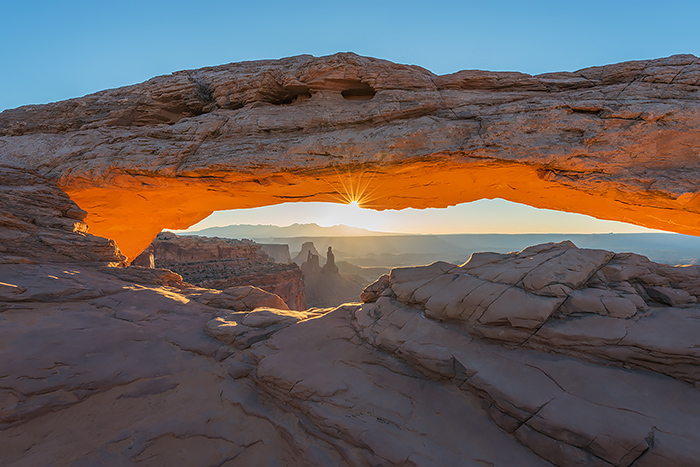
Photographing icons is always and interesting experience as a landscape photographer. Mesa Arch in Canyonlands National Park is one of the most photographed locations on the entire planet. Mesa Arch is iconic for a reason but expect to be joined by lots of other photographers making similar images or an often photographed location. While it can be fun to photograph icons, it can also be stressful and less rewarding then photographing lesser known locations. Technical Details: Nikon D810, Nikkor 16-35mm F4 ED VR
I’ve just returned from a few amazing days out in the red rock country surrounding Moab,Utah. Specifically, I spent time photographing Arches National Park and Canyonlands National Park. It was certainly a nice change of pace and it’s always fun to get out of your comfort zone and work in different surroundings. In the past I’ve spent a fair bit of time photographing the area around Moab, mostly with my 4×5 large format film camera. Even so, it felt like it had been eons since I last photographed the area.
With my photography focusing mostly on Rocky Mountain National Park and a four year old daughter at home, I’ve spent much less time photographing the red sandstone of Utah then I care to admit. Finally however, I had the opportunity to return to the desert for a few days of photography and fun. I must admit I felt both a bit out my element while also torn deciding which locations I should attempt to photographs. Moab and the National and State parks surrounding the town are filed to the brim with iconic locations to photograph. At times it seems as if you only have to go a few hundred yards to find yet another iconic western vista. In the past I’ve photographed many of these locations and over the course of the last few years I’ve seen thousands of jaw dropping compositions on both magazine covers and on the internet.
This of course led me to question both what I was seeking to accomplish photographically speaking and furthermore how did I feel about standing next to a dozen or more other photographers while trying to make a meaningful connection to the landscape as well as meaningful images. Guy Tal, a Utah based photographer and writer whom I greatly admire once commented, and I’m paraphrasing here that photographing Mesa Arch was like going to a five star restaurant and then requesting the chef make you a Big Mac. Guy’s sentiment certainly resonated with me.
So after spending a few days photographing some of the lesser visited locations in and around Moab, I wrestled with the thought of heading over to Mesa Arch in Canyonlands as I peered out my hotel window at the cloudless nighttime skies. Without clouds in the sky, Mesa Arch seemed like the most logical location to head out too. Dramatic skies are always a great asset for landscape photographers but Mesa Arch is one of those locations that can be dramatic both with or without a cloud in the sky. Could I do it?. Did I really want to head out to Mesa Arch, claim a spot early and then line up with throngs of other photographers to shoot sunrise from one of the most photographed locations on earth?.
With some reservation and a lot trepidation I decided I would indeed head out early and at least experience photographing at Mesa Arch once again. It had been nearly 12 years since I had last photographed Mesa Arch, so I figured at the very least I could not be accused of personally photographing a location to death.
I arrived at the Mesa Arch parking lot over two hours before sunrise. Even though I believed I had arrived early, I found the parking area bustling with activity and headlamps. Most of the parking spots had been filled and I could see other photographers preparing their equipment and gear for the short hike to Mesa Arch. I’m grumbled a bit to myself as I grabbed my bag and headed out on the trail toward the arch. Perhaps I thought by some fluke only one or two other photographers would decide to show up this day. In reality I may was in a bit of denial myself over where my decision to photograph had led me.
When I arrived at Mesa Arch I found three or four other photographers already setup. We joked about all descending on this ‘hidden gem’ at the same time, exchanged pleasantries and attempted to work as courteously with one another as possible. Within 20 minutes or so of arriving and setting up, a workshop had joined the photo line along with more photographers. Just before sunrise someone took a head count and it was just under sixty people waiting for the sun to rise under Mesa Arch.
It was a different and unique experience that morning at Mesa Arch. The only similar scenario I can think of would be standing along Maroon Lake photographing the Maroon Bells at the peak of fall color season. Maroon Lake however, has a lot more space and shoreline than does the area surrounding Mesa Arch so one does not quite have the same sense of crowding like you do in the tight confines around Mesa Arch.
After what seemed like an eternity, the sun rose, I made some pleasing images of this iconic location. I had some nice conversations with other photographers but felt a total sense of relief as I hiked back out to my car after sunrise. Hiking out the stress of shooting this busy of a location quickly receded and faded. I could hear the birds in the tree’s and smell the sweet spring air again. I thought about Guy Tal’s comment. I chuckled to myself and thought, ‘I’m good for another twelve years’.