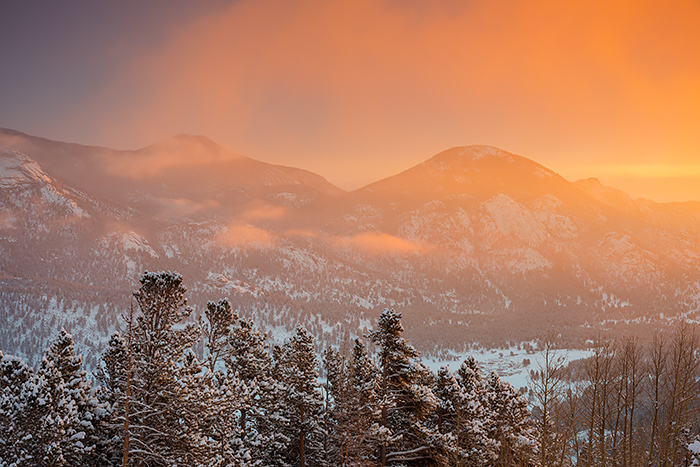
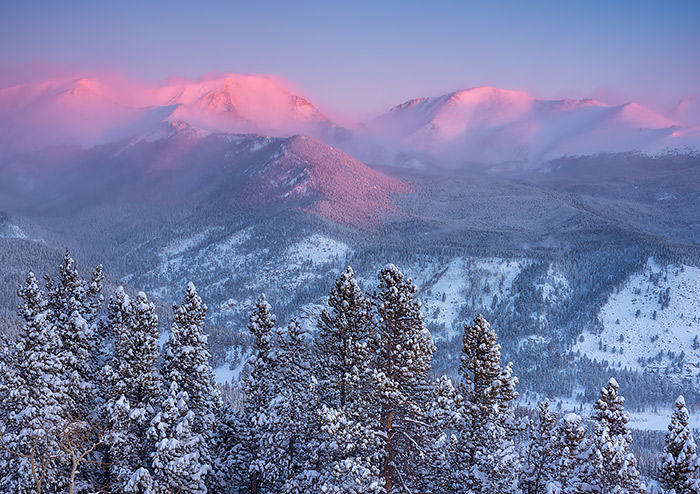
Spring is just around the corner but we’ve still got two of the three snowiest months in Colorado ahead of us. It’s a good time of year to bear down, get out in the inclement weather and capture some of your best winter images of the season. I made this image of Horseshoe Park from above Trail Ridge Road last week during pristine winter conditions. Maybe I’d like to be on a beach, but this is now the time to photograph some of your best winter scenes in Rocky Mountain National Park. Technical Details: Nikon D810, Nikkor 24-120mm F4 ED VR
Winter is finally winding down in most parts of the country. It’s been an historic winter in many parts and most of us are ready to move on with the cold and snow. Only fourteen more days to go until the calendar officially reads spring. We will turn the clocks ahead tonight and while the sun will now rise an hour later, it wont set until after 7:00 PM now. The change is seasons is perceptible now, spring fever is officially setting in. Warmer days filled with hours and hours of sunlight can not be far of right?.
For the most part this is true. Except a funny thing happens here in Rocky Mountain National Park and the Front Range of Colorado come spring time. It tends to snow, and when it snows, it snows a lot. So while Spring Fever is setting in, March our snowiest month of the year is upon us, with April our third snowiest month of the year waiting in the wings. So while the days keep getting longer and the temperatures more mild, the chance to get out and photograph the landscape in a pristine coat of fresh powder will only be increasing here in the next two months.
For me personally March and April feel a bit like going into overtime after a tough fought four quarters of Basketball. Winter is almost over, fatigue has set in but it’s time to suck it up, dig down for a little more motivation and get out there in the field. Instead of complaining or pining for warmer weather, finish strong and make some of your best winter images before the season here does transition over to warmer weather. Winter may still have a few doozy’s up her sleeve, but before you know it the lakes will thaw, flowers will bloom and Trail Ridge Road will open for the season.
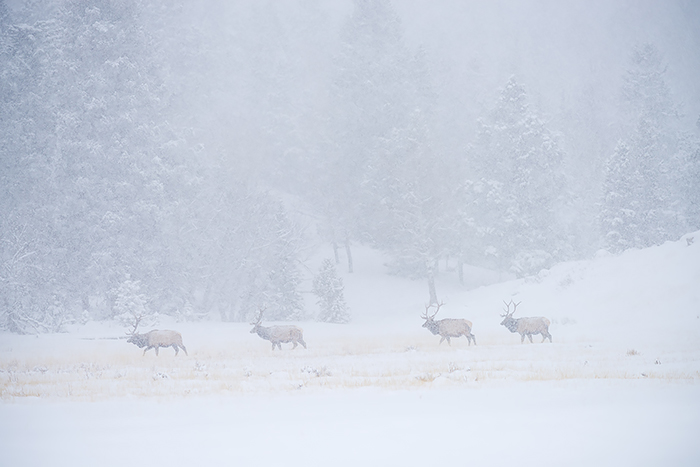
It’s easy to let gear choices overwhelm you and confuse you when out in the field. Some of the best advice I can give is to keep it simple. This was the case last week when I photographed these four Bull Elk crossing a meadow in Horseshoe Park in Rocky Mountain National Park. I only had a 70-200mm which is not typically a ‘wildlife’ focal length. Needless to say it helped me create this ‘Elkscape’ which was one of my favorite images of the day. Technical Details: Nikon D810, Nikkor 70-200mm F4 ED VR
Most photographers I know love gear and equipment. Theres no doubt about it, shiny new stuff is fun and exciting. Sometimes that shiny new gear’s even useful and dare I say necessary when it comes to photography. Photographers, myself included can sometimes let our gear overpower and interfere with our power to create and make images. When it comes to photography and gear there is certainly times when one can have too much of a good thing.
Those who have been following my blog know that at the end of October I sold off some of my excess Canon equipment and purchased a small Nikon system consisting of a Nikon D810 and a handful of Nikkor lenses. So as not to bore anyone with the reason I did this, essentially I wanted to test out the Exmor sensor in the D810. For my photography I find the additional dynamic range of the sensor useful. I considered the the 36 megapixel sensor to be and additional benefit but not something I felt I required. Needless to say I’ve been very impressed with both the D810, the Exmor sensor as well as the small kit of Nikon lenses I put together. The greatest benefit however, has been minimizing my kit and working with a much more limited group of lenses.
Working with a smaller kit has allowed me to refocus on creating images instead of fumbling with lens choices and focal lengths. It’s been refreshing to say the least to essentially be working with a 3 lens kit of a 16-35mm, 24-120mm and 70-200mm with the D810. My Canon kit consists of 16-35mm,24-70mm,70-300mm,100mm Macro lens and 24mm and 17mm TS-E lenses. Granted I did not always lug all these lenses around but I would still have to make a conscious choice prior to heading out into the field as to what lenses I would keep in the bag. I also keep a Canon 100-400mm in the front seat of my truck in case I stumble along some wildlife while driving around the park. Needless to say, my Canon kit gives me a lot of choice. Perhaps to much choice.
Besides the benefit of more mental focus when working with a smaller kit, the added benefit of creating stronger images has also became apparent when photographing in Rocky Mountain National Park last week. It was a snowy winter day in Rocky. A perfect day as far as I’m concerned for landscape photography. Heavy snow and fog enveloping the tree’s, peaks and valley of Rocky.
After spending a good bit of the morning photographing the conditions in and around Horseshoe Park, I stumbled upon a group of twenty or more Bull Elk that had bedded down to weather the storm out. It was a poignant scene. The large group of Bull’s, covered in snow, large antlers still in tact congregated together with snow falling. For a split second I panicked. The longest lens I had in my Nikon kit was a 200mm. There was no way I was going to be able to make a meaningful image as the Elk were to far off in the distance with that short of a lens.
As I was berating myself for not having a longer lens with me, some of the Bulls got up and moved across the meadow in a line for the cover of the trees. I had my 70-200mm on my D810 and figured I’d make an attempt to photograph the line of Bulls. I figured with the higher resolution of the D810 I could possibly crop the image later to help negate the shorter focal length of my 70-200mm. I framed the four Bull Elk walking across the meadow and a funny thing happened. I realized the shorter focal length was a benefit, not a hinderance. Showing these majestic creatures in their habitat was more powerful than a frame filling head shot of an Elk would be.
The image I captured of the four Bull Elk walking across the meadow in heavy snow turned out to be my favorite image of the day. When I got back to my computer and started sorting through my images it occurred to me that if I had a longer lens with me I would have completely missed the shot. Most likely I would have had a longer focal length lens on my camera and would have likely been making an attempt to photograph one or two of the Elk with a longer focal length, completely missing the wider image of the Elk in their habitat. It was a bit of an epiphany for me. Photographing with less instead of more helped me as opposed to hindered me. Overtime it’s easy to end up with more than is necessary. Try working with less and keep it simple, the results might surprise you.
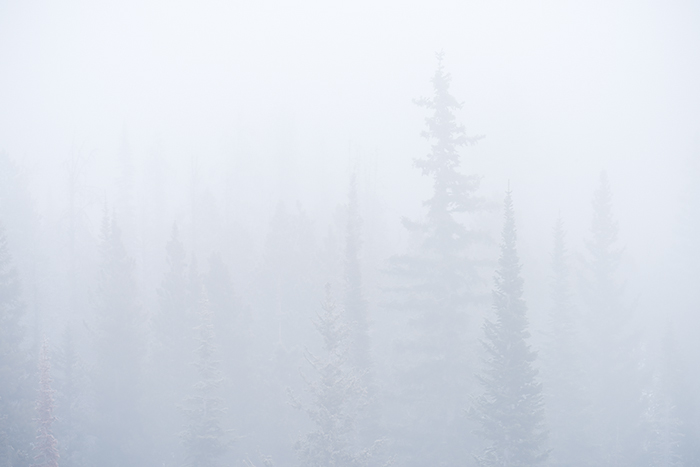
It’s the time of year again. Winter doldrums have set in and it’s easy to leave the camera bag in the closet and find other things to do with your time. Gray winter days are the worst and often times its difficult to get inspired on gray days to get out in the field. While things may not be as dramatic, conditions can still be quite favorable for creating unique and compelling images. This particular day was not looking very good when I entered Rocky Mountain National Park. I found the cloud layer, hoar frost and fog just above Nymph Lake. I spent an entire morning shooting more intimate landscapes which were quite rewarding to me. Technical Details: Nikon D810, Nikkor 70-200mm F4 ED VR
For some landscape photographers, cloudy days can be the bane of their existence. Combine cloudy days with your typical winter doldrums and some landscape photographers may avoid heading out to photograph all together. Cold weather, lack of a dramatic sunrise or sunset and subjects like streams and waterfalls frozen over narrows down the amount of options one has in the field to work with. While I cant argue it can be more difficult creating compelling images, cloudy and grey winter days still can produce dramatic, moody and unique images if one keeps and open makes sure to get the camera out of the bag. Here’s some ideas for those less then optimal grey winter days.
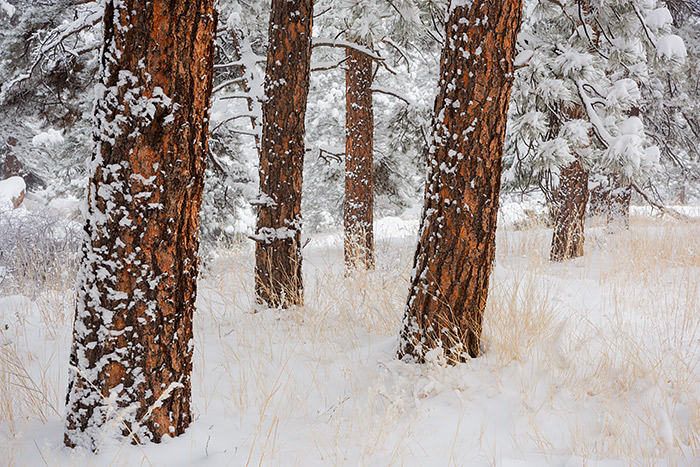
Go where the snow is. Cloudy gray days with no fresh snow are very challenging to photograph in. The weather here in Colorado during the winter months can vary greatly over a short distance. Much of our winter weather is determined by both elevation as well as which side of a mountain range your on. Depending on locations of weather systems, one side of a mountain range may be more optimal for producing snow then another. Here on the Front Range we are typically on the leeward side of the mountain range. This means that while it may be snowing very heavily on the windward side of the range only a dozen or so miles away, the leeward side has little in the way of clouds or snow. This is common here in the winter months of Colorado with snow falling heavily on the west side of the Continental Divide while little snow and mainly winds occurs on the east side of the Divide. This scenario will reverse often act in the inverse when ‘upslope’ conditions are occurring on the east side of the Continental Divide. On days like these it’s best to either head over to the west side of the Continental Divide, or head higher up in elevation on the east side of the Continental Divide where blow over from the storm may be causing snow to fall. The downside of staying on the east side or leeward side of these conditions is that it’s likely to be very windy. Ponderosa Pines on a cloudy gray day near the summit of Flagstaff Mountain west of Boulder. Technical Details: Nikon D810, Nikkor 70-200mm F4 ED VR
Head out on days when inversions or a low lying cloud layer form either during or after a storm. Sure it may be cloudy and gray with little to no snow down along the lower elevations of the Front Range, but you may have fog and snow and higher elevations if conditions are more favorable a little higher up the mountainsides. Typically inversions occur along the Front Range when we have ‘upslope’ conditions or winds that are blowing in a north easterly direction. A couple of positive outcomes may occur if you head out into the cloud layer caused by and inversion. First you may be lucky enough to actually get above the cloud layer and into clear or sunny skies. Obviously the ability to get above the cloud layer creates all sorts of opportunities for dramatic landscape photography. Secondly, even if your unable to get above the inversion layer, you may be able to get at or near the transitional zone where fog, snow, and hoar frost are occurring. Snow, fog and pines coated with ice or hoar frost can lead to limitless possibilities for photography. Personally, this is one of my favorite kinds of weather conditions to photograph in. Familiar landscapes take on a anonymous like quality. Suddenly iconic locations, photographed time and time again are incognito and allow for new viewpoints and photographic interpretations. When conditions are like this, the landscape truly transforms into a winter wonderland.
Lastly on cloudy and grey days I’ll parrot the advice I consistently give to photographers not just on cloudy and grey days, but anytime they are out in the field creating images. Pay attention to the details and look for the little things. Study the bark of a Ponderosa Pine to see if the details, patterns and colors warrant a deeper look?. Look for subtle transitions in color such as the red willows along a creek or stream. Take a look down at your feet and study those ice fractures and patterns on the surface of a frozen lake or stream. Fractures and patterns on the ice will never look the same. Each inch on the surface of a piece of frozen ice will be different and unique. Even the coloration of the ice will vary greatly depending on your locations, the depth of the water and the location of the water which is frozen.Wnen in doubt, look down and look for interesting patterns in the ice like these at Dream Lake. Technical Details: Nikon D810, Nikkor 105mm Micro AF
It’s going to be more difficult making dramatic images on cloudy grey days, especially in winter. Even so, remember that while the lighting is less dramatic on grey days, the soft diffused glow of a cloudy day on the landscape allows photographers the opportunities to explore and revisit compositions that may not be feasible on sunny days when the lighting is more direct and harsh. The longer I photograph the more I desire and appreciate cloudy days and soft diffused grey light which they bring to the landscape. So even if its cloudy and grey, grab your camera bag and head outside to make some images. Your imagery may be more subtle, but its also likely to be more original and unique as well.
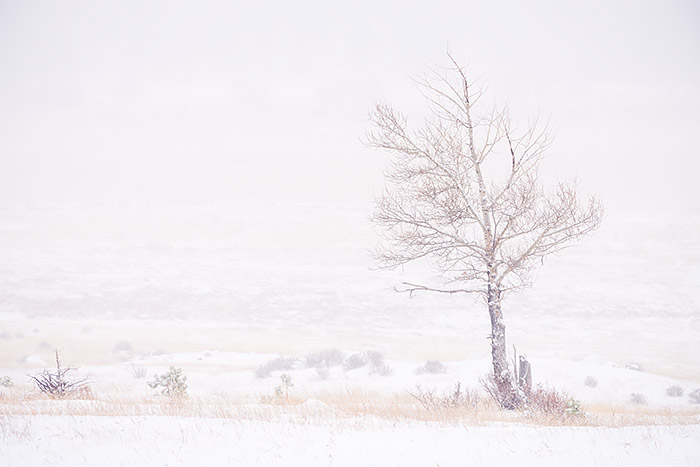
It’s that time of year again. Were fully immersed in the winter season and winter fatigue may be starting to set in for some. It can be hard to be motivated to get out when the weather turns cold and snowy, but this time of year can yield some beautiful images and classic Colorado scenes. It was a cold and snowy day when I photographed these beautiful Ponderosa Pines on the side of Flagstaff Mountain just west of Boulder. Sure I’d take some warm weather, but being out in the elements during a Colorado winter is exciting and rewarding. Technical Details: Nikon D810, Nikkor 24-120mm ED VR
Cold, snow, ice and wind. That’s how 2015 has been progressing so far here on the Front Range of Colorado. 2014 ended on a cold chilly note and 2015 picked up the baton from 2014 and has been providing much of the same. My personal mantra as well as many other landscape photographers I know’s of ‘bad weather = good image’ holds true as ever. Commitments have prevented me from taking full advantage of this unsettled weather and unfortunately I have not been able to get out in the field to take advantage of this winter weather to make images.
Fortunately for me my schedule should be freeing up shortly and I am planning to take full advantage of my time and get out in the field early and often in the coming weeks. 2014 was one of my most productive years as a photographer and I plan on carrying and building on that momentum right through 2015. It doesn’t feel quite right watching the snow and wind howl from the comforts of a heated office while I should be out in the elements with frozen fingers and toes doing what I love to do and attempting to capture the essence of winter here in Colorado. So while winter fatigue may be setting in and daydreams of beaches, chaise lounges and margaritas cloud your mind, take advantage of the winter weather and immerse yourself in it. I know that’s what I’ll be doing soon enough.
2014 has been a banner year for me. I’ve been able to devote more time in the field in Rocky Mountain National Park then any other previous year. I’m hoping to continue forward with the momentum I’ve built and continue to add to my portfolio of Rocky Mountain National Park in 2015. Even though 2014 is nearly complete, I’m still trying to sneak in a few more images before 2015 greets us. I photographed this beautiful view of the Mummy Range yesterday after Rocky Mountain National Park was covered with a foot of fresh powder. Technical Details: Nikon D810, Nikkor 24-120mm F4 ED VR
2014 is quickly coming to a close. It’s truly unbelievable how quickly 2014 passed by, something each progressive year seems to do at a more expedited pace then the previous year. 2014 was a watershed year for me. I made numerous changes to both my photography and personal life that allowed me to spend more time in the field, specifically Rocky Mountain National Park as well as devote more time honing my craft and working on my portfolio of images.
It’s been my goal for sometime now to be able to devote more time in the field photographing Rocky Mountain National Park and this year everything came into alignment and allowed me to dedicate myself to photographing Rocky on a near daily basis. It’s been productive and enlightening to be able to spend so much time in a place that I feel a very deep connection to, one that feeds my soul and creative muse. I’m hoping to continue to build momentum and continue to grow and improve my portfolio of not only Rocky Mountain National Park as well as the area around Boulder and the Boulder foothills and mountains.
My to-do list of locations to photograph keeps growing and even with the ability to dedicate as much time as I have done in the past year, sometimes there just aren’t enough days in the year or hours in a day to get to all the locations one dreams about when looking over a map. So I’ll keep pushing ahead enjoying the time I able to get out into the field and make an attempt to avoiding fretting over missed sunrises and locations realizing one can only be so many places at a time.
As 2015 approaches I’m looking forward to moving my photography business forward while continuing to learn new skills and improve my craft. I’m also looking at providing a photography guide/tour service for photographers in Rocky Mountain National Park. I’m still in the process of working with the Park Service, but should by the start of spring by licensed, insured and registered with Rocky Mountain National Park to provide photography tours within the park. Look for more information and rates on my web site in the near future regarding photography tours in Rocky Mountain National Park.
So with a spate of snow and arctic cold weather bearing down on us here in Colorado I’m going to do my best to see if I can still manage to create a few more images before 2014 waves goodbye and we usher in 2015 and wrap a nice bow on what has been a banner year for me.
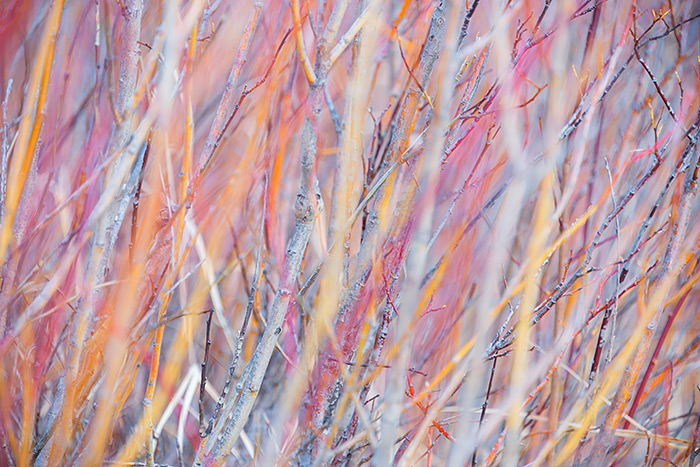
I set out to Rocky Mountain National Park this morning hoping to capture a dramatic sunrise. Sunrise never materialized so I had to look for other subjects to photograph. While not exactly what I had in mind, this abstract of willows along Fall River in Horseshoe Park was both fun and rewarding to make. I had to just take a moment to get over the fact that sunrise was a bust, and then start looking around for other subjects. The colorful willows caught my eye. Anyone who has had to bushwack through willows will have a greater appreciation for the ‘density’ these bushes put forth. Technical Details: Nikon D810, Nikkor 28-300mm F4.5-5.6 ED
We all dream about setting up on location and waiting for a stunning sunrise to unfold before our camera. It’s the kind of dreams that get people out of bed at zero dark thirty so they can be ready and on location just for the chance they may photograph something special. The truth of the matter is that even though magazines, coffee table books and the internet are chock full of locations with screaming light, more times than not one will not experience epic light or optimal conditions while out in the field photographing.Sunrise might have been a bust this morning but there was no wind which allowed me to capture this pattern of willows and grasses in Horseshoe Park. Technical Details: Nikon D810, Nikkor 24-120mm F4 ED VR
We all need to make the most of our time in the field. You’ve put a lot of time, energy and money into being at the right place at the right time. There’s no reason a busted sunrise needs to be a make or break proposition, especially when photographing in one of the most beautiful locations in the continental United States such as Rocky Mountain National Park.
This very situation unfolded when I was out in Rocky this morning. In fact, I have this very scenario unfold when out photographing Rocky Mountain National Park countless number of times. Once I get over the self pity of not being in one of the worlds most beautiful places for a spectacular sunrise or sunset, I gather my thoughts and start to think of ways I can make images in the moment and under the current, even is less favorable conditions. You know what?, these kinds of days in the field have yielded some of my most original as well as most satisfying personal images.Cant forget the obligatory ice image. Fall River has finally begun to freeze over again. Technical Details: Nikon D810, Nikkor 28-300mm ED VR
While they may not all be book or magazine cover material, finding compositions and working under conditions and lighting that may be deemed by some as less than optimal, allows a photographer to free his mind and create unique, subtle images that help to unveil the more modest side to beautiful locations like Rocky Mountain National Park.
So by all means sacrifice and seek out epic and spectacular sunsets. Get up early, stay late, hike the extra mile. Do so with an open mind however. Be ready to switch gears if the light and clouds don’t materialize how you were hoping they would. Slow down instead. Look for the overlooked, the patterns in nature whispering, not screaming for you to photograph. Look to create a more personal and unique body of work on days like these. Most of all enjoy your time and efforts in the field regardless of the conditions.
It may be the so called ‘Brown Season’ in Rocky Mountain National Park but that certainly does not mean there are not colorful and dynamic landscapes to be photographed this time of year. Here I used a combination of backlit clouds and a frozen Sprague Lake to reflect both the mountains and the colorful sky to create a colorful and dynamic composition. Technical Details: Nikon D810, Nikkor 16-35mm F4 VRFor some its the ‘shoulder season’ for others its known as the ‘brown season’ and for others its the ‘off season’. Whatever you want to call it the month of November into early December is considered by many to be a less favorable time to visit Rocky Mountain National Park.
Many photographers feel the same way about the ‘brown season’ as do other visitors to Rocky Mountain National Park. Many begrudge this time of year and find other things to do to occupy their time while waiting for snow to fall or the weather to warm up come springtime. The persistent winds, frozen lakes, long shadows and bare tree’s keep many photographers at home or searching other locations to photograph.
Sure it’s a little more difficult to photograph Rocky Mountain National Park during this traditional time of year, but there are still plenty of rewarding images to be made and opportunities to be found if one’s willing to work in the wind and keep an open mind to the possibilities. Here are a few of the things I do to keep busy in the field with my photography this time of year in Rocky. Another example of using a backlit sunrise in Moraine Park to help create color and drama. Technical Details: Nikon D810, Nikkor 18-35mm F3.5-4.5 VR
1. Look for reflections of color, shapes, clouds and mountains in the frozen ice. Temperatures will drop this time of year and most water will freeze over in the park. While you wont be able to get full on reflections of mountains and peaks like one can during the warmer months, frozen surfaces can create interesting patterns, foregrounds and subtle reflections. Furthermore if your lucky enough to have colorful clouds or skies overhead, the ice will reflect that color helping to warm up the scene in front of you.
2. Photograph into the sun and use silhouettes to your advantage. So what if the grasses are brown and aspens have lost all their leaves. Photographing backlit subjects will relegate most of those bland areas to black space while backlit objects like grasses and water will pop when the low angle of the sun rises and illuminates these objects.
3. Get out when it’s snowing!. A fresh coating of white transforms everything in Rocky Mountain National Park to a pristine postcard winter scene. Diffused light like that during a snowstorm is some of my favorite light to photograph Rocky in. Locations where the light may never properly illuminate a subject has now evened out over the scene allowing for multiple compositions. The fresh snow will cover brown grasses and give extra detail and dimension to the landscape.
So even though it may not be the most glamorous time of year to photograph landscapes in Rocky Mountain National Park it’s still more than warrants a few expeditions to photograph the landscape during the so called ‘brown season’. Keep an open mind, embrace the season, and most importantly get out in the field and you will certainly come away with some winners.
Rocky Mountain National Park is now cloaked in white courtsey of our latest visit from the ‘Polar Vortex’. Now’s the time to get out on the Front Range of Colorado and make winter images as this is going to be the flavor du jour until things start to thaw out in six months or so. Moraine Park looked like a winter wonderland on Saturday and the conditions open up a lot of new oppurtunities to photograph Rocky Mountain National Park. Technical Details: Nikon D810, Nikkor 28-300mm F4.5-5.6 ED VRWinter has us well in its grips this week as early unsettled weather has filtered in from the north and west. The Polar Vortex, now the hip phrase of the day has brought with it arctic cold and snow to Colorado’s Front Range. While arctic cold and snow are certainly no stranger to Colorado, this blast of weather has arrived much earlier than is typical.
What does this mean for photography?. Well as always unsettled weather is usually good for making images if one does not mind getting out in the cold. Working a camera and playing with one’s tripod with the temperature around 0 degrees Fahrenheit can test one’s patience with numb fingers and frozen and fogged over viewfinders and LCD displays. Even so it’s a nice change of pace to see the landscape covered with fresh snow and winter like scenes.
While it looks like its supposed to warm up a little next week, winter is here to stay in the high country and places like Rocky Mountain National Park. It’s time to dust off the snowshoes, grab your winter gear from your attic or basement and get out in the field and make some images of winter scenes because we’ve got six months before things start to thaw out again!.
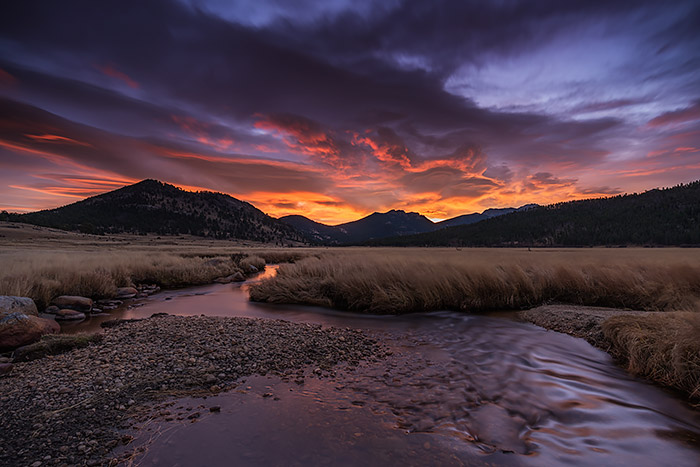
Sunrise this morning over Eagle Crest Mountain, The Big Thompson River and Moraine Park. To date the Nikon D810 has impressed me with its ability to handle scenes with high dynamic range like this one from this morning in Moraine Park. Technical Details: Nikon D810, Nikkor 18-35mm F3.5-4.5 ED lens
Were now firmly in whats known as ‘Shoulder Season’ in Rocky Mountain National Park and the two towns of Estes Park and Grand Lake that border Rocky. The autumn leaves are off the tree’s, the Elk rut has wound down and the throngs or visitors to Rocky, Estes, and Grand Lake has decreased considerably. Even with our mild weather to date, the cool nights have frozen over much of the surfaces of the higher lakes and at this point it’s only going to take one cold front and some snow to propel Rocky Mountain National Park into full winter mode. As of this writing it looks like that cold weather event will be upon us by next week.
It’s easy as a photographer to take a step back from making images and waking in the middle of the night to make it to your destination before sunrise. Grasses have turned golden or brown and the westerly winds seem to blow unabated each day. While it’s certainly a little less glamorous of a time to photograph Rocky Mountain National Park then say summer and fall, there are still unlimited opportunities for ‘wow’ type moments and images to be had.
I’m also using this time to continue to give the Nikon D810 a full shake down in the field. As I stated last week, I picked up a Nikon D810 with a modest set of Nikkor lenses to put the famous 36 megapixel Sony Exmor sensor through its paces. Clean, pliable, high dynamic range files at low ISO are very useful for the images I create when out in the field.
My Canon’s have served me very well and over time I have been able to adjust to the limitations of my Canon bodies and sensors to create images the reflect my vision. Even with that being said, I’ve seen very little improvement in low ISO files on my Canon bodies and quite frankly my 2007 Canon EOS 1Ds III had cleaner lower ISO files then my 2012 5D Mark III does. I’m really hoping Canon takes a hard look at low ISO dynamic range and again becomes a class leading innovator in this area. In fairness to Canon their sensors at high ISO until very recently were class leading and Canon continues to add innovate and update lenses in their lineup setting them apart from every other camera manufacture. As has been said many times, photographers don’t buy a sensor, they buy a camera system. As a whole, Canon is still a very attractive and innovative system. Even so, at this time I believe it’s only fair to give the Nikon D810 and it’s class leading low ISO sensor a whirl to see if it indeed does live up to the hype and potentially help to aid my image making.
If your looking for a full on review of the Nikon D810, your looking in the wrong place. There are plenty of great sites on the internet with in-depth reviews, charts and test images. Periodically, I will use this space to reflect on my experiences with the D810 and what my real world impressions are of the camera and sensor from the perspective of a landscape photographer who typically does not need to photograph at ISO’s higher than 400.
Here are a few thoughts after having the camera in hand now for a week and having sometime to use it in the field. I expect some of my impressions to change overtime as I get used to the new interface of the Nikon system. While I was a Nikon user 15 years ago, the past 15 years of Canon usage has more or less erased all my Nikon ‘muscle memory’ so to speak and the first and most difficult thing I’m dealing with is seamlessly working with the camera in the field. I still feel quite disjointed using the D810 but I expect this to dissipate quickly with more use.
First off some of the negatives of the camera from my perspective as a Canon user. The menu system is not nearly as easy to navigate as Canon’s. While it’s not as quirky as some other reports make it out to be, to me at least it’s not nearly as intuitive as Canon’s layout.
Secondly, I miss the Canon quick control dial on the back of the camera. On the D810 there are two dials to adjust shutter speed and aperture, to my liking the quick control dial is much more easily found and accessed when one’s eye is pressed against the viewfinder. Thirdly, Live View is still very much behind Canon’s implementation. As a former 4×5 large format shooter, I use Live View religiously to check focus on my images. Canon’s Live is quick, responsive, detailed, accurate and also acts to lock the mirror in the up position during shooting to prevent additional camera shake. One of the reasons I never purchased the Nikon D800 was because I had heard Live View was more or less useless. The image on the screen was an oversampled image and not a true representation of what the viewfinder was seeing. The Nikon D810 Live View supposedly addressed this and improved upon it. While it apparently no longer over samples the image on the LCD, it’s quite jumpy when trying to zoom and its still difficult for me at least to gauge if I’m actually in focus, especially in dim lit conditions which is often the case in the predawn hours that I’m out.
Lastly, I am finding the color balance on the Nikon to be more difficult to work with. For the most part, I very much enjoyed the color balance of the Canon sensors and the Canon’s do a very good job setting a proper white balance. The Nikon on the other hand at least to me tends to lean to a more yellowish coloration and I often find I really need to play around with the white balance to get it more to my liking. Even so, none of those issues are deal breakers for me and I’m already well on my way to making adjustments.
As for some of the positives, there are quite a few. First off and most important to me is the low ISO dynamic range of the sensor. To date I have been blown away with the quality of the sensor. The files from the D810 are like rubber. It is very easy to push and pull shadows and highlights with little degradation to the image file. No banding, no chroma noise in the shadows and clean skies. All things I constantly had to adjust and fight with when processing files from my Canons. The native 64 ISO of the D810 creates a beautiful clean raw file to work with when exposed properly. This of course is why I purchased a D810 and to date I’m really impressed at just how much cleaner the files from this camera are.
Secondly, I am impressed with the 3 Nikkor lenses I am using on the demanding 36 megapixel sensor. With the exception of the Nikkor 14-24mm F2.8 lens which has now achieved legendary status, I had heard mixed reviews on some of the Nikkor lenses. When I shot Nikon’s back in my film days I had always been extremely pleases with Nikon glass but with pixel peeping, demanding sensors and the internet amplification affect I was a little unsure of what to expect from the 3 lens kit I have chosen. To be clear, my Nikon kit is much more modest than my Canon one, but I still need lenses that will perform on the D810 when used between F8 and F13 which is where I do 95% of my landscape shooting. The 18-35mm F3.5-4.5, 24-120 F4 and 28-300mm F4-5.6 have all proven very capable to date. While I’m guessing I may make some slight adjustments to this kit if I continue to move forward with Nikon, I feel I can cover most of my bases with this current setup.
So in summary after a week with the D810 I’m very pleased with the quality of the files coming from the camera. I would say to date, the files from the D810 have exceeded my expectations. I’m pleased with my current lens kit and at this point other than having a lens wider than 18mm, I dont see the Nikkor lenses as a weak point in the system. Live View needs lots of improvement and Canon’s is still far superior. Overall I’m still getting used to the menu’s and ergonomics of the D810 but I expect these to fade with more usage. As always, the most important thing is not gear. It’s one vision, passion for the subject and ability to put themselves in the field often that will lead to true growth and improvement. Overlook these and it wont matter what camera or lens you own.
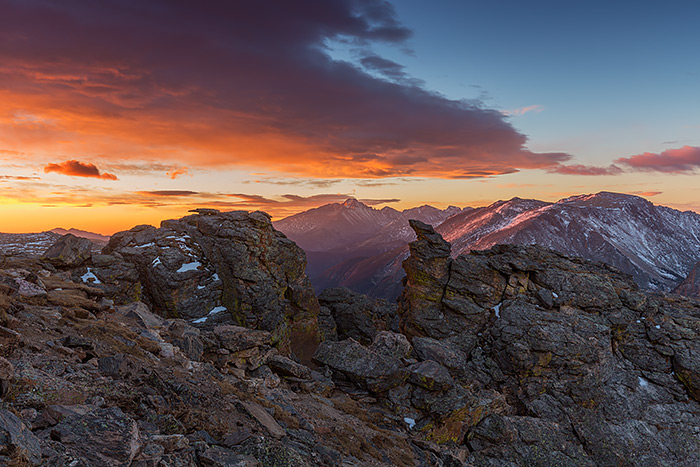
To date my favorite image that I’ve created from the Rock Cut along Trail Ridge Road. I almost passed up photographing from the Rock Cut this week because typically it’s considered best to photograph during the afternoon. In reality, there is no such thing as optimal times to photograph a landscape, only optimal lighting conditions which can come in the morning as well as the afternoon. Technical Details: Canon EOS 5D Mark III, 24mm TS-E F3.5 L II
It’s an afternoon shot. Typically that’s what I would tell people who asked me for a recommendation as to when the best time to photograph from The Rock Cut along Trail Ridge Road is. While mostly true, the more I photograph locations in Rocky, especially iconic ones, the more I find equally as pleasing images when photographing during times that are considered less ideal. This also applies to exploring and photographing from vantage points that may not actually highlight the actually icon or depict the iconic scene seared into our consciousness.
Having just returned from my fall jaunt to photograph autumn colors in New York State, I was keeping my fingers crossed that Trail Ridge Road in Rocky Mountain National Park would stay open while I was out of town. Mostly mild weather over Rocky Mountain National Park allowed Trail Ridge Road to stay open into this week. For those not familiar with Trail Ridge Road, it’s the highest continuous road in the United States and reaches and elevations just of 12,183 ft above sea level. Typically Trail Ridge Road is closed during the first significant snow storm of the season which on average usually pans out to be the third week of October.
Essentially at this point in the season any inclement weather is likely to close Trail Ridge Road at Many Parks Curve on the east side of Rocky and the Colorado River Trailhead on the west side of Rocky for the winter season. So as soon as I set foot back on Colorado soil, I was dead set on spending time photographing along Trail Ridge prior to it becoming a long, cold, and difficult winter hike.
Tuesday was the first day I was able to get out to photograph Rocky Mountain National Park. With conditions looking promising for a nice sunrise, up Trail Ridge Road I headed long before the break of dawn. I drove Trail Ridge Road all the way to Medicine Bow curve trying to decide where I wanted to photograph from. Normally, I’ll spend a few afternoons photographing from the Rock Cut, but I had yet to do so this year.
The sunrise was looking very promising and the early morning glow was just starting to color the skies over the eastern plains of Colorado. A large lenticular cloud was forming east of Longs Peak and the skies to west had started to clear. The Rock Cut seemed like the perfect vantage point to take in sunrise. ‘It’s an afternoon shot’ is the thought that raced through my head. With little time left to mess around with what now looked like a slam dunk sunrise, I headed to the Rock Cut. I was prepared to go down in flames for photographing a location that’s supposed to be an afternoon shot.
Thoroughly enjoying a rare late October morning at just under 12,000 ft, with a light breeze and mild temperatures, I grinned ear to ear as sunrise unfolded and my shutter clicked with the constantly changing hues of a spectacular sunrise. I often have to relearn this lesson, but mornings like these are a great reminder. There is no such thing as a morning or afternoon location. There is good light, great light and spectacular light, chase the light, not the location!.