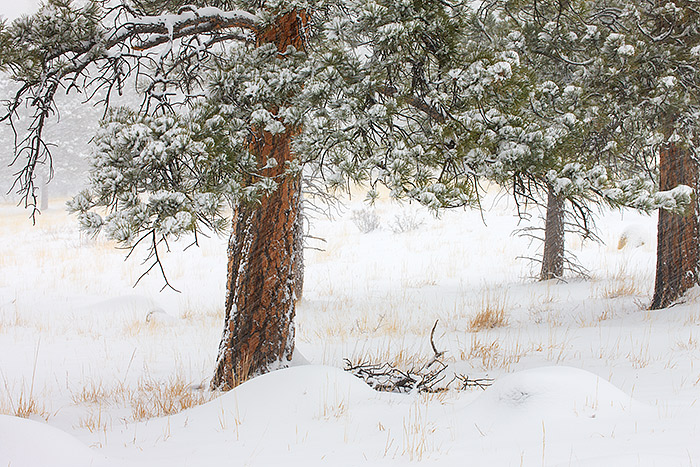
Snow start to fall hard on these Ponderosa trees of Walker Ranch. The conditions quickly deteriorated this day, but I was able to sneak away with an image that typified the experience for me on this day at Walker Ranch. Technicial Details: Canon EOS 1Ds III, 70-300 F4-5.6 LLocated west of Eldorado Canyon State Park lies Walker Ranch. Situated on Boulder County open space property, Walker Ranch is the site of a former homestead from the turn of the century. Portions of the property skirt the banks of South Boulder creek which makes for great hiking and fishing.
The area around Walker Ranch is going through a transition of sorts. In 2000, the Walker Ranch fire burned through much of the property and it’s forest. In 2013, the Flagstaff fire again burned inside portions of the Walker Ranch area. Many of the tree’s inside of Walker Ranch have been affected by these two most recent fires.
Even with the recent burns in the area, Walker Ranch is still a spectacular location for photography. Our long dry spell seems to have temporarily abated in the last couple of weeks. Snow has become a common occurrence once again in and around Boulder.
During a recent snowstorm, I took the opportunity to head up to Walker Ranch to see what subjects I could find. It was snowing hard, and the wind had really begun to pickup as I headed out in search of images. I found this group of Ponderosa pines weathering the storm.
Though it was snowing hard, it was quiet and peaceful as I photographed. Not another soul was to be found. The parking lots were empty and people remained in the comforts of the inside returning this popular location back to a place of wildness and solitude.
I was only able to photograph for a short time. The winds and blowing snow soon made it to difficult to keep the front of my lens snow free. I packed up and headed back to the car. Though I’m a photographer, experiences like these are never about recording images to a memory card. For me, it’s the experience of committing special days like this to my memory.
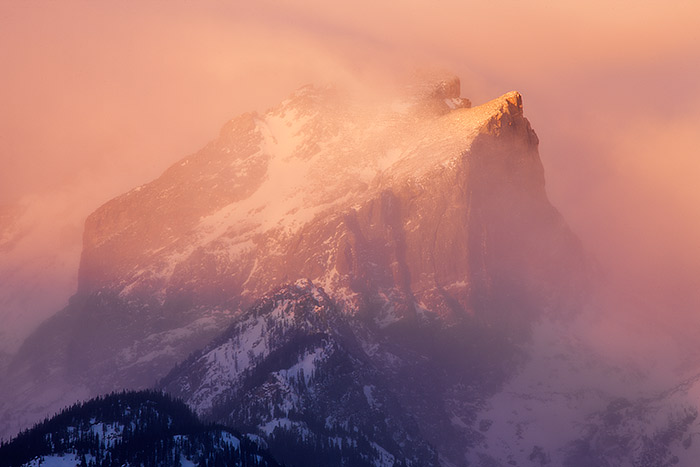
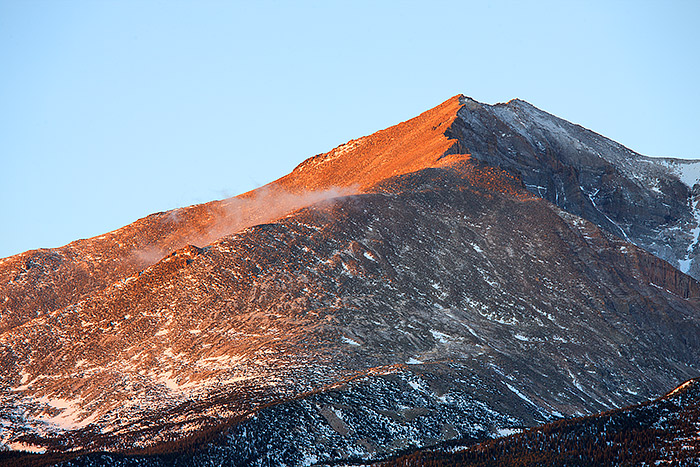
In a scene that is reminiscent of an Albert Bierstadt painting, high winds and snow create drama over Hallet Peak. Bierstadt’s dramatic paintings were often panned by critics as being unreal. However, conditions like these make it easy to see what Albert Bierstadt was seeking to convey. Technicial Details: Canon EOS 1Ds III, 70-300mm F4-5.6 LEvery so often, the light, wind and snow come together just perfectly enough to create a scene that looks otherworldly. A strong storm was moving in over Rocky Mountain National Park this past Saturday that provided the perfect conditions to produce what I refer to a Bierstadt lighting. Clouds swirled over Hallet Peak as the intense first rays of sunshine filtered through the blowing snow off the Continental Divide.
The light was changing quickly and only lasted a short time before the sun began to be blocked out by the passing of ever more clouds in the sky. I chose to isolate Hallet Peak from it’s neighboring peaks to highlight the drama going on in the sky and around Hallet. Isolating Hallet Peak allowed for me to showcase the drama unfolding this morning. The resulting image of Hallet this morning seemed to take on an owed to Albert Bierstadt.
Albert Bierstadt’s name is familiar to many visitors to Rocky Mountain National Park as well as Colorado. Bierstadt Lake only a mile or so from where this image was photographed is named in this nineteenth century painter in his honor. Bierstadt travelled the west painting dramatic canvases of the high peaks and breathtaking mountain vistas. Bierstadt travelled to Estes Park during his second journey through the west in 1863.
If you have ever viewed one of Albert Bierstadt’s paintings in person, they are quite a site to behold. Bierstadt often painted on very large canvases. The Hudson River School painter emboldened the scenes before him and often took liberties in exaggerating the scale of the mountains and the drama and weather surrounding them.
In many ways, Bierstadt’s dramatic style is mirrored by today’s landscape photographers. Like many of today landscape photographers, Bierstadt’s style was often panned by critics as being unreal and over the top. Modern day landscape photographers often here similar critiques. On mornings such as this one, it’s easy to see what inspired Bierstadt’s love of the west and his desire to showcase it’s dramatic beauty.
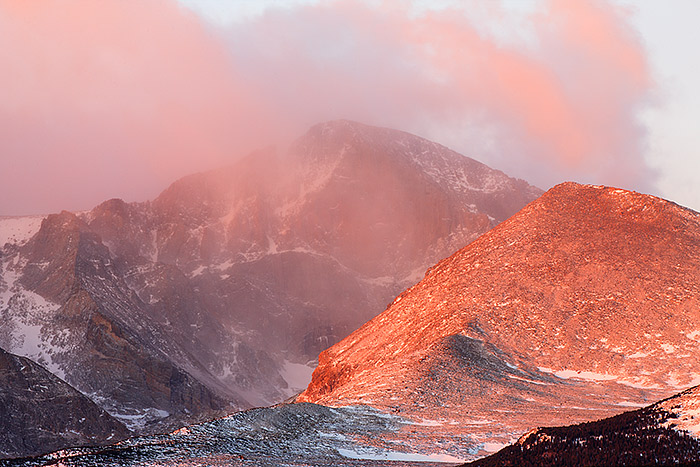
14,259 ft Longs Peak summit is raked by winds and blowing snow and a typcial winter morning in Rocky Mountain National Park. It’s easy to want to stay inside during the winter months, but there are endless possibilities for rewarding photography experiences in Rocky for those willing to brave the elemens. Technicial Details: Canon EOS 1Ds III, 70-300mm F4-5.6 IS LIt’s the middle of winter and sometimes it can be difficult motivating oneself to head out into the elements to create images. It’s easy to want to hit the snooze button on your alarm and stay in the comfort of a warm bed. Winter photography can be challenging but rewarding. Here are three suggestions for getting out and the elements and successfully photographing Rocky Mountain National Park in winter.
The Tahosa Valley and the Twin Sisters: Located along Highway 7, the Tahosa Valley and the Twin Sisters formation offer some of the most impressive views of Longs Peak and Mount Meeker, the two tallest peak in Rocky Mountain National Park. Hike up the Twin Sisters trailhead for impressive views of Longs Peak and it’s famous eastern face known as the Diamond.
Trail Ridge Road and The Mummy Range: The Mummy Range has a southeast facing orientation. This southeasterly orientation is ideal for capturing the winter sun which rises in the southeast this time of year. A short hike up a closed Trail Ridge Road from Many Park’s curve will result in spectacular viewpoints of Mount Chapin, Mount Chiquita and Yipsilon Mountain. It’s common to find clouds floating over the peaks of the Mummy Range which will only help to aid in capturing even more stunning light at sunrise.
Bear Lake Area: Nearly everybody favorite spot in Rocky Mountain National Park for winter activities of all sorts. There are endless possibilities for winter photography in this area. Slap on some snowshoes or cross country skies and impressive viewpoints of the backside of Longs Peak, or towering blocky summit of Hallet Peak lend themselves to your camera and lens. Dream Lake is a popular location even in the middle of winter. Images of Hallet Peak from Dream Lake are just as impressive in winter as is summer, but Dream Lake also attracts photographers looking to photograph abstract images of its icy surface. Because Hallet and Flattop mountain have a northeast orientation, late winter will provide fuller and more complete lighting of this iconic location.
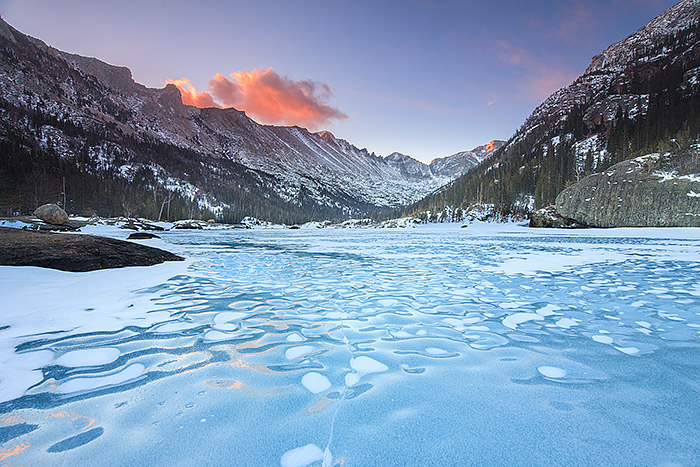
The sun illuminates the top of 14,259 ft Longs Peak from a frozen Mills Lake. It’s cold but majestic morning in Glacier Gorge but the timeless beauty of this location makes it easy to forget the cold temperatures. Enos Mills had the forsight to understand that locations such as Mills Lake needed to be protected and preserved so that future generations could enjoy the beauty of this location much like he would have in the early 1900’s. Technicial Details: Canon EOS 1Ds III, 17mm F4 TS-E LSometimes it’s easy to forget what a short history Rocky Mountain National Park has. While the geographic area that is now Rocky Mountain National Park, has soldiered on for eons, the protected entity drawn out on a map that is Rocky Mountain National Park is not even one hundred years old.
While there are many who were responsible for establishing Rocky Mountain National Park, none other than a former Kansan named Enos Mills. Enos Mills had a greater influence in establishing Rocky Mountain National Park than any other individual. Furthermore, Mr. Mills was a talented photographer and his images of Rocky taken with his Kodak Pocket camera are images of locals in Rocky Mountain National Park never before photographed.
While the Estes Valley was filled with strong pioneering type personalities such as F.O. Stanley and Abner Sprague, it was Enos Mills strong belief in the conservation movement that helped establish Rocky Mountain National Park as a protected and treasured piece of America.
In remembrance of Mr. Mills efforts in helping to establish Rocky Mountain National Park, a lake was named in his honor. Mills Lake is one of Rocky’s most popular and spectacular locations. Located 2.6 miles up Glacier Gorge, Mills Lake resides on the backside of Longs Peak in a beautiful glaciated valley. It’s a location worthy of the man’s name who lectured and educated citizens on the need to protect these beautiful and unique areas.
A set of clouds roils up the steep slopes of Mount Meeker on a nearly clear Colorado morning. This small set of clouds which formed along the flank of Mount Meeker was just enough to get me to look at photographing a subject other than Longs Peak. It’s easy to fall into the trap of concentrating on Longs Peak while ignoring the equally impressive Mount Meeker just to the southeast of Longs Peak. Technicial Details: Canon EOS 1Ds III, 70-200mm F4 IS LMount Meeker is Rocky Mountain National Park’s second highest peak. Rising to 13,911 ft above sea level, the ridgeline of Mount Meeker towers over Rocky and the Front Range. Even with it’s impressive sight and ridge lines, Meeker does not get the attention and respect of Longs Peak, it’s nearest neighbor and only fourteener located in Rocky.
While both Mount Meeker is shorter in stature than Longs Peak, it is in fact a more technical mountain than the already difficult and challenging routes up Longs Peak. For us photographers it’s also easy to overlook Mount Meeker with the siren of Longs Peak towering just to the north.
I’d like to tell you that the morning I decided to hike half way up the Twin Sisters was to indeed photography Mount Meeker in all her majesty. I’d by lying of course if I wrote that. My intent in fact was to capture sunrise unfolding over Longs Peak and the Diamond instead. The Twin Sisters reward hikers and photographers with some of the best views of Longs Peak and Mount Meeker anywhere in Rocky Mountain National Park.
Sunrise this particular morning had more or less fizzled out. The clouds that had circled above Longs Peak prior to sunrise had for the most part dissipated. The northern area of Rocky had a nice set of clouds over it, but I was committed at this point to photographing from the Twin Sisters.
A small set of clouds started to form along the flanks of Mount Meeker just as I was about to pack up my gear and hike out. The inversion along the flanks of Meeker were just enough to get me to reframe my shot and train my lens and camera on Meeker instead of Longs Peak. In my many previous images from this location, I had never thought to concentrate on Mount Meeker’s impressive lines and ridges alone. Longs Peak was always to much of a distraction.
It was because of a busted sunrise and a set of small clouds rolling up the flanks of Meeker that allowed me to train my camera on the red headed stepchild of Longs Peak known as Mount Meeker.
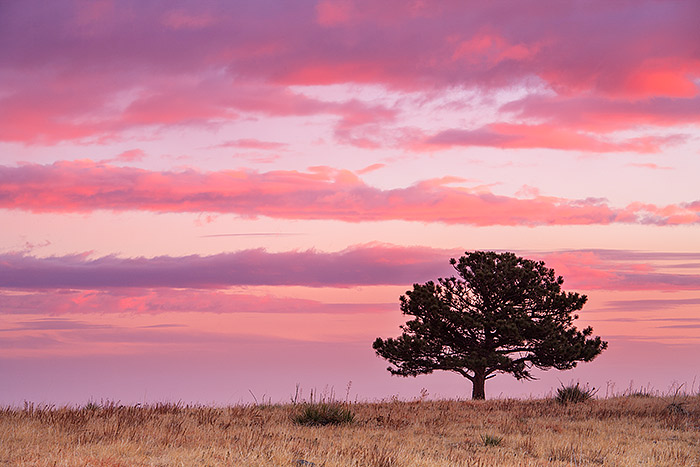
Each sunrise over Boulder and the Front Range is unique from the previous one. This particular morning the pastels, pinks and magentas really popped before the sun rose over the eastern horizon. I love mornings like these because I know no two sunrises will ever be alike. Technicial Details: Canon EOS 1Ds III, 70-200 F4 IS LSunrises on the High Plains of Colorado are often magnificent. No two sunrises over the plains are ever alike. Each sunrise is as unique as fingerprints are to one’s hand. The intensity of the colors, the shape of the clouds, and the richness of light are always changing and varied.
In this day and age of digital photography and the use of software to enhance and refine imagery, some may be skeptical of the intensity of the colors and light that some of my sunrise images exhibit. When photographing a location, it is never my intent to reproduce an exact carbon copy of the scene. There are tweaks and adjustments made to some of my images, but sunrises photographed over the Front Range and High Plains rarely need much work after they are photographed.
When photographing sunrises, I prefer to head out long before dawn on mornings when there is a good amount of cloud cover overhead. Before the sun appears, the light show begins. Clouds will begin to pickup the colors of the sun and the hues an intensity of the light will change rapidly as sunrise approaches. Like a kid in a candy store, I use this time to vary my compositions and experiment with my exposures. My advice, get out early, capture the intensity of the sunrise and spend less time in front of the computer after your shoot.
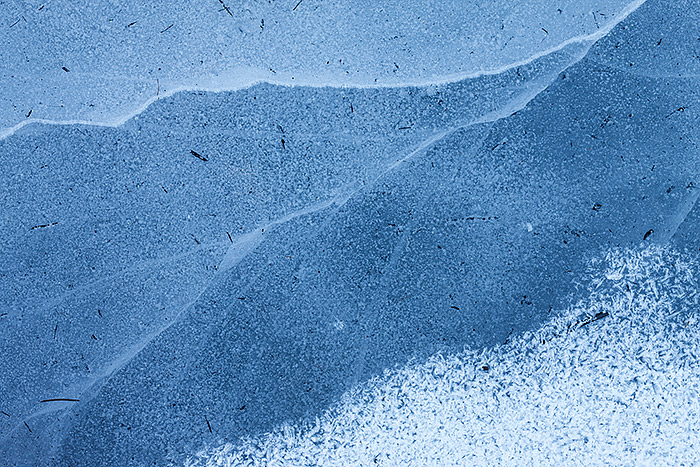
Here’s another shot of ice to hold everyone over. The news this morning declared this day ‘Blue Monday’. I was working on this image from Rocky and Sprague Lake when the story aired and I thought it fit the mood on this Monday just perfectly. Technical Details: Canon EOS 1Ds III, 100mm F2.8 L IS MacroAs I sit here at my desk processing some files on Monday, a story on the news declares this as ‘Blue Monday’. Apparently the day people will feel most depressed. The news story cites debt and lack of motivation as some of the reasons behind declaring this day ‘Blue Monday’.
Of course the story wrapped up by stating that most will attempt to treat their ‘Blue Monday’ depression through retail therapy. Initially the story caught my attention as I personally find this time of year a little less motivating and exciting for photography than other times of the year.
Of course once they mentioned retail therapy the cynic in me quickly dismissed the story as just another attempt to get people out spending money they don’t have on items they don’t really need. ‘Blue Monday’ quickly sounded like our familiar friends of ‘Black Friday’ and ‘Cyber Monday’.
I happened to be working on this image from last week when the story aired. It certainly seemed to fit the them well. Of course, I find nothing depressing in spending a chilly morning in Rocky Mountain National Park photographing the surface of a frozen lake.
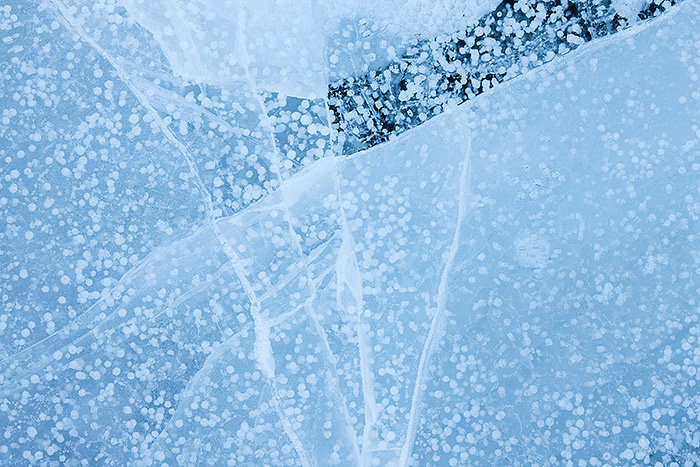
Here’s and example of ice fractures on the Big Thompson River. I photographed this image in Moraine Park on a cloudless morning. After walking around the surface of the Big Thompson for some time, I settled on this fracture and snow. If you look closely enought you can see ash embedded in the ice from the Fern Lake Fire. Technicial Details: Canon EOS 1Ds III, 100mm F2.8 L IS MacroDisclaimer: Photographing ice can be a dangerous and deadly activity. Conditions in Rocky Mountain National Park can change rapidly causing ice to quickly become unstable. Before wandering out on the ice to explore, I strongly advise that you check with NPS Rangers for the latest conditions before heading out on the ice.
It’s that time of year again. That time of year when you start to see shots of ice fractures and patterns from Rocky Mountain National Park popping up all over the internet. It’s a subject that has been photographed quite a bit, but even still some may wonder where and how to capture images of ice in Rocky Mountain National Park.
While there are many locations in Colorado where one can photograph ice patterns on our lakes and streams, Rocky has some of the best locals in all of Colorado to photograph icy surfaces. Combine plentiful locations to photograph ice, with your typical winter doldrums and photographing ice can be the perfect cure to get you back out in the field with your camera.
Rocky is chock full of watery locations that will freeze over once the colder weather settles in. There are however, a few locations that are more accessible and more popular locations to photograph ice in the Park.
Dream Lake tops the list of my popular locations to photograph ice in Rocky. The high winds that race down from the peaks above Dream Lake act like nature’s Zamboni. Even when there is heavy snowpack, winds will often sweep the surfaces of Dream Lake exposing large swaths of the icy surface of the lake. Dream Lake is also a fairly short hike in the winter. The trail is heavily used and will most likely be hard packed. It rarely requires snowshoes to access but I would recommend snow spikes or Yak-Trax type equipment to make your footing a little more sure on the ice and snow.
The Loch, like Dream Lake is also a very good location to photograph ice. The winds at the Loch in the winter can be relentless. This of course will keep large areas of the good size lake free of snow and ready for exploration. The Loch requires a bit more of a physical commitment to reach than Dream Lake but you are likely to encounter fewer photographers here than Dream Lake.Dream Lake is by far the most popular location in RMNP to photograph ice. You could spend days photographing the different patterns on the surface of Dream Lake. Technicial Details: Canon EOS 1Ds III, 24-105mm F4 IS
For those who want to avoid long hikes or extended periods out in the cold and wind, Fall River in Horseshoe Park, and the Big Thompson River in Moraine Park can provide some nice areas of ice, especially if the snowpack is lower. Keep in mind you will be able to find interesting ice patterns in just about any location in Rocky Mountain National Park where there is water present.
As for actually photographing the ice and the patterns, I recommend taking your time to observe the patterns, bubbles and fractures present on the ice. Try lots of different compositions and look for patterns or anomalies in the ice that will make for an interesting subject. My favorite lenses when photographing ice are my 100mm Macro lens and my 24-105mm lens. I find the 85-105mm range to be best at isolating the patterns.
Furthermore, keep in mind that weather conditions will play a big part in your results in the field. Cloudless Colorado bluebird days will result in the ice taking on a bluish hue from the sky reflecting in the ice. Cloudy days will result in the ice taking on a more milky white like hue. I recommend you photograph the ice in Raw. Why you ask?, mostly because this gives you the option of adjusting your white balance when processing your shots. This will result in much more dynamic images as you can decide to warm and or cool the white balance based on your desired results.
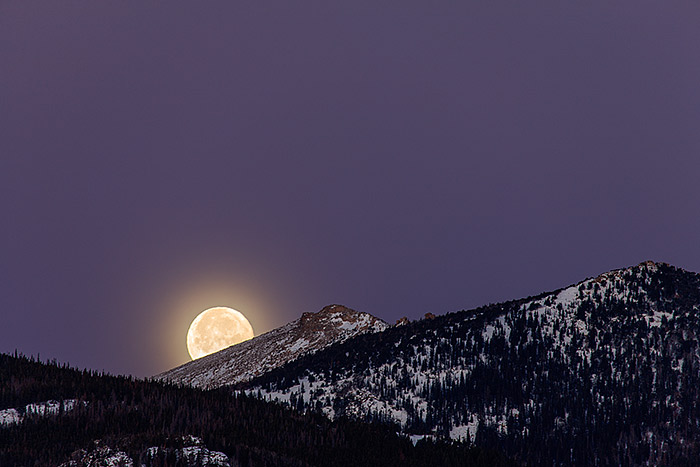
The full moon sets behind Beaver Mountain as the purple glow from the earth’s shadow combined with pre-dawn light makes for an impresssive scene over Moraine Park. Just below me, a pair of Coyotes was yipping and howling. It’s mornings like this in Rocky, when I’m unsure of exactly what I want to photograph that can turn into some of the most memorable mornings. Technicial Details: Canon EOS 1Ds III, 100-400mm F4.5-5.6 IS LWhen I head up to Rocky to photograph at sunrise, I usual have some idea in mind of where and what I want to shoot. Sometimes I have a location in mind that will require a long hike to reach, and sometimes I have a general area in mind that I would just like to explore and photograph what strikes me as interesting. Over the years, I’ve found that I need to remain flexible and have a good ‘plan B’ location in case my pre-determined areas are looking less primary.
For me personally, I find having a location in mind allows me to make sure I’m at a good location when the action starts happening and the sun rises. I’ve found the ‘lets go hike around and see what unfolds’ approach often ends up with me running up a trailhead rushing to capture the unfolding sunrise leaves me rushed, detached and unprepared.
On very few occasions do I head up to Rocky Mountain National Park with little to no idea on where or what I want to photography. 90% of the time I have a fairly good idea of where I want to be and what I want to photograph.
A few weeks ago I found myself in the position of being up in Rocky with no game plan at all. It’s the middle of the brown season and most of the waterways and lakes in the park have frozen over. The peaks and the mountains though are still only covered with snow in all but the highest locations.
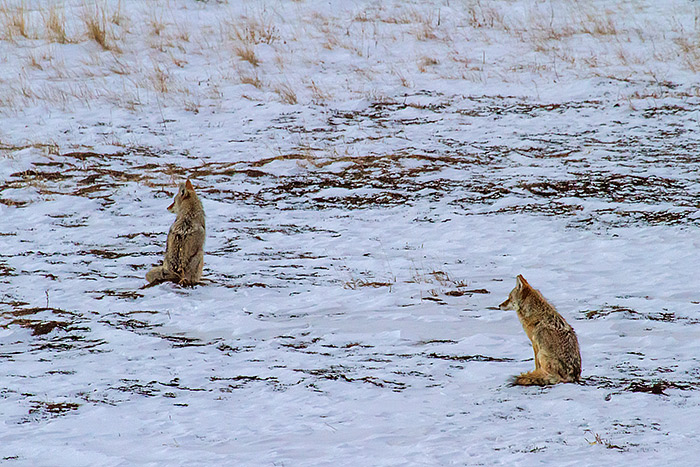
For me, any day in Rocky Mountain National Park, regardless of the conditions is better than spending a morning anywhere else on the planet. Because of this, I headed up to Rocky with no agenda, and no plan for where I wanted to be at sunrise. I took a lets just see what happens approach, contrary to how I normally photograph most mornings.A pair of coyotes howls on a chilly morning in Moraine Park while the full moon sets behind the mountains to the west. Technicial Details: Canon 7D, 100-400mm F4.5-5.6 IS L
I’ll admit the conditions and lack of a plan left me feeling a little uninspired as I approached Estes Park. There were no clouds in the sky this morning, it had been a week or so since any fresh snow had fallen and so I really had no good ideas on what I wanted to shoot that morning when I entered the park.
That all changed in a heartbeat as I round a corner in Moraine Park and glimpsed off to the west. A beautiful full moon was quickly setting to the west and over the continental divide. At that moment I knew what I wanted to photograph. I quickly headed up a hillside near the Moraine Park Museum to get an unobstructed view of the setting moon.
As I was setting up my camera and tripod, admiring the beautiful setting moon, a pair of Coyotes wandered out into Moraine Park and started barking, yipping and howling. It was an impressive display with the full moon setting over Beaver Mountain while the chorus from the playful Coyotes howling echoed through Moraine Park.
The scene quickly inspired me. Heading up to Rocky with little to no idea of what I would photograph had now placed me in Moraine Park experiencing a unique and memorable experience that one can only experience in the American west. That’s why in the end I like to say, a morning in Rocky is better than a morning anywhere else, and sometimes the journey and unknown is inspiration alone.
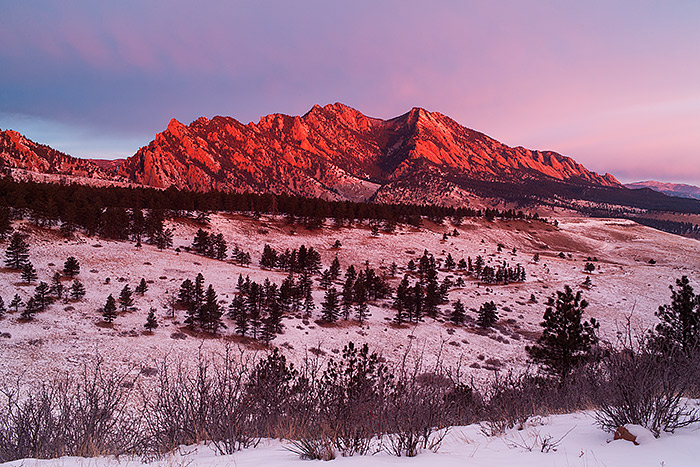
Here’s to hoping that the first sunrise of 2013 is a sign of things to come in the new year. It was a spectacular start to 2013 as a beautiful sunrise unfolded over the Flatirons of Boulder, Colorado. What a way to welcome in the first day and sunrise of 2013. Now if I could only get every sunrise in 2013 to unfold like this. Technicial Details: Canon EOS 1Ds III, 40mm F2.8 STMHappy 2013 to everyone. Here’s hoping to a healthy and productive year to all. I managed to keep my tradition of shooting the first sunrise of the new year this morning. This gets easier to do the older I get, as in some years past I probably would be going to bed as the sun was rising.
This year I wrangled myself out of bed and made the short drive over to Boulder and the Flatirons Vista trailhead to photograph the first sunrise of 2013. It was a chilly morning with temps in Boulder hovering around 12 degrees, give or take a few degrees depending on your location.
It had cleared off to the east over the high plains of Colorado but a nice set of clouds remained over the Front Range, and the Flatirons. The conditions were coming together to form one of our classic and intense sunrises here in Colorado. I hiked the few miles back to my location in the pre-dawn light and waited in the stillness and silence of the morning for the light show to unfold.
This mornings sunrise was more amazing than any fireworks show celebrating the new year and as I stood their watching it unfold there was no better place to be to start 201