Saint Catherine’s Chapel On The Rock

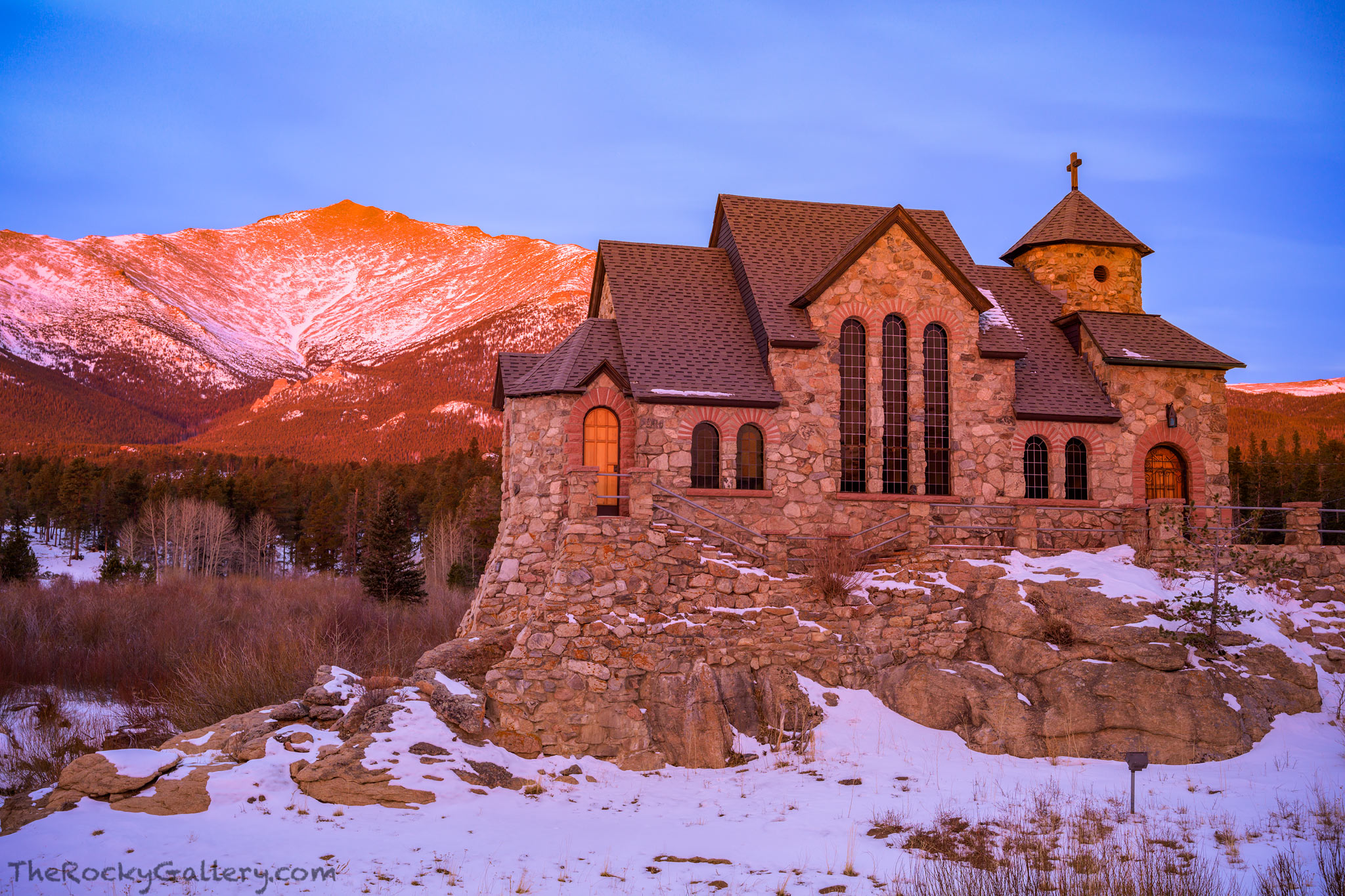
Over the past year or so, I’ve been making a concerted effort to photograph more images in Rocky Mountain National Park that may include man made features. One of the most beautiful locations which include a man made object, is Saint Catherine’s Chapel On The Rock. Saint Catherine’s is located on the St. Malo Retreat center complex, but has Rocky Mountain National Park as a backdrop. 13,916 ft Mount Meeker towers behind Saint Catherine’s and this time of year the lighting on Mount Meeker’s southeast face is nothing short of electric. Technical Details: Nikon Z7, Nikkor 24-70mm F4 S lens

It’s been a quiet couple of weeks here in Rocky Mountain National Park. After what seemed like a very active weather pattern from October through November, December has been very quiet. While there have been a few small systems that have moved through RMNP this month, most of the weather other than some light accumulation of snow have been wind events on the east side of the park.

Looking at the long term forecast for the rest of December it appears the pattern will continue to give us more of the same. Of course long term forecasts aren’t all the accurate so we can still keep our fingers crossed for some more fresh snow to blanket Rocky.

Even with it being quiet on the weather front, there have been some very nice sunrise and sunsets as there often is this time of year. While we may not end up with much in the way of snow on the east side of RMNP, those wind events often produce lenticular cloud formations. These of course make for beautiful sunrise and sunset colors once the sun illuminates the bottom of the lenticular cloud.

As we head into the holidays and the new year here in Colorado, I’ve been trying to get out and photograph as much as possible with the conditions look interesting. One of the subjects I’ve been working on with regards to my portfolio of Rocky Mountain National Park is images that include the hand of man in them.

While many landscape photographers go to great lengths not to include man made objects, buildings, trails, etc., I’ve been slowly adding to my extensive collection of Rocky Mountain National Park images by making attempts to actively photograph buildings, trails, and other interesting views that may include man made objects.

With Christmas almost upon it seems as good a time as ever to photograph Saint Catherine’s Chapel on The Rock. This beautiful church which sits along Highway 7 between Allenspark and Estes Park is a spectacular location. Not only is the church a beautiful stone church, but its perched on top of a rock with Rocky Mountain National Park as a backdrop.

While the church is not technically inside Rocky Mountain National Park, Saint Catherine’s On The Rock is oriented in such a position that it’s also a location with one of the best views of Mount Meeker. Many people mistake Mount Meeker for Longs Peak from this location, but the stunning backdrop to Saint Catherine’s is the southeast face of 13,916 ft Mount Meeker. While Mount Meeker is just short of 14er status, its still a very impressive mountain and one that ranks as the 68th tallest peak in the state of Colorado.

The lighting this time of year on the southeast face of Mount Meeker is nothing short of electric. There’s pretty much nothing to obstruct the sunrise on the side of Mount Meeker this time of year so that as soon as the sun begins to rise over the high plains of Colorado below, Meeker starts to glow. Place Saint Catherine’s Chapel on the Rock in front of Mount Meeker and you have all the ingredients for some beautiful light as well as a composition.

So I’ll continue to work on making images of Saint Catherine’s, with the goal being to photograph the area after our next snowstorm covers the landscape in fresh powder, this is a location that landscape photographers visiting Rocky Mountain National Park should not overlook.

The Buck Stops Here

Sunrise was a bust yesterday morning in Rocky. Often when this occurs I move onto a ‘Plan B’ which more times than not is wildlife photography. With fresh snow on the ground, I was able to spend a few minutes photographing this beautiful Mule Deer Buck on the side of aptly named Deer Mountain. It can be tricy to photograph both wildlife and landscapes well, but I find it a good idea to persue both opportunities in Rocky Mountain National Park to increase one’s chances of capturing images. Technical Details: Nikon D850, Nikkor 200-500mm F5.6 AF-S VR Lens

While my primary focus photographically speaking is landscape photography, those who know me and have photographed with me also know I’m apt to photograph just about any subject in good light. Next to landscape photography, wildlife photography ranks second in subjects I enjoy photographing.

Sometimes landscape photography and wildlife photography work hand in hand and one can benefit from the other. There are times when I’m out in a meadow in Rocky Mountain National Park setup for a sunrise image, when a large bull moose wanders out of the woods, undisturbed by my presence. In cases like these, I’m usually able to parlay my fortune into photographing both a landscape image, while I also being able to photograph wildlife that’s in the general vicinity.

Personally, I find those kinds of situation to be more of the exception than the rule. More often than not I find that to make compelling images, one has to commit the time to one or the other subject or you end up with mediocre images or no images at all. That being said, I believe its beneficial when photographing in a location like Rocky Mountain National Park to be prepared to photograph both landscapes, while having the ability to photograph wildlife which you may encounter trailside or roadside.

With the exception of portions of the fall elk rut, I typically prioritize photographing landscapes over photographing wildlife. As is often the case with both forms of photography, mother nature does not always want to cooperate and it’s easy to head home empty handed in those situations.

The upside of photographing both landscapes and wildlife photography in locations such as Rocky Mountain National Park is that there is also a good chance you will be able to capture some beautiful images of one of the two subjects.

Many days in the field I am able to capture stunning landscapes, draped in dramatic lighting. More than likely on these mornings I’ve only caught a glimpse of animals here and there and probably haven’t had an opportunity to photograph any of them. On the flip-side, many times I’ve gone out with the intention to photograph landscapes, only to have the conditions not work in my favor. It’s at this point that I start looking for other photographic opportunities in RMNP.

This was exactly the scenario that unfolded on yesterday mornings outing. Rocky was covered in fresh snow and there were lots of clouds hovering over the Front Range as I left my house and headed towards Estes Park. Forecasts called for some clearing and it looked like we would have a good probability of a dramatic sunrise.

Sunrise came and went and clouds over the eastern plains of Colorado, blocked out any dramatic color in the sky, along with any sun for the first 45 minutes of the morning. On mornings like these, I’m going to stick around and look for other subjects such as wildlife to photograph. In mid December the low angle sun provides beautiful lighting nearly all day long and of course having a fresh coat of snow on the ground in winter is always welcome.

As can often be the case, a herd of Mule Deer were grazing near the roadside at the base of aptly names Deer Mountain. With the Mule Deer rut winding down, there were three good looking bucks just east of the grazing herd of ‘Muley’s’. One buck in particular took his time grazing and spent most of his time basking in the warm morning sun on a 4 degree Fahrenheit morning.

I always welcome these opportunities and they make for a good ‘Plan B’ if your primary subject is not cooperating. I find it to be a good idea when driving or hiking the roads of Rocky Mountain National Park to keep a camera with a long lens at the ready for opportunities like this. Have the camera setup for action, and have a lens that can give you some reach. Your vehicle makes a great blind and oftentimes, if you a prepared you can get a few minutes with your subject and capture some nice images as I was able to do yesterday.

Some Foothills Magic

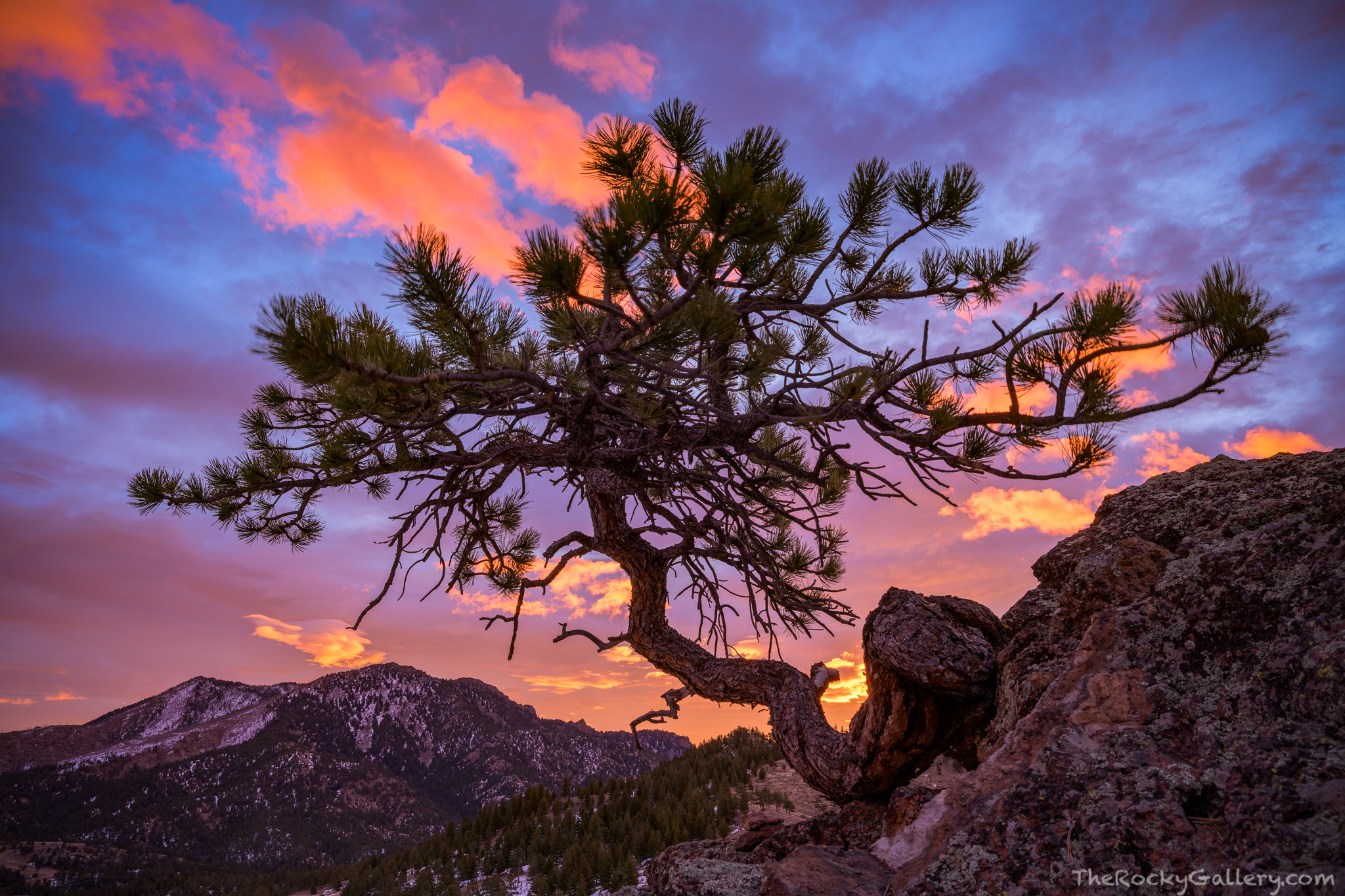
The winter solstice is only a week away and this time of year I enjoy exploring areas close to home. I spent Thursday morning in the foothills just west of Boulder near Walker Ranch enjoying what was certainly our best sunrise of the week. Technical Details: Nikon Z7, Nikkor 14-30mm F4 S lens

Were a week away from the Winter Solstice here in the Northern Hemisphere. You can feel the change in the lighting and sun angle this time of year. Not only are our days very short this time of year with just over 10 hours of daylight, but even when the sun is out and shining, it doesn’t have quite the warmth it does most of the year in our high altitude of Colorado.

Snow from our large snowstorm just before Thanksgiving is still covering much of the open ground. That would be a rarity as we get into February and the sun rises higher in the sky and causes snow to quickly melt in all but the shaded areas quickly.

The winter winds have returned and even if its not snowing in Rocky Mountain National Park, the Continental Divide is often blanketed in clouds as storms from the Pacific dump snow on the west side of Rocky Mountain National Park as well as Colorado’ ski areas.

I like to use this time of year to recharge. I’ll still spend a good amount of time in RMNP, photographing, especially when conditions warrant it based on freshly fallen snow or the promise of an amazing sunrise. This time of year however, I really enjoy spending time in the lower foothills and plains in and around Boulder

The weather and the winds down here are usually a little more cooperative and the sunrises over the high plains and foothills this time of year are often stunning. It’s a nice change of pace and it allows for different compositions and locations for photography. It also involves a little less travel and driving which can often be welcome in the middle of winter.

Thursday morning I took the opportunity to head up to Walker Ranch in the foothills just west of Boulder to photograph what was an amazing sunrise. I could tell it was going to be a good one as we had the classic setup of clouds over the foothills and mountains with a small gap in the cloud cover over the high plains. As long as the clouds aren’t moving off to the east to fill in that gap, your pretty much guaranteed and explosion of color in the sky when this occurs.

There was no disappointment with Thursday’s sunrise and other than it being breezy west of Boulder, the color in the skies over South Boulder Peak were amazing. Truth be told, the sunrise east of Boulder was even more intense and peoples social media feeds all around the Denver metro area were filled with images capturing the amazing sunrise.

With us heading right into winter now, I’ll be searching out and exploring not only locations in Rocky Mountain National Park for new compositions and photographs, but I’ll be spending plenty of time in and around Boulder on their numerous open space properties and mountain parks.

‘Oh Shoot’

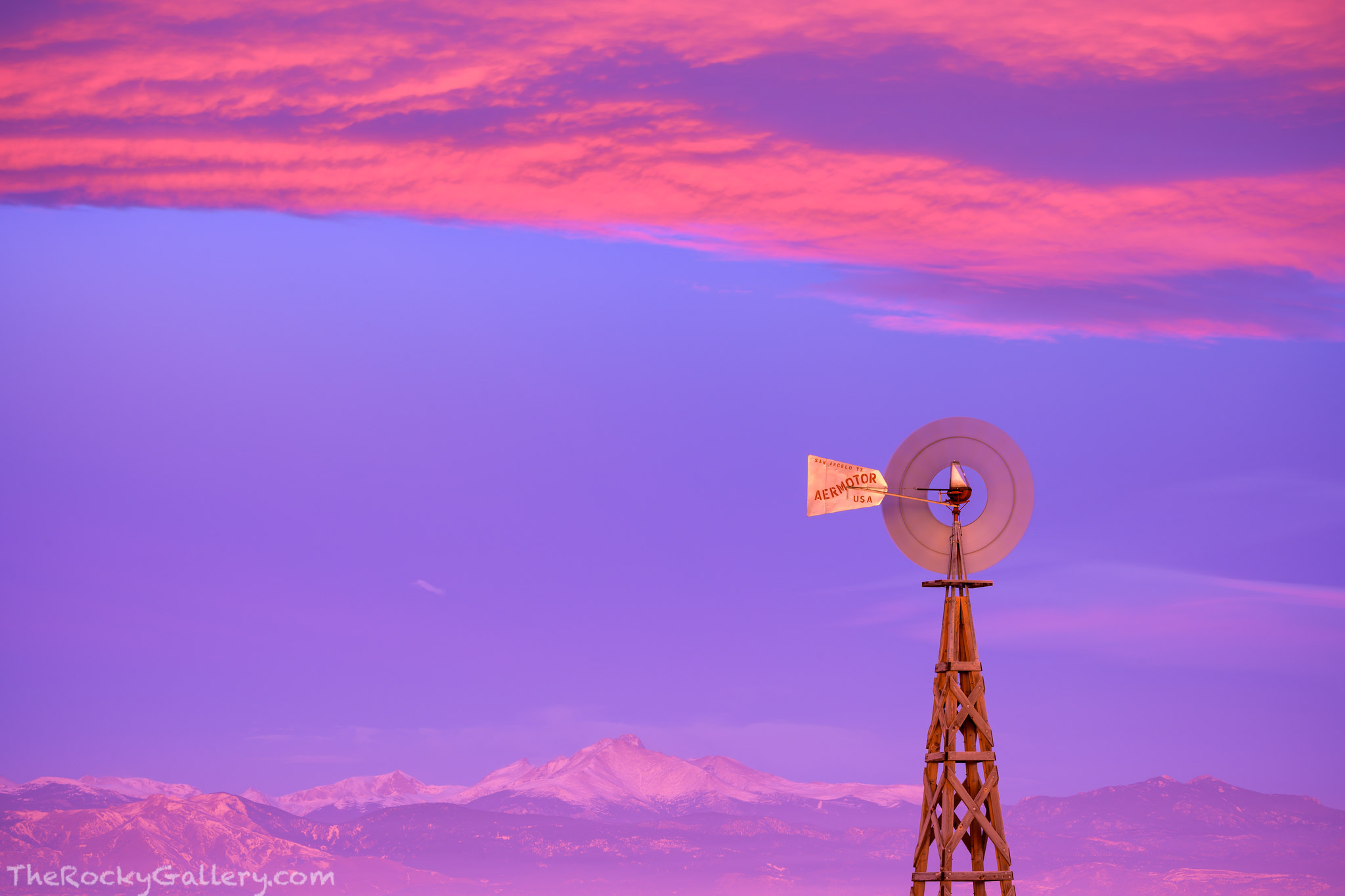
It’s always a good idea to have a location close to home that one can quickly head to if spectaular conditions sneak up on you. My ‘Oh shoot’ location located about 5 minutes from my house here in Erie is a spot I can quickly head out if sunrise or sunset looks to good to pass up but I cant get anywhere else. This windmill with Rocky Mountain National Park, Mount Alice,Longs Peak and the Twin Sisters as a backdrop has saved my bacon a few times as was the case this past Saturday. Technical Details: Nikon Z7, Nikkor 70-200mm F2.8 AF-S VR FL lens

Do you have and ‘oh shoot’ location?. You know a location close to where you live that you can quickly run out to when amazing lighting or conditions sneak up on you and catch you off guard. ‘Oh shoot’ is the rated G version of a spot close to one’s home that when you look out the window of your house and see what is going to be an epic sunrise or sunset you can grab your camera and be shooting in five to ten minutes.

I have a few of these spots close to my house. While I’m pretty good about being up long before sunrise to assess the conditions and probability of a good sunrise, there are times when beautiful conditions sneak up on me and being a spectator watching from my home office window isn’t going to cut it.

Last Saturday I had the in-laws in town to help celebrate my daughters birthday. We had been out for dinner and all the predictive weather forecasts I had inspected looked like sunrise would be mostly clear and uneventful. Even walking my dog long before sunrise gave very little indication that there were many clouds in the sky or that sunrise that particular morning would be noteworthy.

After getting back in from my walk with Jackson, I headed off to my office to work on updating my web site, answer emails etc with no intention of heading out to photograph that morning. As the sky started to brighten up after a few hours of work on the computer that morning, I took a break to gaze out the window. ‘Oh shoot’(Rated G version) I though as I looked out the window.

The skies had filled with clouds and the easter horizon had that small break in indicating a short window for the sun to illuminate the skies. Furthermore, the skies had already started turning a beautiful magenta and soft red. I could immediately tell that not only did I misjudge conditions this morning, but we were about to have one heck of a sunrise unfold.

Sure it would have been great to have been up in Rocky Mountain National Park, or setup in one of the open space properties in Boulder but there was no way I would have the time to get anywhere close to either of those locations.

With 10 minutes or less before the light show really started, I quickly grabbed my camera gear and jumped in my truck. Off to my ‘Oh shoot’ location which is about a 5 minute drive from my house. I was able to get setup and shoot this familiar location within 10 minutes of deciding to leave my house and head out. With Longs Peak and Rocky Mountain National Park as a backdrop, the skies over Erie put on a show for a short while. One things for sure, I was glad I avoided being a spectator this morning all thanks to my ‘Oh shoot’ spot.

Snow Days

During the middle of last week we had some amazing conditions for landscape photography in Rocky Mountain National Park. Another snowstorm dropped almost 30 inches of fresh snow on RMNP and in somewhat of a rarity, conditions remained calmed as the storm moved off to the east. I was able to capture this image of Ypsilon Mountain and the Mummy Range in fresh snow on Wednesday morning which often not an easy task to do. Technical Details: Nikon Z7, Nikkor 24-70mm F4 S Lens

I hope everybody enjoyed their Thanksgiving holiday here in the States with their families. Maybe some of you were even able to get a few extra days off from work and sneak in some field time with the camera and create some new images.

This past week in Rocky Mountain National Park was a whirlwind with regards to the weather. Another great snowstorm dropped over 30 inches of fresh snow in and around Estes Park and RMNP by Wednesday morning. Even better is that the wind that so often wont cooperate after snows (more on that later), stayed calm as the front moved off to the east. Skies did not completely clear and we were left tons of fresh snow on the landscape, no wind and some beautiful cloud over the mountains on Wednesday morning.

In fact, conditions stayed fairly calm right through Thursday morning which allowed two decent sunrise shoots after a large helping of snow, much more of a rarity than many think here on the Front Range of Colorado.

That all changed again by Friday into Saturday as the jet stream moved right over the top of the northern Colorado. After a little more snow, those winds I spoke about earlier returned with a vengeance. Hurricane force winds descended over Rocky with nearly eighty mile and hour gusts recorded and ninety mile and hour gusts recorded just south of Estes Park in Nederland.

All our fresh snow quickly began to blow around and over the roads which the park service had done a great job keeping clear. Snow falling combined with fresh snow on the ground created ground blizzard like conditions in RMNP and by the middle of Saturday morning, the NPS had to close many of the roads in Rocky Mountain National Park on account of large snow drifts, high winds and some trees that had fallen over the roadways.

All in all, par for the course here on the east side of Rocky Mountain National Park as we head from November into December. That being said there was a nice window from Wednesday until Thursday for photographing beautiful winter landscapes on the east side of RMNP.

The remainder of this week looks a lot more calm then last weeks weather pattern, though the winds will remain and we may have some light snow by Thursday. As always with Rocky Mountain National Park in the winter, one needs to make quick work of any chances to shoot freshly fallen snow and keep an eye on the weather and hope for a little bit of good luck with the timing of the storms for conditions to come together like the image of Ypsilon Mountain and the Mummy Range at sunrise on Wednesday morning.

Chanelling Lyman Byxbe

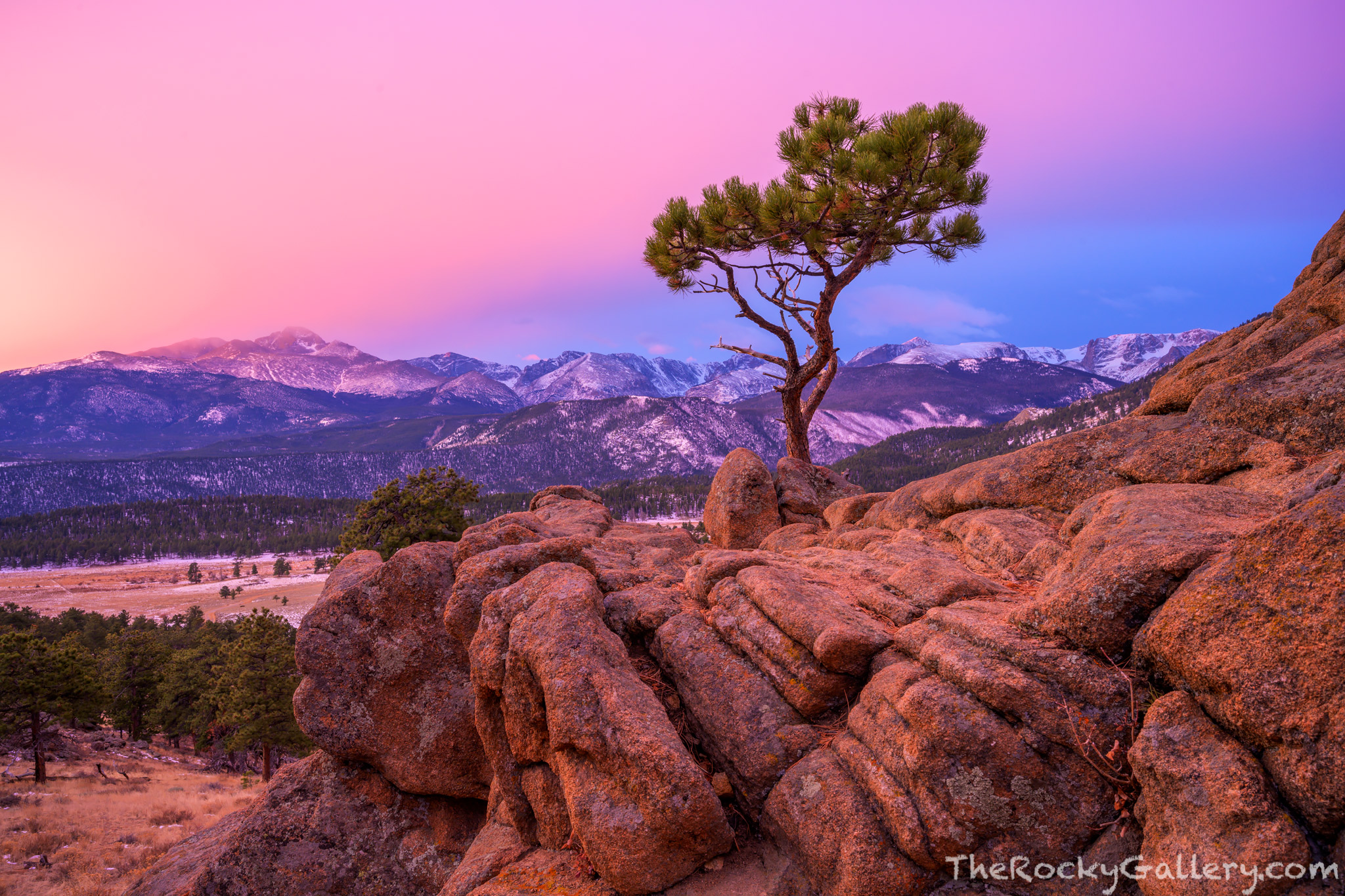
Before the arrival of another large early season snowstorm to Rocky Mountain National Park, I was able to capture this beautiful sunrise from above Upper Beaver Meadows. My compositions here echo’s that of many of Lyman Bxybe’s copper etchings of Rocky Mountain National Park. It’s always interesting to see other artists influence in one’s photography as was the case yesterday. Technical Details: Nikon Z7, Nikkor 14-30mm F4 S lens

With another large November snowstorm about to descend on the Front Range of Colorado, I took a run up to Rocky yesterday morning. Based on the weather forecast, cloud cover and timing of the storm it looked like we might have some nice light at sunrise before the weather started changing over RMNP.

As I’ve stated many times, the lighting in Rocky Mountain National Park can be simply stunning in November when sunrise or sunsets cooperate. While the lighting can be amazing this time of year in Rocky Mountain National Park for photographers, there are still challenges when photographing this time of year.

The biggest challenge is accessibility. Trail Ridge Road is closed at Many Parks Curve on the east side of Rocky and the Colorado River Trailhead on the west side. Old Fall River Road is closed at the Alluvial Fan, Wild Basin is open a short distance from the entrance station to the winter parking lot. Bear Lake Road will stay open to the Bear Lake Parking lot though the road may be snow packed and icy, especially after recent storms.

While Bear Lake Road will stay open, many of Rocky’s classic landscapes in and around Bear Lake, Dream Lake, Glacier Gorge etc., are not lit very well during the shortest days of the season. Most of the peaks in the Bear Lake/Glacier Gorge area orient facing northeast. Combine this with towering mountains and valley’s and the lighting can be tough this time of year in this area of the park (contrary to the summer months when the sun is farther north and the lighting is amazing).

This leaves the Mummy Range, Moraine Park and Upper Beaver Meadows as the most accessible areas in Rocky in the winter with the best light for photography. This is a fairly small geographic area so if your not creative you can quickly run out of new or different locations to photograph.

As somebody who has been photographing Rocky Mountain National Park for well over twenty years now, I’ve had plenty of opportunities to photograph these areas so its always a challenge for me and my personal portfolio to find new locations and compositions. Of course, weather, lighting and conditions are never the same twice so it’s less difficult than I’m making it sound.

I ended up settling on a composition that is very close to a popular pull out along US 36 that has a commanding view of the continental divide and many of the prominent peaks in Rocky. I’ve seen many others photograph from this location as I have, but I’ve never incorporated this tree into the image (as others have).

While watching this colorful sunrise unfold in front of me, I couldn’t help but thinks how much the image in the viewfinder reminded me of many of the Lyman Byxbe copper plate etchings of Rocky Mountain National Park made famous in wall art and postcards.

Lyman Byxbe spent many years in his Estes Park studios creating beautiful copper etchings of what are some of the parks most iconic scenes. In fact, I would argue that Lyman Byxbe pioneered many of the compositions that photographers such as myself end up emulating today.

Often found in Lyman Byxbe’s beautiful copper etchings is the use of tree’s to add depth to a landscape presented on a two dimensional medium. Like myself, it’s obvious that Mr. Byxbe was fond of the beautiful and unique trees found in Rocky Mountain National Park and sought them out in his art.

Like a lot of artists, Lyman Byxbe’s work does not receive the credit and acclaim it probably should. In recent years with the ever growing popularity of Rocky Mountain National Park, Byxbe’s work has become more sought after and appreciated. I know I certainly feel his influence in my work often as was the case yesterday morning.

There are a few books available through third parties that chronicle Lyman Byxbe’s work but other than those books, his work is available for viewing throughout various pages on the internet. I would highly recommend anybody interested in viewing one of Rocky Mountain National Park’s most interesting artist when it comes to the landscape to use a search engine and search for Byxbe’s work. If you have not taken the time to do so I think you will really appreciate his love for the landscapes of Rocky Mountain National Park.

A Few Days At Bosque del Apache

I just returned from a short trip to Bosque del Apache located in south central New Mexico. The purpose of the trip was to photograph sandhill cranes on the refuge as well as any other subjects or landscapes that presented themselves. Overall it was a short but productive trip and I will certainly be heading back down in future years. Technical Details: Nikon D500, Nikkor 200-500mm F5.6 AF-S VR lens

As most of you who follow my blog or photography know, easily eighty percent of my photography takes place in Rocky Mountain National Park. While I love photographing in Rocky, just like every other photographer I enjoy getting out and spending time in the field in different and new locations when possible.

Earlier in the week, I made eight hour drive down to Bosque del Apache National Wildlife Refuge near Socorro, NM. The point of the trip down to Bosque was to photograph the sandhill crane migration along with large flocks of snow Geese that also congregate there this time of year.

While the sandhill cranes are certainly the main attraction at Bosque del Apache, the large flocks of snow geese that arrive on the refuge are equally compelling to photograph. Photographing ‘blast off’ in the morning is an experience every photographer should have. Technical Details: Nikon D500, Nikkor 500mm F4 AF-S VR lens

Primarily, I would consider myself a landscape photographer. That being said, I enjoy photographing wildlife when the opportunity presents itself and find both birding and avian photograph fun as well as very challenging. Visiting Bosque del Apache would allow me to really practice my birds in flight photography and get me plenty of opportunities to photograph beautiful sandhill cranes as well as snow geese. On top of these two birds, photographing an iconic southwestern bird like a roadrunner would be nice to stumble upon.

From November through mid winter, Bosque del Apache plays host to a large groups of migrating Rocky Mountain Sandhill Cranes. These sandhill cranes spend their days in the various fields around the refuge, eating grain in the fields that the refuge manages as they head south along the Rio Grande river.

How can one make a trip down to New Mexico and not get a photograph of the iconic roadrunner?. These birds are common birds at Bosque del Apache but they dont sit still and pose for very long. Technical Details: Nikon D500, Nikkor 200-500mm F5.6 AF-S VR lens

This makes Bosque del Apache one of the premier locations in the United States in which to photograph sandhill cranes as well as snow geese. Having the beautiful New Mexico desert and mountains as a backdrop for these birds is what really sets it apart from many other locations that the sandhill cranes frequent in different migration corridors.

As an opportunist when it comes to photography, Bosque del Apache was more than I could have hoped for. The avian action was great. Plenty of opportunities in the day and half I spent at the refuge to photograph sandhill cranes, snow geese and even a roadrunner. One beautiful sunset and a jaw dropping sunrise allowed for some great landscape opportunities as well.

On top of photographing the wildlife at Bosque del Apache, landscapes are always my primary focus of any trip. Bosque location on the northern tip of the Chihuahuan Desert makes it a special place, especially when the lighting cooperates. This mornings sunrise at the refuge was absolutely spectacular. Technical Details: Nikon Z7, Nikkor 24-70mm F4 S lens

I certainly see myself returning to Bosque del Apache in the future as well. The landscapes and action were great and frankly, its one of the best locations to photograph in mid to late November when the fall color opportunities have dried up and many locations begin to see their first good snows of the season. The trick here is to hone your birds in flight skills and keep an open mind on what subjects you will photograph. As always, the lighting should dictate your subject and Bosque del Apache will give you plenty of both.

Weather Whipsaw

So far this autumn there seems to be only two speeds when it comes to the weather on the Front Range of Colorado and Rocky Mountain National Park. It’s either beautiful or snowy and cold. This weather whipsaw is creating great opportunities for landscape photographers. Yesterday, I greeted Monday morning with cold temps and fresh snow in Rocky. With the fast moving storm moving out right out sunrise, Notchtop, Knobtop, Gabeltop and the Little Matterhorn caught some nice light with the landscape covered in fresh snow. Technical Details: Nikon Z7, Nikkor 70-200mm F4 AF-S VR lens

Can you think of a better way to start a Monday morning than to find a few inches of fresh snow falling?. Most would probably pass on starting their week this way but I’m certainly happy to take it.

In what’s become a Jekyll and Hyde autumn in Rocky Mountain National Park it’s only become par for the course to expect either a beautiful warm day, or very cold temperatures and snow. We seem to be lacking when it comes to the transition of the season from autumn to winter.

It’s not unusual to being seeing snow this time of year in Rocky Mountain National Park and already this fall we’ve had as I count them, four good snowfalls in Rocky with another decent one in late August that covered the high peaks above 12,000 ft. Whipsaw like weather here on the Front Range of Colorado is nothing new, but while it creates headaches from commuters and travelers, it makes for great opportunities for landscape photographers.

One of my most common requests from workshop and photography tour clients is to capture Christmas card like scenes in Rocky after a fresh snow. Most visitors and photographers to Rocky Mountain National Park assume it’s quite easy to capture postcard scenes of Rocky draped in fresh snow.

As one who believes in both transparency and managing expectations, I spend a lot of time explaining to prospective clients that capturing winter scenes in RMNP is one of the harder things to do. As I’ve stated in past blog posts, winds, sun and either too much snow or too little snow often conspire to throw a wet blanket on photographers well laid plans to capture images of snow in Rocky Mountain National Park.

One other item I like to tell clients looking to photograph snowy scenes in Rocky is that the best times to do so are often fall and late spring. This is because fall and late spring are very transitional in Rocky. Not only do we often get unsettled weather during these periods, but access and overall conditions such as open water are better than the middle of winter.

So with this season off to a decent start as far as opportunities go for photographing snowy scenes in Rocky Mountain National Park, I was more than happy to wake up Monday morning to fresh snow on the ground with more falling.

The forecast called for clearing right around sunrise so it was as good a morning as any to get out and take my chances with the weather and clearing storm. So while we had weather in the 60’s and 70’s on Saturday and Sunday in the Boulder area, Monday morning greeted me with snow and a cold 11 degrees fahrenheit.

With that said, all I could think as I scraped the ice and snow off my truck before heading the 45 miles up the hill to Estes Park was ‘what a way to start the week’. Hopefully our pattern of whipsaw weather continues because as a landscape photographer, I’m certainly enjoying all the opportunity.

Freeze And Thaw

November is a transitional season in Rocky Mountain National Park. A mix of just about anytype of weather can lead to lots of opportunities for landscape photographers. It’s a quiet time in the park as the summer crowds have moved on. I photographed this image yesterday morning in Moraine Park. The Big Thompson River is partially frozen and the cycle of freeze and thaw will continue until winter really settles into RMNP. Technical Details: Nikon Z7, Nikkor 24-70mm F4 S lens

As I write this blog post, summer and autumn seem like long distance memories at this point. It was only a month ago that I was out enjoying our late season autumn color. Fall took it sweet time to arrive this year in Rocky Mountain National Park, but winter certainly wasn’t going to provide the same courtesy.

As of early November, Rocky Mountain National Park is already 3 good snow events into the middle of autumn. From a landscape photographers perspective, were more or less into the winter season. The snow is going to stay on the high peaks from now until June and the lakes will remained covered in ice through May,June and July depending on their elevations.

One can still find a few open pockets of water here and there and with a few warm days thrown in here and there, it may remain so for some of November. It’s an interesting time of year to photograph Rocky Mountain National Park. The crowds are gone and so are many of the photographers who make their appearances each fall for the fall colors and elk rut.

Even though much of the park is now frozen and or snow covered, I enjoy shooting in Rocky this time of year. Sunrises and sunsets can be amazing this time of year. In fact the quality of light with the low sun angle is spectacular. Get the right conditions and you may be able to photograph one of the most colorful sunrises or sunsets all year.

November is also a great time of year to capture winter landscapes. The caveat with photographing winter scenes in Rocky is always the timing. On account of the winds and sun, the snow wont hang around very long on the pine trees, or ice covered surfaces of the lakes. One needs a little bit of luck regarding the timing of the storm and what time it exits the area and brings in high winds on the backside of the front and sun which quickly melts snow even in the middle of winter.

Overall, November can be a very exciting time to photograph Rocky. You get a little bit of everything this time of year without the crowds found during the summer months. On top of that, sunrises and sunsets are some of the best and a well timed snowstorm is always a possibility as we move through the brown season into the winter season in RMNP.

Order And Chaos

They key to capturing intimate landscapes is being to make order out of chaos. It’s knowing what to exclude from a composition, not include. I photographed this particular composition above the Roaring River this fall in RMNP. The colors of the aspens along with the forest floor was striking. Finding a way to make a compelling composition that was not too busy was more difficult. Technical Details: Nikon Z7, Nikkor 24-70mm F4 S lens

Making order out of chaos. That’s one of our primary jobs as landscape photographers. I preach to students on my photography tours that photography is not about what to include in a particular scene, but what not to include. Landscape photography is more about exclusion of objects and landmarks than it is about inclusion.

What I often see from clients out on a photography tour with me in Rocky Mountain National Park is a desire to capture what are large expansive vistas. They are beautiful to behold and frankly can be overwhelming to many photographers who are not accustomed to Rocky Mountain National Park high peaks and ridgelines.

Students first instincts are to pull out their wide angle lens, rack it back to 11,14 or 16mm and make an attempt to get all the landscape they can into the frame. The problem with this approach is that the beauty of the subject they are trying to convey quickly gets lost in the vast sweeping landscape. While a wide angle lens helps to include all the scenery and landscape they are photographing into the frame, the subject is lost as is the intent of photographer.

If I’m photographing the same scene alongside my students, they are often surprised to find me photographing with my vanilla 24-70mm lens or 70-200mm lens. Often they want to know how ‘I’m fitting all that in’ with telephoto lens. I’ll show students what I’m photographing, how I’m isolating the subject, removing distracting elements from the edges of the frame and attempting to convey my subject through the use of exclusion and isolation. For many clients this is an epiphany, they quickly go to their camera bag and grab one of their plain vanilla lenses that they use ‘back home’ and begin to craft a composition as opposed to relying on the physics of a wide angle lens to create an effect.

This image posted above and photographed this fall in Rocky Mountain National Park is a good example of making order out of chaos in a landscape. I was out with clients photographing one of the well visited waterfalls in the park. We had spent a good amount of time making beautiful images of this location and were about to move on.

Out of the corner of my eye, I spied some beautiful red and orange color on the floor of the forest. There were golden aspen trees above and I climbed a ridge to get a better look at this scene. I spent quite a bit of time with my client working on compositions and discussing the importance of making order out of chaos with this scene. The colors, the trees, this small piece of real estate in the vast expanse of Rocky Mountain National Park was calling out to be photographed, it was just a matter of figuring out how.

I tell my clients all the time that scenes like these speak to me much more than a grand landscape does. They are much more personal and cerebral. It’s very unlikely that another photographer will duplicate this scene and frankly it may be years before the undergrowth and tree canopy look like this again.

I could walk by this particular scene a million times and never find a composition. This time there was just enough order amongst the chaos to make it work.