I Thought It Was Supposed To Snow?

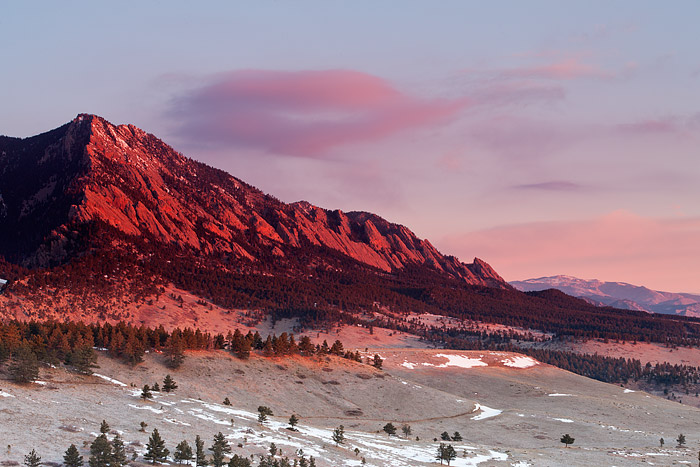
The Flatirons of Boulder, Colorado light up at Sunrise
When I headed out this morning, I had visions of the Flatirons covered in fresh snow, or at least that's what the weather report said would happen. When it became obvious to me that there was not going to be any snow on the Flatirons this morning I nearly turned my vehicle around and headed back home. Being in the field is the most important thing any photographer can do. If your not out with your camera, you wont be expressing your vision and passion. Even though this was not the image I intended to capture, the clouds and light more than made up for the lack of snow. Technical Details: Canon EOS 1Ds III, 70-200mm F2.8 IS L II
Or so the weather report said the night before. I was expecting two to four inches of fresh snow on Friday morning. I woke up Friday morning per my usual routine, hit the gym and walked the dog. Those who know me well, know I’m a hardcore morning person (and think I’m nuts). I get up and start my day every morning around 2:30 AM. It work’s well with my photography routine and it allows me to accomplish quite a bit before most people are even awake.

In my town of Erie, east of Boulder we had a light dusting of snow. Not the two to four inches I was expecting, but enough to coat the ground and make things interesting. Erie which is 12 miles east of Boulder will typically get a little less snow then Boulder proper so I figured the area around the Flatirons and the foothills west of town probably had a bit more snow. Not the amount of snow the weather people promised, but enough to get the adrenaline pumping thinking about the possibilities.

Heading east into Boulder it didn’t take very long for my hopes of seeing the Flatirons covered in fresh snow to be dashed. By the time I drove into Lafayette, there was literally no snow cover remaining on the ground. After some choice words directed towards the weather folks from the confines of my vehicle I continued on into Boulder. There’s a real temptation to visualize how you want a particular scene to look before you photograph it. Sometimes that works well for the photographer and sometimes it is to their detriment.

Disappointment can make you veer from your intended course. My first reaction was to turn my car around and head back home. What was the point I thought to myself?, no snow, probably no clouds. Sure the hike in would be nice but so would a nice cup of coffee back home. Early on in my photography career I would often succumb to this line of thought. While I’ve always considered myself motivated, it was an easy trap to fall into. I’ve slept through many beautiful sunrises or not been in the right location to photograph a beautiful image because I delayed and made excused to be out in the field. I just figured I’d go out another day with better conditions, etc. I’ve learned to ignore this voice in my head and forge ahead with the plans. Being flexible and adapting to the conditions is important, but I’ve learned getting out into the field regardless of what you perceive the end result to be is the most important action I can take as a photographer.

Crown On Ice

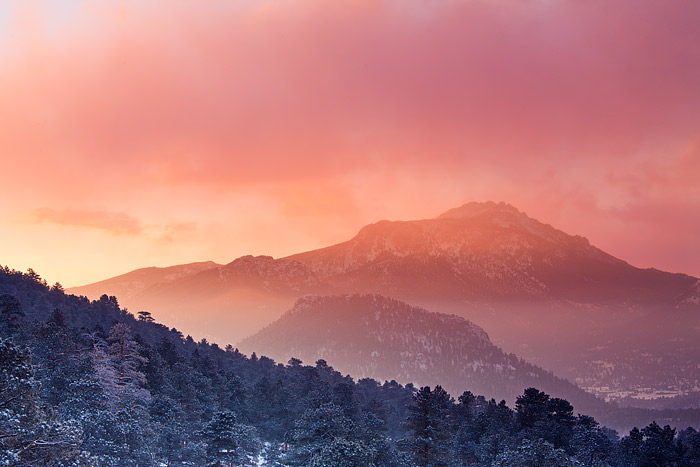
Frosted Ponderosa's along the flanks of Crown Rock
It was the last image I photographed this day and an image I almost did not make. Boulder's Crown Rock formation contrasts against the frosted pines along it's steep hillside. Technicial Details: Canon 5D Mark II, 70-200mm F2.8 L
It might be a little too early on a Monday morning to be thinking about having that kind of Crown on ice, but its not too early for this view of Boulder’s Crown Rock and frosted pines from last week’s storm. Crown Rock is a popular destination for Boulder’s famous rock climbing crowd. It’s located roughly 2 miles up Flagstaff Mountain and offers stunning views of Chautauqua Park and downtown Boulder. The rock formations around Crown Rock have a distinct reddish hue.

I’ve hiked by Crown Rock many times looking for an opportunity to photograph the formation and distinctive red rock’s but have never found anything compelling enough to even get the camera out of my bag. This day I very nearly missed out on this image. I was photographing the frosted hillsides above Crown Rock essentially oblivious to beauty of the frosted Ponderosa’s contrasting against the formations red rock’s. I was wrapping up and put my equipment away when I pointed the viewfinder downhill towards Crown Rock. I had done this in order to make it easier to detach my camera and lens from my tripod and I caught just enough of a glimpse of this scene through my viewfinder to stop myself in my tracks and spend some time working on this composition. Just another day in the field with dynamic conditions and a little bit of luck on my side.

Rocky Mountain Cotton Candy

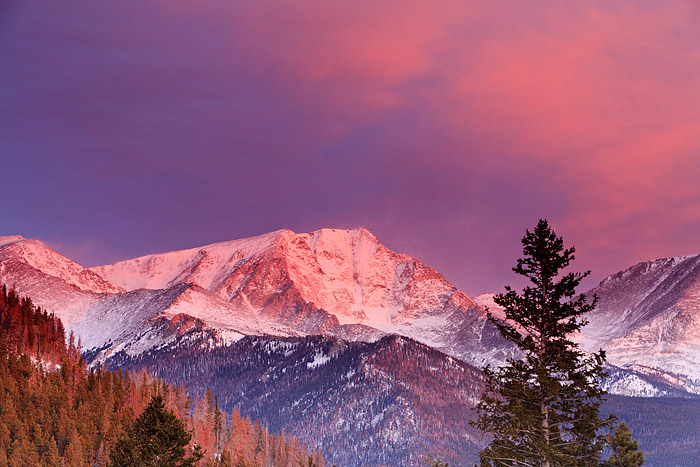
Sunrise light engulfs Hallet Peak in a pink hue in Rocky Mountain National Park
The first ray's of light illuminate Hallet Peak and a shrouded Mt. Otis in Rocky Mountain National Park. The wind sculpted clouds and pink hue gave the appearance of a cotton candy machine wrapping over the peaks this morning. Technical Details: Canon EOS 1dsIII, 70-200mm F2.8 IS II
One of the reasons I love photographing in Rocky Mountain National Park, is that each trip to the park is unlike any previous visit. I never tire of photographing Rocky Mountain National Park because I always feel like I’m coming away with new images, even if its from locations I’ve photographed many times before. The weather, the wind and the light are always a little different each time I go to Rocky enabling endless photographic possibilities.

I was expecting there to be some fresh snow on Saturday morning as I drove up to Rocky early in the morning. As I headed through Pinewood Springs, I encountered a light dusting of snow on the roads as well as coating the trees. Things were looking favorable for some nice winter conditions, with one exception. The sky was clear and the stars where bright and shining in the calico sky. When I left Erie, there was fog and clouds, but by the time I gained some elevation west of Pinewood Springs, the clouds and fogged cleared.

Dropping down into the Estes Valley all looked clear. Longs Peak was cloud free as was the Mummy Range. Entering Rocky Mountain National Park and heading over Bear Lake road through Moraine Park, I saw what looked like a hint of clouds over Hallet Peak and Otis Peak. Just enough of the cloud cover from the previous nights storm wrapped over Hallet Peak and the Glacier Gorge area. The wind was picking up so I opted not to head up to Dream Lake to be blown across it’s icy surface and toyed with by the wind. Instead I hightailed it over to the Bierstadt Lake trail, slapped on my Yak Trax and hiked up to the top of the Bierstadt Moraine for the view of Otis and Hallet Peak. The first rays of the morning illuminated Hallet and Otis in a beautiful pink hue. Wind’s wrapped the clouds over and around Hallet and Otis making the trek to the top of Moraine the place to be to view the show.

Hanging Out With The Twin Sisters

Cold air filters through the Estes Valley and around the Twin Sisters
Cold and snow below Estes Park and Rocky Mountain National Park lead to a beautiful sunrise over the Twin Sisters formation. Cold air can be seen filtering up the valley and the sun peaks through the upslope clouds below making for some dramatic light. Technicial Details: Canon EOS 1dsIII, 70-200mm F4 IS L
Winter, albeit a little late seems to be settling into the Front Range and Rocky Mountain National Park. Arctic air that has been staying north in Canada most of the winter, finally found a way to filter down to the Front Range. Most of the arctic air mass settled east of Colorado, but some of it still managed to back into the eastern half of Colorado this weekend and drop the temperatures. The cold air, combined with some light snow made for some pretty dramatic atmospheric conditions in Rocky.

Many times it seems like you are either dealing with clear blue skies at sunrise in Rocky, or beautiful lenticular wave clouds combined with constant 60 mph winds. This particular morning in Rocky Mountain was neither. It was a manageable 16 degrees with almost no wind. Even better, there were lots of clouds swirling over the peaks. So many clouds, that many of the prominent peaks such as Longs Peak, Mt. Meeker and Hallet Peak were engulfed by the clouds. The Twin Sister’s however, were still in view.

Below Estes Park, Ft. Collings, Loveland and Boulder were experiencing snow and single digit temperatures. The upslope storm created enough of an inversion this morning that it was not snowing in Estes Park and it was in fact warmer in Estes Park, then the Front Range towns at lower elevations. Cold foggy air filtered up through the Estes Valley as sunrise rose up out of the fog and snow below creating a short but colorful sunrise over the Twin Sisters formation.

Plan ‘B’, Forget The Mountains!

Sawhill Ponds Sunrise, Boulder, Colorado
The Sun breaks the horizon of the Eastern Plains of Colorado on onto a cold and frozen Sawhill Pond. I was not planning on shooting this location this morning, but an unplowed parking lot left me scrambling for another location to photograph. Racing to beat the sunrise, I headed to the east side of Boulder and found both fog and hoar frost aplenty at Sawhill Ponds. Technical Details: Canon EOS 1Ds III, 16-36mm F 2.8 L II
It’s Colorado, so of course images of snow capped majestic peaks come to mind. I’ll be the first to admit that although a large portion of Colorado actually is found on the High Plains, it’s harder to start your photographic adventures heading east, than west. That’s just how my morning started after the Boulder area received 20 plus inches of snow from a rare February blizzard. My intention was to head over to one of the Open Space trailheads south of Boulder, snowshoe into a particular location and photograph the Flatirons formation covered in fresh snow.

My morning itinerary quickly went awry. At 6:00 AM it’s very much still night time driving conditions and visibility is limited and it’s still very much dark. As I was turning off Highway 93 and into the Flatirons Vista trailhead, the unplowed lot and 4 ft wall of snow in front of the trailhead entrance quickly altered my plan. With no place to park and sunrise approaching rapidly, I’d have to come up with a plan ‘B’ quickly. I turned around and headed north back towards Boulder.

I didn’t have a back up plan this morning. I figured the trailhead entrance would be plowed and other than getting a good workout snowshoeing in the deep snow, I’d be photographing the Flatirons. The easy option would have been to head over to Chautauqua Park and photograph sunrise from the meadow. I’ve done that plenty of times before and I’m sure there were lot’s of other photographers who would have that location covered just fine. As I drove north past one of the reservoirs outside of Boulder, I caught the first hint of an orange sunrise reflecting off the partially frozen surface of the water. The light bulb went off and now it was a race to find some water.

I figured Sawhill Pond’s on the east side of Boulder might present some opportunities for open water while at the same time allowing me to get into position before sunrise. I arrived at Sawhill Pond’s to find that fog was now forming over the Pond’s. Thing’s were looking more promising by the minute. Sawhill Pond is located in a low spot between Lookout Ridge to the north and Valmont Butte to the south. This was the only area within miles that had any fog forming. The fresh snow, hoar frost and fog made for a very dynamic conditions at sunrise. I only had a few minutes to get into position but my plan ‘B’ paid off. Hopefully after the next big snow the trailhead parking lot get’s plowed, but I’ll make sure I have a better back up plan the next time in case it’s not.

Winter Sunrise Over The Mummy Range

Mummy Range Winter Sunrise over Rocky Mountain National Park
A light dusting of snow covers the Mummy Range and Mt. Yipsilon in Rocky Mountain National Park. It was another windy morning in Rocky, but these winds have been helping to create some great clouds in the sky to add drama to the image. It's a catch-22 for sure, keeping your camera still in the high winds can be a challenge in itself. Technical Details: Canon EOS 1dsIII, 70-200mm F2.8 IS L II
Colorado’s sunrises are legendary for their beauty. Open vista’s and open skies can lead to some very dramatic sunrises for sure. The Winter months tend to be most productive when it comes to dramatic sunrises. This is mostly due to the down sloping winds that help form the clouds above the peaks of the Front Range and east side of Rocky Mountain National Park. As a photographer this is both a blessing and a curse. We get dramatic sunrise with colorful skies and snow peaks. We also get to be human flagpoles attempting to stand in the wind with our camera gear in order to capture the shot. I’m certainly not complaining and with the colorful skies we’ve been having you certainly find my volunteering for human flagpole duties in the future.

Wish You Were Here?

Windy Sunrise on 14,255 ft Longs Peak in Rocky Mountain National Park
High winds rake across the summit of 14,255 ft Longs Peak in Rocky Mountain National Park as evidenced by the wave clouds rounding over the Diamond and aptly named Keyboard of the Winds. The beautiful sunrise mask the harshness of the condtions this morning as well as the difficulty in capturing an image in the high winds. Technical Details: Canon EOS 1Ds III, 70-200mm f2.8 L IS II
A good photographer looks to use their imagery to convey a sense of place and time of the location they are photographing. It’s a two way street with landscape photography. Sometimes harsh, raw conditions are glamorized. Sometimes, if were not doing a good job conveying our message and vision we may not impress upon the viewer the essence of the location and our experience at that particular point in time regardless of how beautiful the scene or the light are.

This particular morning in Rocky Mountain National Park was brutal to put it nicely. A strong Pacific storm was moving into the Colorado mountains and over the Park from the west. Of course as is the case when these storms move in, relentless high winds grate the peaks of Rocky Mountain National Park. Estes Park was clocking winds of 45 mph, but the gusts on 14,255 ft Longs Peak this morning were over 80 mph. I’d hate to even imagine being on that high rock this particular morning. The sunrise was beautiful with the soft magenta light bathing the peaks as waves of blowing snow moved across the range.

From a pull out on Trail Ridge Road, I was able to position my vehicle in a manner that acted as a slight break from the wind. I setup my tripod and did all I could to keep my camera in place and steady. I tried to shoot when the wind would subside, but the maddening thing about the wind in Colorado is just when you think a break is coming, the wind blow’s even harder as if to taunt you. Many of my images from this morning show motion blur and wont be useable. Luckily for me, I have a few frames where I managed to escape the winds wrath and come away with a sharp, in focus image of this spectacular, but windy morning.

Winter Loner

Snow falling on Bobolink Cottonwood
A lone Cottonwood tree gets coated in fresh snow along OSMP's Bobolink trailhead. The monochromatic look of the lone Cottonwood in snow made for a great winter subject. Technicial Details: Canon 5D Mark II, 70-200mm F2.8 L
The snow has been sparse in much of Colorado’s high country this year. Not good news for Colorado’s Ski industry and the lack of snow may also hurt the wildflower season come Summertime. There is still plenty of time for the high country to make up for the lack of snow, so we should collectively keep our fingers crossed and hope the weather pattern changes.

The Front Range however, is actually above average as far as snowfall goes. We’ve avoided large dumps of snow and blizzards, but we gotten some consistently good snows up here in the Boulder area. On average, we’ve been getting about one good snowfall a week. Front Range snow’s tend not to linger for very long. Quick moving storms on the Front Range drop their snow and move east across the Plains. The Sun then does it’s trick and the snow begins to melt of rapidly. Oftentimes, you have a short window to photograph fresh powder.

Last week we had another quick moving storm. The meadow along Boulder Open Space and Mountain Park’s Bobolink trailhead has always been a great place to photograph Cottonwood trees along the riparian habitat of Bobolink. The colored grasses and lone Cottonwood in the meadow makes for a great subject with the snow coating the ground and fog moving through the trees.

Ode To An Elm Tree

Sunrise Over The Boulder Flatirons from Doudy Draw
A great sunrise illuminates over the Flatirons of Boulder, Colorado. Winter skies over Colorado's Front Range can bring some impressive color. Combining these colors with an image of a lone Ponderosa Pine tree goes hand and hand for me and my photography. I've had a long running obsession with both photography, and imagery of tree's. Technical Details: Canon Eos 1DsIII, 24mm TS-E F3.5 II L
My never ending obsession with capturing images of tree’s continues onward. I cant exactly tell you why I enjoy photographing the shapes, forms and textures associated with trees, but it’s a never ending quest for me. In fact, my first ever published photo in my High Schools arts publication the ‘Soupstone’ was of a very large American Elm tree that resided in my front yard. This Elm tree was a giant and was located right in the center of my front yard, just 30 yards or so from my bedroom window. The tree framed my bedroom view looking west over the Hudson Valley of New York, a place where I spent many hours of my childhood staring out my window into the world. Other than the fall, when my brother and me would be tasked to rake the Elm’s tree’s leaves for weekends at a time, I held great respect for this tree. The coarse, cork like texture of the bark, the way the trunk split into two large distinct sections, or the way Winter winds howled through the swaying leafless grey branches at sunset all left very distinct memories for me.

The photograph, I had taken that day in 1990 of this tree with my Dad’s 35mm Minolta 5000i and 35-70mm lens still follows a formula I use today when photographing trees. With Kodak Tri-X black and white film loaded in the camera, I laid down at the base of the tree, opened the zoom lens as wide as it could go to 35mm, and photographed the trunk of the Elm tree rising straight towards the sky, it’s branches moving outward’s from the two distinct sections of the tree. There was something about the synergy of all those branches moving and spiraling outward, and the massive trunk of anchoring the branches that garnered my attention. Again, I had spent many days admiring this tree, but this was one of my first steps in successfully using photography to convey the feeling and reverence I had for this tree.

The recognition of this by my High School photography teacher, the publishing of the photo helped to light an insatiable desire to continue to document and photograph tree’s. Today those tree’s are much more likely to be Ponderosa Pines, Cottonwood’s or Aspen tree’s as opposed to American Elm’s, but the desire to photograph tree’s is still just as strong now as it was that day I wandered out in my front yard with Dad’s camera.

Move Over 2011 A Busy 2012 Ahead

Ponderosa's and Evergreens in fresh snow on Shanahan Ridge
Ponderosa's and Evergreens are buried beneath a fresh dump of snow on Boulder Shanahan Ridge. I plan on spending more time photographing scenes like this one in 2012. Boulder's Open Space and Mountain Park's properties are ripe with potential. Technicial Details: Canon Eos 1Ds III, 16-35mm F2.8 L II
2011 is almost over. It’s been an exciting and eventful year for me for sure. Lot’s of great days spent in the field creating new images, new locations visited and a list that continues to grow longer of new locations I would like to photograph. While I always like to reflect on the past year, I typically find myself eagerly awaiting a new year with new challenges and adventures. I don’t typically make new year’s resolutions. Some would argue that resolutions area really just excuses to delay actual goals. Regardless, making resolutions to begin a new year is not something I typically do. I do however use this time of year to reset the compass so to speak. It’s a good time for me to embark on a new path and to set a ‘to do list’ of items that apply to my photographic aspirations for the year. Below I’ve listed some of the things I would like to accomplish and focus my photography on in 2012.

1. Continue to refine my personal style: This is by far my most important goal for 2012. Every year this is one of my most important goals on my list and I cant stress enough how important to me this goal continues to be. Each day the internet is full of exceptional imagery of iconic locations from heavily travelled and photographed viewpoints. While I enjoy this imagery, I want my work to have a more personal feel that represents my vision in a unique, maturing, and artistic manner. There is a lot of great landscape photography out there and differentiating my work from the masses is very important to me.

2.Stay local, photograph local: I love to travel. The thought of being on the road for months, sleeping out of the back of my truck and traversing the country traveling to remote locals and National Park’s is something I dream about a few times each day. While someday this may be my goal for the year, I’ve found it to be much more rewarding and productive to photograph locations close to home. Rocky Mountain National Park and Boulder County Open Space property will continue to top the list of locations I plan to spend most of my field time in 2012. I find it very rewarding photographing local locations and staying local allows a greater appreciation and understanding of these areas close to home.

3.Less gear lust, more adventure and photography: This goes without saying. In 2011 I was fortunate enough to be able to update a good portion of my landscape photography kit. It’s not that I did not already have an adequate lineup, In fact I had more than what I needed to produce high quality imagery. Even so, I was able to update some of my older Canon lenses to more recent releases. These updated lenses wont improve my photographic vision one iota, but they do produce slightly better results than there older counterparts. The truth is there are many great photographers capturing images with basic camera’s and kits. It’s important to remember that a good carpenter never blames his tools for poor workmanship. Furthermore having to much gear or constantly lusting over gear gets it the way of the end product, creating imagery and art.

Well here’s to having a great 2012. There lots out there to do and photograph and I plan on taking the bull by the horns this year. It’s been a fun first year of blogging and I’ll keep updating as often as I can. Happy New Year to all, and a toast to success in 2012.