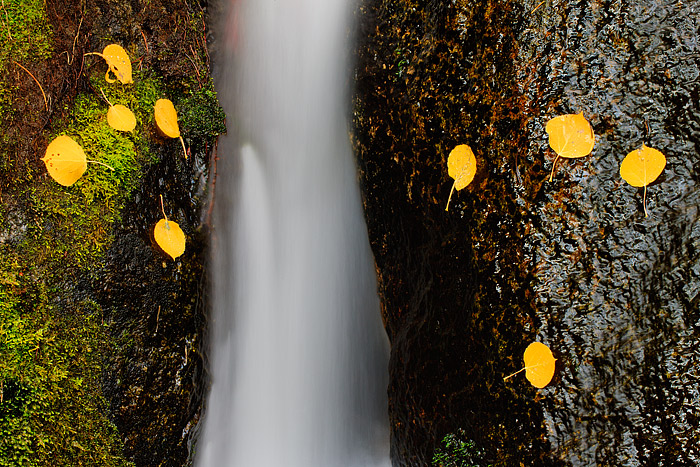
Fall color in Rocky Mountain National Park is looking great right now. If you want to photograph Rocky’s fall splendor this week would be the time to do so. One of my favorite areas for capturing fall color in Rocky is the Boulder Brook area. This beautiful stream runs right through a large aspen grove. There are endless compositions along Boulder Brook, and fall is one of the best times to explore the area. Technicial Details: Canon EOS 1Ds III, 100mm F2.8 IS L MacroThe fall color is moving very quickly along in Rocky Mountain National Park. I’m actually a bit surprised at how fast the color has progressed in the last week. It’s been warm, dry and unfortunately very hazy from smoke from fires in the Pacific Northwest.
The good news is that it looks like rain and cooler temperatures will be moving in early this week and that should not only make for some nice diffused lighting to photograph the fall color, but also clear out the smoke and haze that has been making photography challenging for the last few months.
As for the fall color, it’s looking very nice in Rocky Mountain National Park, but as I stated earlier, it seems to be peaking very quickly. Areas around Bear Lake are now past peak. Bierstadt Moraine is about 80% changed an looking nice. Even the Cottonwoods and Aspen tree’s in the Moraine Park and Horseshoe Park area are nearing peak. While there is still some green around and I expect there to be remnants of fall color in the park for the next two weeks or so, My advice would be to hit up Rocky now if your looking for color in the park.The area all around Boulder Brook is chock full of potential. I photographed this pair of aspen leaves on a dead aspen bole just a few yards from the stream. Technicial Details: Canon EOS 1Ds III, 100mm F2.8 L IS Macro
I took sometime the last 2 days to photograph around Boulder Brook. The aspens around Boulder Brook are also at peak right now and the stream, vibrant green moss, and leaves on the forest floor are all combining to make for some beautiful fall photography.
The Boulder Brook area is one of my favorite locations in all of Rocky Mountain National Park, and if your looking for fall color mixed in with a beautiful mountain stream, this is the spot. The entire Boulder Brook area has a very unique and lush feel to it. The stream flows between the aspen groves and boulders and there are endless compositions for photographers and artists.
Again, my advice is to get on up to Rocky now. The fall colors are pretty much at peak in most of the park, and the cloudy, overcast and rainy weather should make for very nice conditions the next few days.
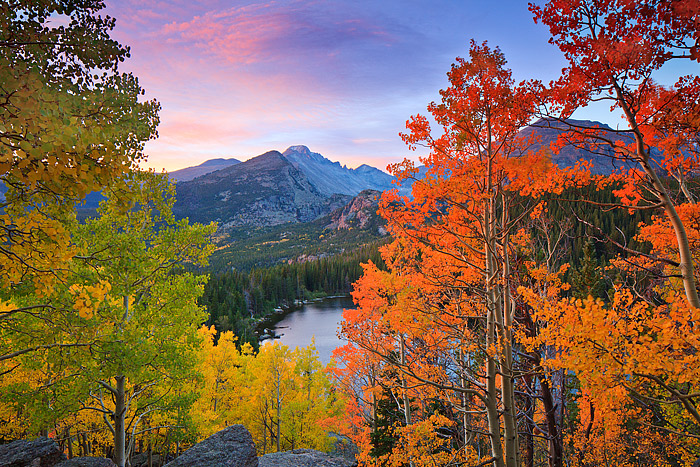
A gorgeous sunrise unfolds over Longs Peak and Bear Lake. The Aspen trees above Bear Lake are looking just about as good as can be right now. I photographed this view on Sunday morning. The Bear Lake area of Rocky Mountain National Park is at peak right now. There is plenty of good color to be found but I would expect this view and these trees to start dropping leaves this week. Technicial Details: Canon EOS 5D Mark II, 24mm TS-E f3.5 L IIQuick update here on the fall colors in Rocky Mountain National Park. At this point in time, the fall color appears to be peaking about a week early or so. The Bear Lake area is at peak, and if you want to photograph the colors around Bear Lake, now would be the time to do so.
Bierstadt Moraine still has a week or so to go and many of the lower areas of the park around Beaver Meadows and Moraine Park are still a good two weeks from peaking. All in all there are plenty of opportunities for fall color photography right now with the higher locations nearing peak.
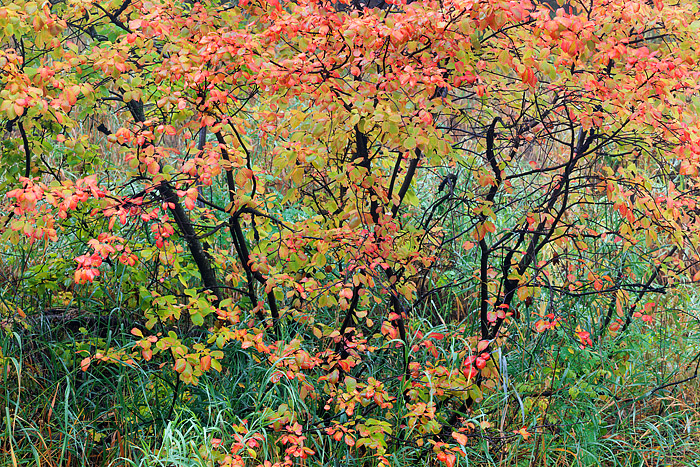
There’s plenty of fall color to be found in and around the foothills of Boulder right now. This Scrub Oak provided some beautiful reds and yellows against the still green grasses. Every year photographer worry that fall color will come to soon and they will miss the peak color. While I often get a chuckle out of the panic that ensues, and the fact that most years are fairly predictable, it does appear that fall color is settling in earlier this year than usual. Technicial Details: Canon EOS 5D Mark II, 70-200mm F2.8 LEvery autumn there are various reports by photographers online depicting an area or grove of trees somewhere that is ‘peaking early’. This of course puts every other photographer in a total panic that they are going to miss the peak fall color while at the same time ruining there plans and itinerary they most likely planned a year in advance.
While this happens every year, and certain trees and locations do from time to time peak earlier the typical years, on average the peak fall color in Colorado is quite predictable. I’d prefer not to be the person crying wolf, but from what I have seen so far, it does appear that our hot and dry weather is causing the leaves in many areas to turn earlier than usual.
I made a quick scouting trip up Gregory Canyon just west of Boulder a few days back and found quite a bit of fall color. There is still plenty to come, but I would say things appear to be at least a week ahead of our typical schedule. This mirrors what I’ve observed in Rocky Mountain National Park over the last few weeks.
Again, I’m in no way trying to be that guy causing a panic. I would just say it would be a good idea to stay open to the possibility that many areas may peak earlier than is typical in most years. My advice, get out in the field, explore and keep your options open. The possibilities for photography this time of year are endless.
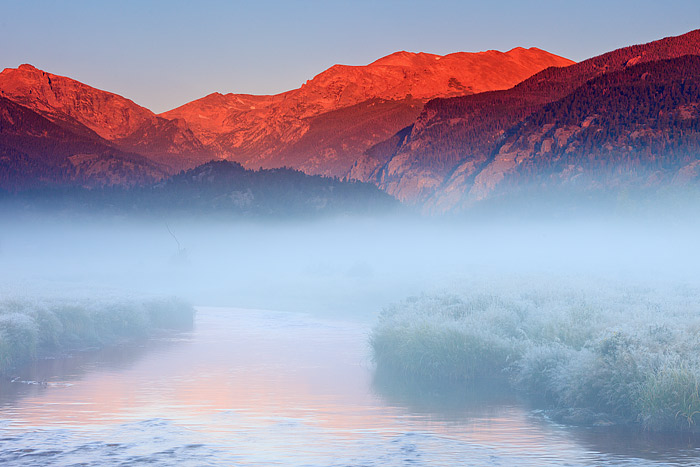
A spectacular day dawns along the Big Thompson river and Moraine Park in Rocky Mountain National Park. Rocky’s first heavy frost coats the grasses along the Big Thompson as the fog hangs in the valley. Stones Peak glows red with the first sunlight of the day. Technicial Details: Canon EOS 5D Mark II, 70-200mm F4 IS LFall is really starting to hit it’s stride in Rocky now. Aspen tree’s are turning gold all around the park, and we had our first heavy frost in Moraine Park on Saturday. Finally, that distinctive sound of Elk bugling through the meadows and valleys is a sure sign autumn has arrived in Rocky Mountain National Park.
Photography in the park can be overwhelming this time of year. Overwhelming in a good way of course. There is a ton of potential this time of year. Do you hike to a high alpine lake which is still unfrozen for sunrise?. Should I train my camera and lens on that grove of golden aspens?. Or should I hang around Horseshoe Park and Moraine Park looking for herds of Elk and photograph the rut?.
Some photographers excel in trying to capture all of the above subjects at the same time. Personally, I find it best to concentrate on one subject at a time. That’s not to say I wont attempt to photograph multiple subjects in Rocky on the same outings, I just find my style works best when I filter some of the background noise and set a destination.
I find it’s a good idea to have a starting point and goal when heading out in the field. That being said, I also like to have a ‘Plan B’ ready in case I have to alter plans due to lighting, location of clouds or weather. It’s also important for me to take advantage of unforeseen images or opportunities when in the field.
Saturday morning was clear and cool. I had planned to hike to Bluebird Lake in Wild Basin for sunrise but changed my plans on the way up to Rocky when it was apparent I had a zero percent change of getting any clouds at sunrise. I had passed through some low lying fog on the way up to Rocky so I figured I’d take a quick look at Moraine Park to see if any fog was hovering in the valley over the Big Thompson.
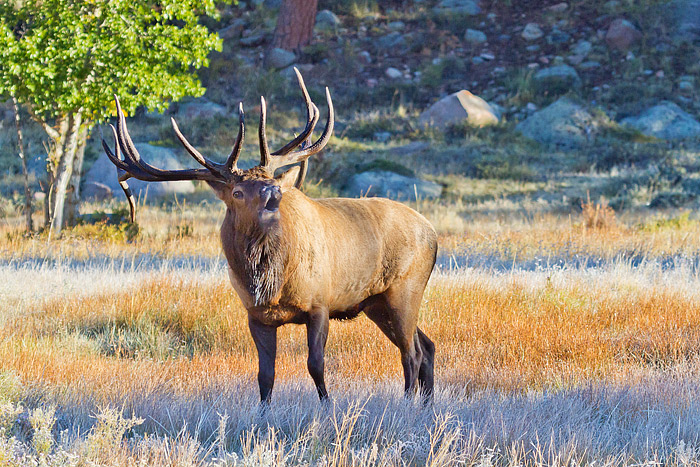
A beautiful Bull Elk bugles loudly as he collects his harem and wards off another approaching male. Frost coats the grasses in Moraine Park and fall is certainly in full swing. Technicial Details: Canon EOS 7D, 100-400mm F4.5-5.6 IS LCresting over the rise from Upper Beaver Meadows I was pleased to find some low lying fog hanging out Moraine Park along the river. Cars parked at the Cub Lake trailhead had a nice coat of frost on their windshields. A short hike out to a nice bend in the Big Thompson River and the elements started coming together. Skies were clear but the fog along the river would provide a nice element to the scene. Furthermore, it would cover up the many fences installed around Moraine Park to protect the foliage from the every hungry elk herds.
Heading back to the trailhead, I could hear Bull Elk bugling all around Moraine Park. This time of year I keep my Canon 7D and 100-400 IS lens with me in the front seat of my vehicle. I don’t consider myself a wildlife photographer per se, but opportunities to photograph the Elk rut can be plentiful on mornings like this so it’s a good idea to be prepared if the opportunity presents itself.
On my way out of Moraine Park I was lucky enough to come upon this beautiful Bull Elk and his harem. For a good twenty minutes or so I was able to photograph this Bull Elk bugling, herding and chasing other males from his harem. Finally they headed back into the cover and shade of the Ponderosa’s, and I headed home satisfied.
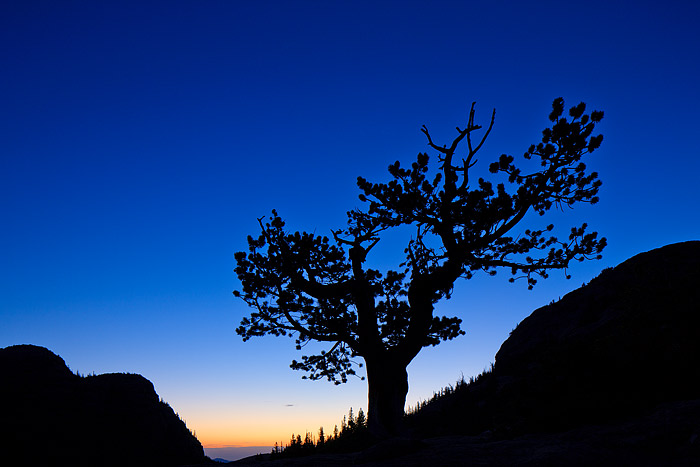
Blue Dawn in Glacier Gorge. Just prior to sunrise, this Krumholtz tree is silhouetted agains the deep blue sky and pre-dawn light. Technicial Details: Canon EOS 1Ds III, 24mm TS-E f3.5 III just finished up with a couple of very productive days in Rocky Mountain National Park. The seasons are definitely starting to collide and change and Rocky is very much moving from summer into autumn.
This is without question my favorite time to photograph Rocky Mountain National Park. For the most part, you still have all the lakes open and free of ice, but the aspen tree’s and underbrush are starting to change and the Elk are starting to rut presenting photographers with plenty of varied subjects to photograph.
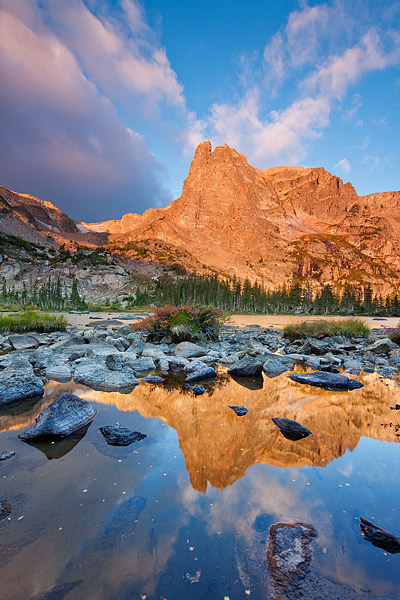
Lake Helene at sunrise.Yellow and red leaves from the underbrush float on the surface of Lake Helene in the forground. Technicial Details: Canon EOS 1Ds III, 17mm TS-E F4Photographing fall colors this week was not in my plans. While it’s not abnormal to see and aspen tree or two changing colors around Labor Day, I have to admit I was quite surprised to find as much color change as I did occurring on many of the hillsides.
I think for the most part, the typical third and fourth week of September will provide photographers with plenty of great opportunities to photograph fall color in Rocky Mountain National Park, but there are certainly going to be some good opportunities to capture fall color in the next week or so. Our dry summer appears be causing some of the stressed trees to turn golden earlier than usual.
My plan was to photograph Mills Lake and Lake Helene if conditions looked right. The clouds I was hoping for at Mills Lake never materialized, but everything fell into place at Lake Helene yesterday.
I’ll start transitioning over to some fall color photography here a bit sooner than I expected. In a nutshell, the Bierstadt Moraine has little to no change. The area around Bear Lake itself is spotty with some decent patches of color. Above Bear Lake it’s also spotty with some patches of decent color. So while there will be plenty of golden color to photograph in the next few weeks, one can certainly find some color in the park already.
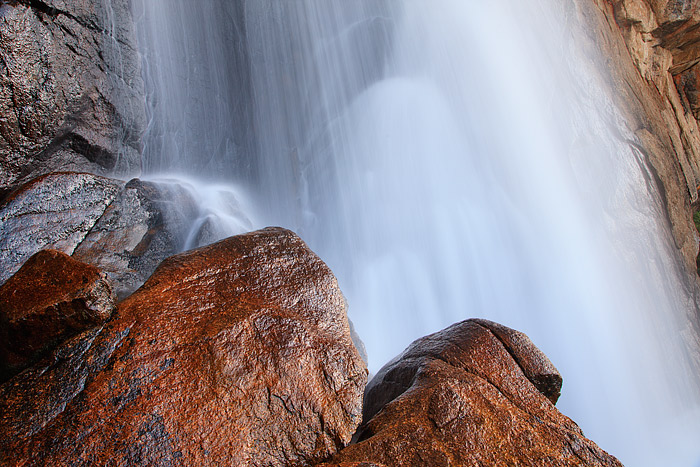
Water flows down over Ouzel Falls in Rocky Mountain National Park. The use of a polarizer allowed for the color to pop in the foreground rocks. I also spent a good deal of time experimenting with shutter speeds before I capture the right amount of flow and detail in the water of Ouzel Falls. Technicial Details: Canon EOS 1Ds III, 24-105mm F4 IS L, Circular Polorizer.Most photographers visit Rocky Mountain National Park hoping to come away with some spectacular shot of a sweeping mountain vista, or an iconic alpine lake with a perfect mirror reflection. While I feel you on that desire, sometimes weather, wind, or a line of other photographers with the same ideas may prevent one from capturing those idyllic scenes of Rocky.
Don’t fret however, when things aren’t working in your favor when it comes to photographing some of the more iconic spots like Dream Lake, or the Rock Cut there are plenty of other locations one can train their camera on.
Rocky Mountain National Park is filled with literally hundreds of waterfalls, cascades and bubbling brooks. These water features are ideal locations to photograph on windy days, cloudy or rainy mornings, or when you just want to get away from photographing the more iconic and crowded locations in Rocky. Here are a couple of quick tips for photographing waterfalls in Rocky Mountain National Park.
1. Typically you want to photograph water in either cloudy diffused light or prior to any direct sun hitting the waterfall or water feature. Diffused light allows for even lighting over the entire scene and prevents contrasty, harsh lighting that will blowout highlights or remove detail for darker areas. Your camera can only capture so many stops of light and dark, bright sun or direct lighting just makes this range more extreme. If you photograph water in Rocky Mountain National Park on a clear blue sky day prior to feature being illuminated by direct sun, expect to play with and tweak your white balance settings when processing your raw files.
2. Use a circular polarizer filter when photographing water features. Circular polarizing filters help to minimize both glare and reflections emanating from the scene. Use of a circular polarizer helps to keep the detail in both the rocks and foliage as well as to help tame bright spots present in the water. The circular polarizer will also help make colors pop by removing flare and reflection from the surfaces being photographed. Keep in mind circular polarizers require an additional two stops of exposure compensation. This can sometimes be a hindrance but it may also be a benefit as it will allow for longer exposures which create the dreamy motion effect on the water feature being photographed.
3. Experiment with both shutter speeds and ISO when photographing water. Your shutter speed will greatly affect how the motion of the water is captured. Every photographer has there own tolerances for how dreamy and silky than want the motion of the water to be represented in their final image. In general you want to capture the motion of the water while retaining some detail in the overall flow of water. Very long exposures not only create the dreamy look, but may create ‘hot spots’ of very white water that can cause a distraction to the overall image. Adjusting your camera’s ISO will help increase or decrease the shutter speed required and the correlating amount of motion capture in the water.
4.Work the scene and composition using both wide and telephoto compositions. Waterfalls and water features are great because there are literally hundreds of possibilities. Encompassing the waterfalls in the overall scene with a wide angle lens may result in an beautiful image, but using a telephoto lens to isolate and capture smaller areas of the waterfall will result in unique and original compositions as well.
5. Visit the water features and waterfalls at different points in the season. You would be surprised how different any given waterfall may look depending on the overall flow of water. Obviously the spring runoff will generate very large amounts of water flow through the feature. More pleasing compositions may actually open up as the flow of water subsides later in the season. Also, capturing waterfalls under a fresh snow, or first deep freeze will allow one to capture more unique images.
So the next time your photographing Rocky Mountain National Park and the weather or the wind is not cooperating at the more iconic locations, just get out your topo map and find some water to photograph.
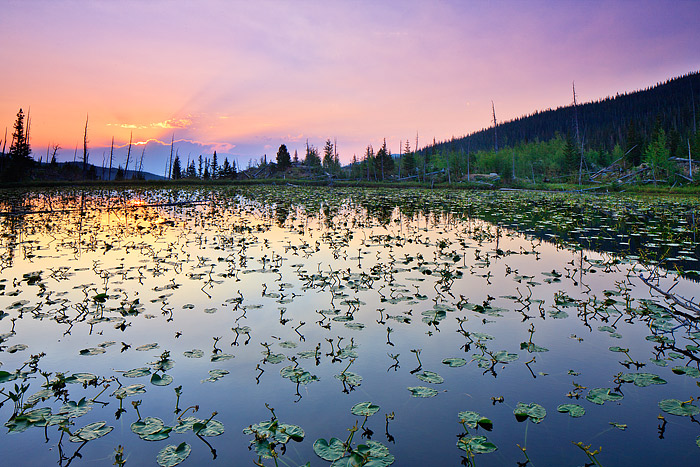
The sun begins to creep above a large thunderstorm over the eastern plains of Colorado. Particulates and smoke from the many wildfires out turns the sky over Chickadee Pond a magenta hue. Wild Basin contains some of Rocky Mountain National Park’s most beautiful locations. It takes some work to get Wild Basin’s many gems, and although the area is often overlooked by photographers, it contains some of Rocky’s most beautiful locations. Technicial Details: Canon EOS 1Ds III, 24mm TS-E F3.5 L IIThe Wild Basin area of Rocky Mountain National Park has it’s own unique feel and vibe. It’s less visited than other sections on the east side of the park, and many visitors to the park are likely to pass on through without exploring this area. I too am guilty at times of overlooking the Wild Basin area for some of the more familiar spots.
Not only does Wild Basin have a different feel with it’s many streams and water features, it makes you work to see much of its beauty. Roads into and around Wild Basin stop about 5 miles short of any of the lakes or impressive peaks located in the Wild Basin. This means your not going to see very much of Wild Basin from your car.
To get close to the divide and the impressive peaks such as Mt. Copeland, Ouzel Peak and Mt. Alice your going to have to hoof it. While most of the hiking is on the moderate side, distance is the biggest obstacle to photographing this locations.
Five, Six and Seven mile one-way hikes are the norm when exploring Wild Basin. With that in front of me, and knowing I’ve neglected this area, I set off for the Ouzel Lake area.
It was a cloudless morning departing the trailhead, but I had been watching a large thunderstorm flicker over the plains east of Ft. Collins on 2:30 AM drive up to Rocky. The plan was either to photograph from either Ouzel Lake or Chickadee Pond at sunrise. In my opinion, Chickadee Pond offers a better viewpoint of the divide and Ouzel Peak than Ouzel Lake does, so that was my primary destination.
Chickadee Pond also has a propensity of pond lilies that grow on its surface. In fact, I cant think of another body of water in Rocky Mountain National Park that is so densely packed with pond lilies. I figured if clouds did not build at sunrise and bluebird skies persisted, I could at least photograph the pond lilies.
Lastly, the wildfires that have plagued the west this year continue to make photography difficult in Rocky Mountain National Park. The smoke from these wildfires has settled into Colorado for the last 2 weeks, diffusing the early morning sunlight and taking the ‘pop’ from the early morning sun.
I arrived at Chickadee Pond and realized my best option was to photograph the sunrise off to the east. That large thunderstorm over the plains I had watched on my drive up to the park could still be seen from Chickadee Pond. In fact, the large thunderhead was blocking the rising sun while allowing for some nice coloration in the sky and clouds.
I setup my camera and began photographing the sun rising over the large thunderhead clouds off to the east. The smokey skies above Chickadee Pond also helped to add color at sunrise by adding a magenta like hue as the first rays filtered through the particulates in the sky. All in all, the combination of the thunderstorm and smoke in the sky made for an interesting morning deep within Wild Basin.
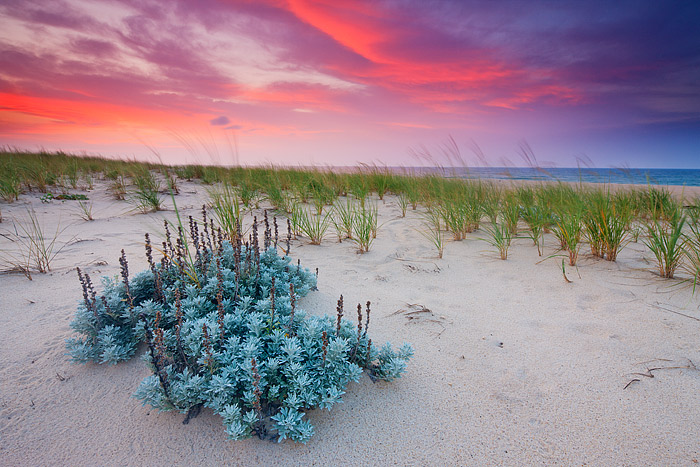
Small bitting bugs, sea spray, sand and high humidity, all the elements I dont typically deal with out here in Colorado. Regardless, I was able to capture this beautiful sunrise from Dune Beach in Southampton, New York. If your willing to get up early and head out to the beach, there is a good chance you the eastern end of Long Island will treat you to a sight such as this. Technicial Details: Canon EOS 1Ds III, 17mm TS-E F4Changing pace can be a good thing. Every once in awhile it’s nice to get out of your set routines, break from the mold a bit and photograph something different. I personally finds it helps the creative process to break from the familiar and get out into different environs.
I spend last week on a whirlwind tour of New York State visiting in-laws and relatives. The trip back east was more about visiting family and catching up with old friends then it was about photography. Of course, there was no way I was going to be able to keep my camera in the bag the entire time.
While spending the end of the week out on the east end of Long Island, I was able to get up early a few mornings and catch sunrise along the beach. While I had a good sunrise this particular morning at Dune Beach in Southampton, the humidity, sand and sea spray where all things I’ve gotten used to not having to deal with here in Colorado. The trip was great, but I’m eager to get back up to Rocky and my more comfortable surroundings.
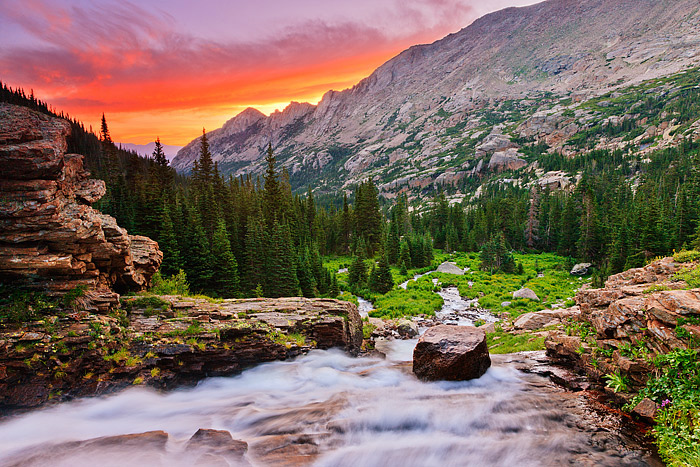
This morning was one of my most productive mornings in Rocky Mountain National Park. A few weeks back I hiked up to Black Lake to photograph sunrise. Everything pretty much broke my way this morning. There was no wind present in Rocky this morning, at sunrise , beautiful clouds setup, and I was able to walk away with four images of Black Lake and Ribbon Falls that I'm very pleased with. I hustled up to Ribbon Falls just before sunrise to capture this image of the clouds lighting just above the side of Storm Peak. I was only able to spend a few minutes at this location before I had to hustle up to Black Lake to catch sunrise on McHenry's Peak. Technicial Details: Canon EOS 1Ds III, 24-105mm F4 IS L This image posted from Ribbon Falls is a follow up to the image posted from Black Lake a few weeks back. As I stated previously, I had a great hike up to Black Lake and was lucky to have near perfect conditions on that mornings hike and accompanying shoot.
There was no wind present this morning and I had a great set of clouds that rolled in right at sunrise. Ribbon Falls just below Black Lake was my first that morning. I was able to make a few images here at Ribbon Falls just before the sunrise.
The clouds to the east were just starting to glow when I took this image from the top of Ribbon Falls, looking back towards the sides of Storm Mountain. I was able to quickly pack up and scoot up to Black Lake for sunrise, and the falls on the inlet stream to Black Lake after that.
All in all I walked away with four images of the Black Lake area that I’m very pleased with. It was one of the best mornings I’ve had in Rocky Mountain National Park, and certainly one of my most productive. Now if I could only get every morning in Rocky to work out this well.
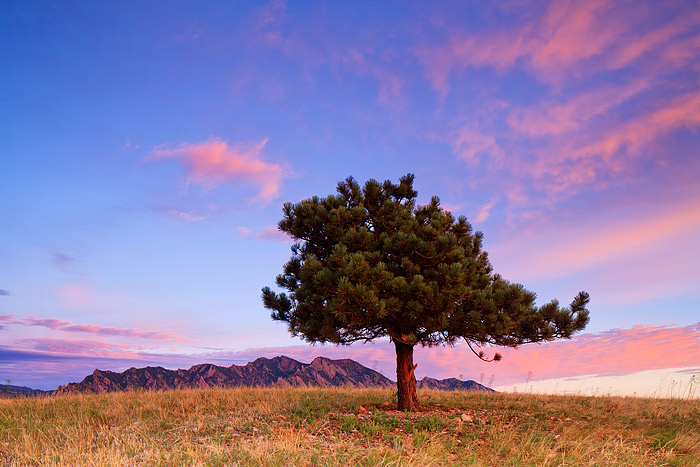
The prevailing winds have helped shape this tree into a boot like shape. This tree is often subjected to very high winds from the west and south during the winter months. This Ponderosa leads a difficult exsistence on the side of this hill just east of Boulder, Colorado. It still manages to survive and endure which is both motivating and impressive. I've been meaning to get out to this spot for some time to photograph this tree and Sunday's sunrise provided the perfect backdrop to frame the tree and The Flatirons. Technical Details: Canon Eos 1Ds III, 24mm TS-E F3.5 L II(which is still working great after it's 10 minute bath in a stream a few weeks back at Black Lake!)Unfortunately for me I’ve got some personal commitments over the course of the next few weeks that will keep me from being able to get up to Rocky Mountain National Park. Luckily for me, there lot’s of good stuff to photograph closer to home in and around Boulder. On top of that I’ll be heading back to New York for some time at the beach with family. While I wont be trouncing around Rocky in the middle of the night waiting for sunrise, I should be able to break out the cameras and get some photography done.
I’ve been eyeing this particular location and tree from sometime. You can see this tree from Highway 93 just south of Boulder on Boulder County Open Space property. This tree has a commanding view of the Flatirons and I’ve driven by it on countless occasions making a mental note that I have to hike in and check it out one day.
Sunday’s sunrise looked very promising so I decided it would be a good time to hike in and photograph this tree. This Ponderosa sits on a hilltop all alone. This tree leads a difficult existence on the top of this hillside. This may be the windiest spot in all of Boulder, and the shape and form the tree has taken is a testament to that.
During the winter months in particular, downsloping winds off the continental divide are funneled out of Eldorado Canyon, roaring out onto the high plains. It’s not uncommon for winds to reach 80-85mph in this location and speeds have been recorded in excess of 100 mph.
All the while this lone Ponderosa persists. It persists through the hot and dry summer months, just as it does through the hurricane force winds common in the winter months. It’s certainly not the biggest specimen, but the fact that it’s endured the harsh conditions from seedling to its present state is impressive.
This tree’s story and it’s ability to endure tough conditions draw me in to photograph it. Getting such a beautiful sunrise is just icing on the cake. I’ll be back to photograph this tree again, I’ll just have to pass on those winter days when it’s a bit ‘breezy’ on this side of town.