Smoked Chickadee

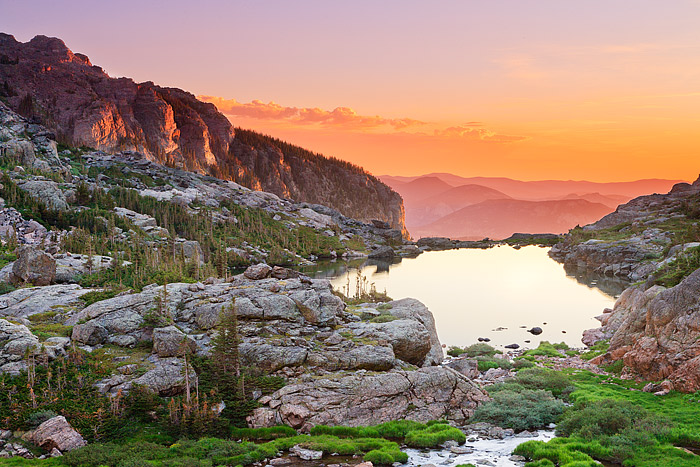
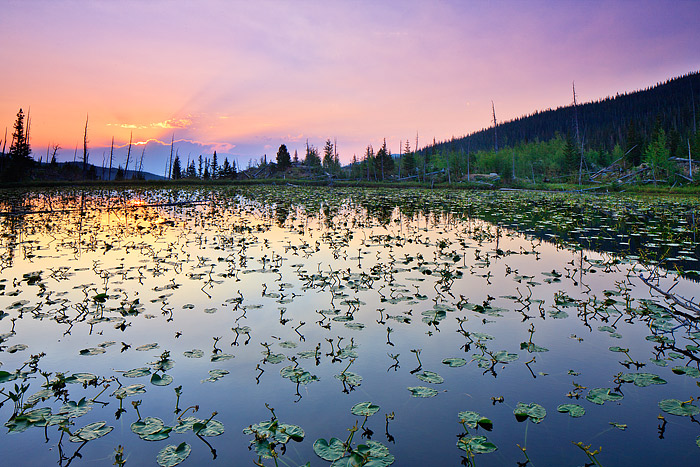
The Sun rises above a thunderstorm over the plains and lights the smokey skies above Chickadee Pond and Wild Basin section of Rocky Mountain National Park.
The sun begins to creep above a large thunderstorm over the eastern plains of Colorado. Particulates and smoke from the many wildfires out turns the sky over Chickadee Pond a magenta hue. Wild Basin contains some of Rocky Mountain National Park’s most beautiful locations. It takes some work to get Wild Basin’s many gems, and although the area is often overlooked by photographers, it contains some of Rocky’s most beautiful locations. Technicial Details: Canon EOS 1Ds III, 24mm TS-E F3.5 L II
The Wild Basin area of Rocky Mountain National Park has it’s own unique feel and vibe. It’s less visited than other sections on the east side of the park, and many visitors to the park are likely to pass on through without exploring this area. I too am guilty at times of overlooking the Wild Basin area for some of the more familiar spots.

Not only does Wild Basin have a different feel with it’s many streams and water features, it makes you work to see much of its beauty. Roads into and around Wild Basin stop about 5 miles short of any of the lakes or impressive peaks located in the Wild Basin. This means your not going to see very much of Wild Basin from your car.

To get close to the divide and the impressive peaks such as Mt. Copeland, Ouzel Peak and Mt. Alice your going to have to hoof it. While most of the hiking is on the moderate side, distance is the biggest obstacle to photographing this locations.

Five, Six and Seven mile one-way hikes are the norm when exploring Wild Basin. With that in front of me, and knowing I’ve neglected this area, I set off for the Ouzel Lake area.

It was a cloudless morning departing the trailhead, but I had been watching a large thunderstorm flicker over the plains east of Ft. Collins on 2:30 AM drive up to Rocky. The plan was either to photograph from either Ouzel Lake or Chickadee Pond at sunrise. In my opinion, Chickadee Pond offers a better viewpoint of the divide and Ouzel Peak than Ouzel Lake does, so that was my primary destination.

Chickadee Pond also has a propensity of pond lilies that grow on its surface. In fact, I cant think of another body of water in Rocky Mountain National Park that is so densely packed with pond lilies. I figured if clouds did not build at sunrise and bluebird skies persisted, I could at least photograph the pond lilies.

Lastly, the wildfires that have plagued the west this year continue to make photography difficult in Rocky Mountain National Park. The smoke from these wildfires has settled into Colorado for the last 2 weeks, diffusing the early morning sunlight and taking the ‘pop’ from the early morning sun.

I arrived at Chickadee Pond and realized my best option was to photograph the sunrise off to the east. That large thunderstorm over the plains I had watched on my drive up to the park could still be seen from Chickadee Pond. In fact, the large thunderhead was blocking the rising sun while allowing for some nice coloration in the sky and clouds.

I setup my camera and began photographing the sun rising over the large thunderhead clouds off to the east. The smokey skies above Chickadee Pond also helped to add color at sunrise by adding a magenta like hue as the first rays filtered through the particulates in the sky. All in all, the combination of the thunderstorm and smoke in the sky made for an interesting morning deep within Wild Basin.
Back From The Beach

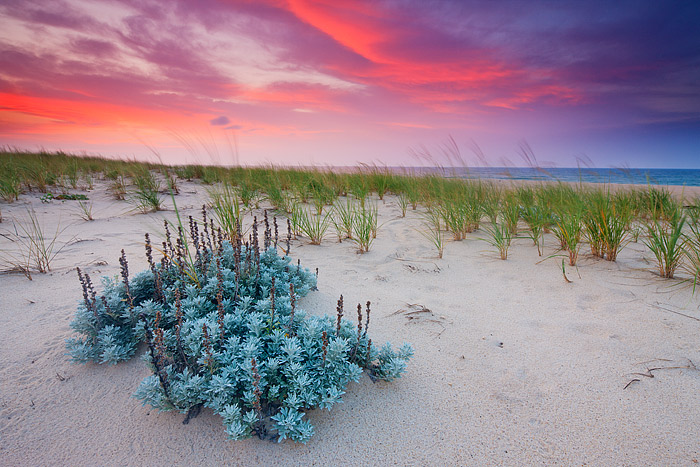
Sunrise at Southampton, New York and Dune Beach
Small bitting bugs, sea spray, sand and high humidity, all the elements I dont typically deal with out here in Colorado. Regardless, I was able to capture this beautiful sunrise from Dune Beach in Southampton, New York. If your willing to get up early and head out to the beach, there is a good chance you the eastern end of Long Island will treat you to a sight such as this. Technicial Details: Canon EOS 1Ds III, 17mm TS-E F4
Changing pace can be a good thing. Every once in awhile it’s nice to get out of your set routines, break from the mold a bit and photograph something different. I personally finds it helps the creative process to break from the familiar and get out into different environs.

I spend last week on a whirlwind tour of New York State visiting in-laws and relatives. The trip back east was more about visiting family and catching up with old friends then it was about photography. Of course, there was no way I was going to be able to keep my camera in the bag the entire time.

While spending the end of the week out on the east end of Long Island, I was able to get up early a few mornings and catch sunrise along the beach. While I had a good sunrise this particular morning at Dune Beach in Southampton, the humidity, sand and sea spray where all things I’ve gotten used to not having to deal with here in Colorado. The trip was great, but I’m eager to get back up to Rocky and my more comfortable surroundings.

Ribbon Falls

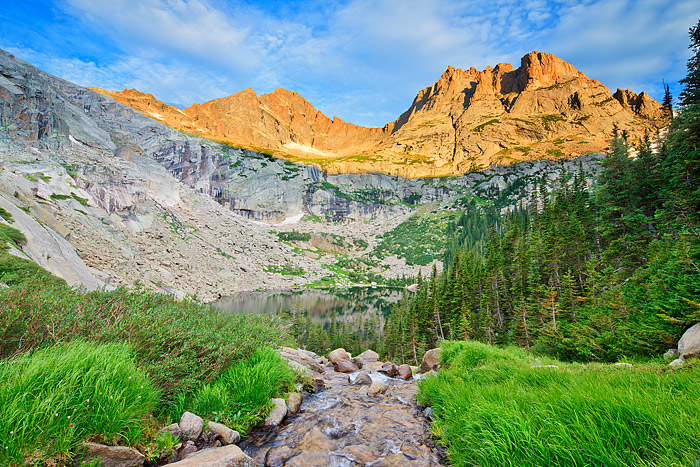
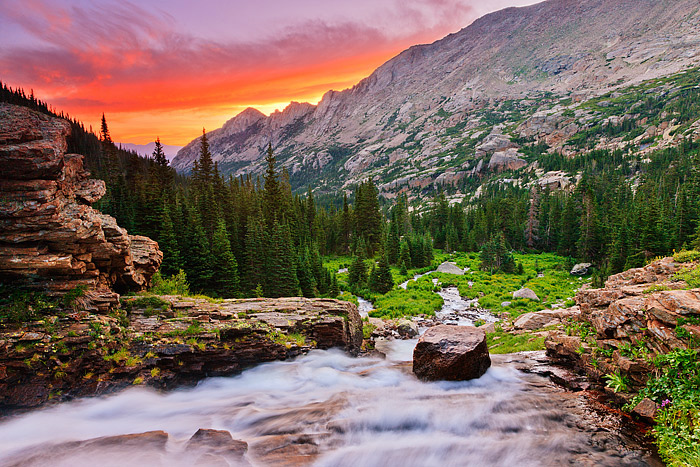
Ribbon Falls tumbles downstream through Glacier Gorge just below Black Lake in Rocky Mountain National Park, Colorado
This morning was one of my most productive mornings in Rocky Mountain National Park. A few weeks back I hiked up to Black Lake to photograph sunrise. Everything pretty much broke my way this morning. There was no wind present in Rocky this morning, at sunrise , beautiful clouds setup, and I was able to walk away with four images of Black Lake and Ribbon Falls that I'm very pleased with. I hustled up to Ribbon Falls just before sunrise to capture this image of the clouds lighting just above the side of Storm Peak. I was only able to spend a few minutes at this location before I had to hustle up to Black Lake to catch sunrise on McHenry's Peak. Technicial Details: Canon EOS 1Ds III, 24-105mm F4 IS L
This image posted from Ribbon Falls is a follow up to the image posted from Black Lake a few weeks back. As I stated previously, I had a great hike up to Black Lake and was lucky to have near perfect conditions on that mornings hike and accompanying shoot.

There was no wind present this morning and I had a great set of clouds that rolled in right at sunrise. Ribbon Falls just below Black Lake was my first that morning. I was able to make a few images here at Ribbon Falls just before the sunrise.

The clouds to the east were just starting to glow when I took this image from the top of Ribbon Falls, looking back towards the sides of Storm Mountain. I was able to quickly pack up and scoot up to Black Lake for sunrise, and the falls on the inlet stream to Black Lake after that.

All in all I walked away with four images of the Black Lake area that I’m very pleased with. It was one of the best mornings I’ve had in Rocky Mountain National Park, and certainly one of my most productive. Now if I could only get every morning in Rocky to work out this well.

The Short Of Things

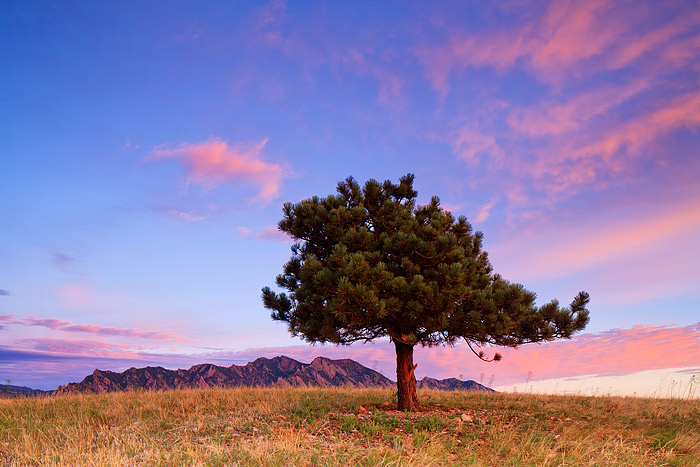
A Lone Ponderosa on a hillside just east of the Flatirons and Boulder, Colorado
The prevailing winds have helped shape this tree into a boot like shape. This tree is often subjected to very high winds from the west and south during the winter months. This Ponderosa leads a difficult exsistence on the side of this hill just east of Boulder, Colorado. It still manages to survive and endure which is both motivating and impressive. I've been meaning to get out to this spot for some time to photograph this tree and Sunday's sunrise provided the perfect backdrop to frame the tree and The Flatirons. Technical Details: Canon Eos 1Ds III, 24mm TS-E F3.5 L II(which is still working great after it's 10 minute bath in a stream a few weeks back at Black Lake!)
Unfortunately for me I’ve got some personal commitments over the course of the next few weeks that will keep me from being able to get up to Rocky Mountain National Park. Luckily for me, there lot’s of good stuff to photograph closer to home in and around Boulder. On top of that I’ll be heading back to New York for some time at the beach with family. While I wont be trouncing around Rocky in the middle of the night waiting for sunrise, I should be able to break out the cameras and get some photography done.

I’ve been eyeing this particular location and tree from sometime. You can see this tree from Highway 93 just south of Boulder on Boulder County Open Space property. This tree has a commanding view of the Flatirons and I’ve driven by it on countless occasions making a mental note that I have to hike in and check it out one day.

Sunday’s sunrise looked very promising so I decided it would be a good time to hike in and photograph this tree. This Ponderosa sits on a hilltop all alone. This tree leads a difficult existence on the top of this hillside. This may be the windiest spot in all of Boulder, and the shape and form the tree has taken is a testament to that.

During the winter months in particular, downsloping winds off the continental divide are funneled out of Eldorado Canyon, roaring out onto the high plains. It’s not uncommon for winds to reach 80-85mph in this location and speeds have been recorded in excess of 100 mph.

All the while this lone Ponderosa persists. It persists through the hot and dry summer months, just as it does through the hurricane force winds common in the winter months. It’s certainly not the biggest specimen, but the fact that it’s endured the harsh conditions from seedling to its present state is impressive.

This tree’s story and it’s ability to endure tough conditions draw me in to photograph it. Getting such a beautiful sunrise is just icing on the cake. I’ll be back to photograph this tree again, I’ll just have to pass on those winter days when it’s a bit ‘breezy’ on this side of town.

Lake Of Glass From Sky Pond

Sunrise over Lake Of Glass from Sky Pond. Rocky Mountain National Park, Colorado
People often ask me what my favorite are my favorite areas of Rocky Mountain National Park. While I tell them I dont have any favorite area in particular, there are some areas of Rocky Mountain National Park that I seem to go back to time and time again. The Sky Pond and Lake of Glass area is one of these places that I photograph as often as I can. From Sky Pond, perched above Lake of Glass, sunrises are spectacular and have all the elements that make Rocky Mountain National Park such a beautiful location. Technicial Details: Canon EOS 1Ds III, 24-105mm F4 L IS
Rocky Mountain National Park has one beautiful lake and peak after another. Study at Topo map of Rocky Mountain and one can attempt to imagine the beauty of the location and surrounding peaks before ever setting foot in the area.

People often ask me what’s my favorite area of Rocky Mountain National Park, or what area do I think is the most beautiful. It’s not a question I can even attempt to answer thankfully. There are just too many beautiful places and locations in Rocky Mountain National Park. Photographing in any area of Rocky will keep me satisfied.

That being said, there are some areas of Rocky Mountain National Park that have an almost other worldly quality to them. The layout of the land, the peaks, the way the light filters in through the valleys give certain areas a look and feel that can only be truly appreciated in person.

One of these ‘slam dunk’ areas of Rocky is the Sky Pond and Lake of Glass area. A moderate hike of 4.5 miles leads you through Loch Vale and some of the most spectacular scenery found anywhere in Colorado. The Lake of Glass and Sky Pond area sit on a high shelf above Loch Vale and the view from the cirque is impressive in all directions.

This area which is world famous for it’s rock climbing formations such as the ‘Sharkstooth’ and the ‘Petit Grepon’ make up the Cathedral Spires which border Sky Pond and Lake of Glass. Along with Taylor Peak, these formations and peaks make the photography very enticing as well.

With that being said, my favorite view from the Sky Pond area is looking northeast back over Lake of Glass and Loch Vale. It’s a classic Colorado alpine scene at sunrise. It has all the elements, lakes, mountains, valleys and lighting that make the 4.5 mile hike well worth the effort.

Black Lake

Sunrise at Black Lake, Rocky Mountain National Park, Colorado, McHenry's Peak, the Arrowhead
Rocky Mountain National Park never fails to impress me. I had been planning for some time to photograph Black Lake, and my first visit to the area did not dissapoint. This is without a doubt one of the most beautiful areas of Rocky Mountain National Park. In this image, McHenry's Peak and The Arrowhead are bathed in the early morning light. I was lucky this morning to have nice sets of clouds roll over the peaks and gorge making for some great photography of this amazing area. Technicial Details: Canon EOS 1Ds III, 17mm TS-E F4 L
Before I start out to photograph a certain location, I often research the area. Staring at a Topo map I make and attempt to anticipate how that given location is going to look, what might be the best areas to photograph from etc.

Exploring new areas of Rocky Mountain National Park is always exciting. I’m lucky enough to be photographing in Rocky Mountain National Park, so it’s always a thrilling experience for me and I’m certainly not complaining. There are times however, when areas of Rocky impress me even more than I could imagine.

Last week was one of those experiences. I have never photographed Black Lake, but it’s been on the ‘to-do’ list for some time. In fact, I’ve never spent much time in Glacier Gorge beyond Mills and Jewel Lake. I have seen some other photographers images from the area and had been told by many how beautiful the Black Lake area is.

It’s a pretty good slog up to Black Lake. It’s a little under 5 miles one-way just to reach Black Lake which is nestled deep in Glacier Gorge. The area I planned on shooting above Black Lake would make the one-way mileage exceed 5 miles, and the total elevation gain exceed 1800 ft.

I set off from the Glacier Gorge parking lot a little before 4:00 AM for Black Lake. The trail can be a little difficult to follow in some areas and a wind event over the winter months has created large areas of blown down timber which can be navigation a little tricky in some areas but I was able to forge ahead fairly easily.

As I neared Ribbon Falls and the shore of Black Lake, some nice clouds and pre-dawn light started to fill the sky to the north and east. I had only a few minutes until the sunrise but things were looking promising. I scurried around the side of Black Lake and followed Black Lake’s inlet stream to a vantage point up above Black Lake with a commanding view of McHenry Peak and The Arrowhead.

I found a nice location along the creek looking back over Black Lake and began to setup my camera. After hiking 5 miles in the dark, it’s somewhat easy to develop tunnel vision and not to observe your surroundings as you normally would. After setting up my gear, I was able to take a deep breath and take in my surroundings.

It’s hard to describe in words how beautiful a location this area is. I can hope to convey that through my images from this particular morning, but this area is so beautiful one needs to experience it first hand to fully appreciate the location and experience.

Black Lake is one of those areas that far exceeded any and all of my expectations. It’s a location I will return to photograph again. And even though I managed to drop my $2400 24mm tilt shift lens into the creek during the shoot, I had one of my best Rocky Mountain National Park experiences on this expedition.

‘Oh Wow!’, Finally Some Rain On Loch Vale

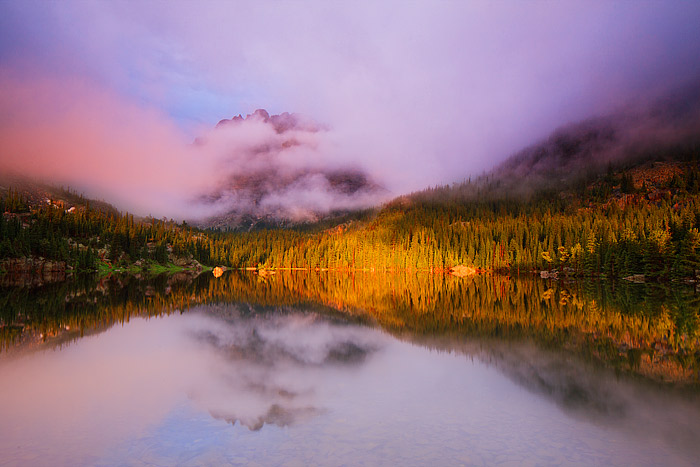
The Loch and Loch Vale at Sunrise in Rocky Mountain National Park, Colorado
We photographers are light junkies. We are in a constant search for dynamic lighting conditions which typically happen on the edge of weather. It's easy enough to want to shoot in dynamic lighting, but photographers have to be willing to pay their dues to capture this illusive lighting. It's been a hot dry summer in Rocky Mountain National Park, and chances to photograph dynamic lighting or 'oh wow' lighting have been few and far between. Finally the weather pattern changed this weekend and I was rewarded with this image of The Loch and Cathederal Wall being splashed with short by spectacular lighting conditions. Technicial Details: Canon EOS 1Ds III, 24mm TS-E f3.5 L II
Finally the hot dry weather pattern broke. It broke in a big way in fact. Record heat and nary a drop of moisture gave way to cool wet weather this week in Rocky Mountain National Park thanks in part to the summer monsoon finally kicking in.

It’s been so hot, dry and windy in Rocky that I was really starting to believe that photography may end up being a lost cause for the season. It’s been unbelievably hot and dry in Colorado for the last few months and these couple of days of cool temperatures and rain are just what the doctor ordered.

I preach it all the time, but dynamic weather like this is also key to capturing unique images in Rocky Mountain National Park. During a typical summer season, a photographer might be lucky to capture dynamic weather conditions like these half a dozen times or so.

It’s very tempting to hit snooze on the alarm clock and head back to bed. There is a very good chance you might end up being skunked after hiking 3 miles in the dark and rain, but if the elements come together, there are few better places to be as a photographer than on the edge of weather.

One tip I often give fellow photographers when photographing Rocky Mountain National Park is to hang in there no matter how poor the conditions appear to be. I cant tell you how many times I’ve headed out into conditions that I thought in no way would allow for extraordinary first morning light.

Mountains and peaks can be socked in by fog and clouds, as can be the eastern horizon. Somehow however, the sun may manage to peek through the bank of clouds just long enough for the ‘oh wow!'(profanity removed) light to bathe the peaks.

Saturday and Sunday both produced ‘oh wow!’ lighting for me. I started Saturday intending to photograph Timberline Falls in Loch Vale. I figured if the clouds and sun did not cooperate I’d still have Timberline Falls to photograph.

On my way up to Timberline Falls, I setup at The Loch to see what sunrise would bring. As is typical, the conditions seemed poor. I hiked up to The Loch in a light mist and I could see no break in the clouds cover over the eastern horizon. I waited patiently at sunrise and just as I was about to pack my bag, the Cathedral Wall and part of Loch Vale lit up all for about 5 minutes or so. It was just enough time for me to capture a half a dozen images of the dynamic and changing light conditions that morning.

So when the lighting appears less than promising, just remember to fight off the urge to pack up your camera bag and leave. ‘Oh wow’ lighting happens a few times a year, but for every ten ‘oh heck’ moments, one ‘Oh wow’ moment will keep you from hitting snooze on that alarm clock and out on the trail even in poor conditions.

The Skeletons Of Trail Ridge

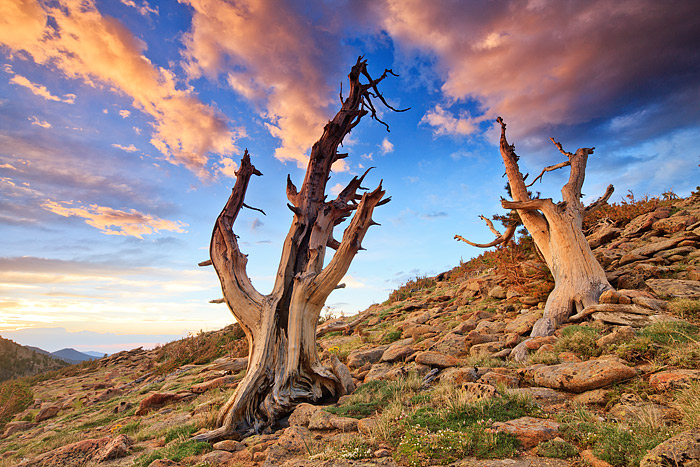
Limber Pines along Trail Ridge and Tombstone Ridge, Rocky Mountain National Park, Colorado
The harsh elements of life in the sub alpine zone of Rocky Mountain National Park have finally taken their toll on these two limber pines. Relentless winds, cold and snow have sculpted these tree's and all that remains is there sun bleached skeletons. I've been waiting for conditions such as these to photograph these two tree's and I was lucky enough to have everything fall into place for me last week. Technicial Details: Canon EOS 1Ds III, 17mm TS-E F4 L
Treeline in Colorado occurs on average just above 11,000 ft above sea level. The determining factor for treeline is an average mean temperature of fifty degrees. Hiking or driving through the transitions from the montane zone, to the sub alpine zone and lastly the alpine zone can be a thrilling experience. The transition zones in these particular areas make for amazing places for photography.

Most visitors to Rocky Mountain National Park get their first taste of this other worldly experience when they drive over Trail Ridge Road. Trail Ridge Road being the highest continuous paved road in the continental United States allows visitors to Rocky the experience of this beautiful but difficult existence with fairly little effort and from the comfort of their vehicles. Stop at one of the many pull offs along Trail Ridge Road even and one is likely to find shorts and a t-shirt offer little comfort even in the middle of a summer afternoon.

The sub alpine zone in Rocky Mountain National Park hosts a wide variety of interesting photography subjects. Wildflowers such as blue columbines, red paintbrush and alpine sunflowers amongst the talus slopes, boulders and stunted plants. What really peaks my interest in these sub alpine areas are the tree’s. The limber pines and krummholz trees which are in a constant struggle for life against the harsh elements.

These limber pines and kummholz tree’s are often contorted and twisted by the wind and elements. The constant air flow at these high altitudes prevents the tree’s from growing in a windward direction. They are often only able to grow in a leeward direction. These tree’s will eventually succumb, sometimes after hundreds of years of existence. Even at this point, mother nature is not quite done sculpting and bleaching there remains.

I’ve been spying this particular pair of dead limber pines near Trail Ridge for sometime. This particular area of Trail Ridge has quite a few limber pine skeletons littering the ridgeline. Finally on Wednesday, the lighting and conditions came together perfectly. The winds were blowing at a pretty good clip, but would subside just long enough to allow me to capture these two tree’s free of any motion blur caused by the high winds. There are limber pines like these two scattered all over the high ridges near treeline in Rocky Mountain National Park, and I’ll continue to scour these ridges for new and interesting subjects.

One final shameless self promotion tidbit. One of my images of Watermill Beach was used for this week’s online edition of Vogue magazine. You can find a link to the article here. Vogue Magazine Watermill Beach Image

Beauty In Nature Is Not Always Fair

Nymph Lake Sunrise, Rocky Mountain National Park, Colorado
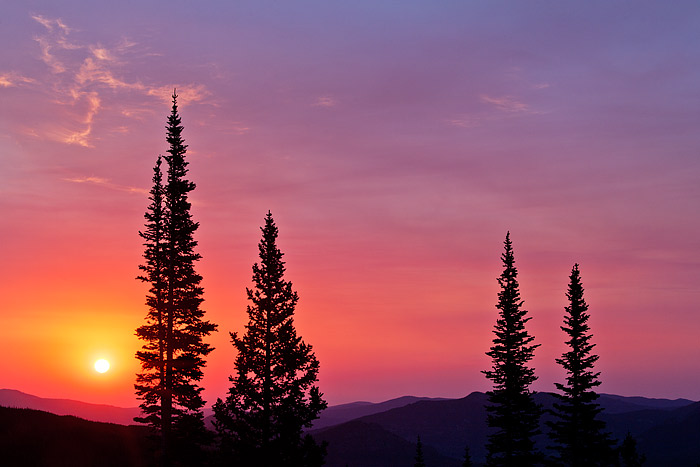
A rainbow of colors fills the sky east of Nymph Lake and Rocky Mountain National Park this morning. Particulates and smoke from the High Fire northeast of Estes Park are the reason for the colorful sunrise. It's been a difficult start to the Summer for photography in Rocky Mountain National Park but it's been much more difficult for many of Colorado's residents displaced by the wildfires. Technical Details: Canon EOS 1Ds III, 70-200mm F4 IS L
It’s been a difficult couple of weeks here in Colorado. We’ve had a very dry Winter, which turned into a very dry Spring and has continued on as an even hotter and dryer Summer. The conditions have made photography in Rocky Mountain National Park a challenge. The hot weather, combined with a general lack of clouds and persistent winds oftentimes means my Plan A agenda, quickly turns into a Plan B outcome.

Regardless of how challenging the photography has been in Rocky this Summer, it’s been a real life and death struggle for many Colorado residents. As of this writing, there are 8 wildfires burning in the State.

The second largest fire in the history of Colorado, the High Fire, is burning 20 miles or so northeast of Estes Park and has already claimed 191 homes and one life. To compound that, a house fire in Estes Park yesterday, just a few hundred yards from the Beaver Meadow entrance to Rocky Mountain National Park quickly burned 21 homes before being brought under control. Lastly, the Waldo Canyon fire is burning out of control just outside of the Garden of the Gods and Manitou Springs.

The atmosphere along the northern Front Range has been filled with smoke for a few weeks now. Because of the smoke, much of the early morning light reaching the mountain peaks is diffused and lacks intensity and pop. Today, the smoke was as thick as it has been in weeks.

In an ironic twist, the smoke combined with high clouds rewarded me with a beautiful sunrise. Just above Nymph Lake, I was able to capture this image of the Sun rising through the smoke from the High Fire and clouds to the east. The colors were spectacular and the Sun rose as a blood red orb over the high plains.

While the sunrise was spectacular this morning, I’m keeping my fingers crossed that the heat subsides and rain falls from the sky. Let’s hope the weather pattern changes and we start to see some moisture out here in the tinderbox that Colorado has become.

Ordering The Chaos Of Wild Basin

Bitter Cress along the North Saint Vrain, Wild Basin, Rocky Mountain National Park
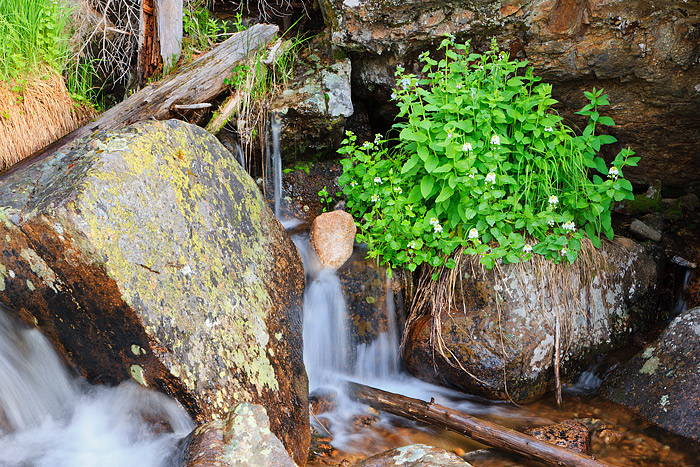
Bittercress and Mountain Bluebells bloom along the banks of the North Saint Vrain Creek. I photographed this image just below Ouzel Falls in the Wild Basin Section of Rocky Mountain National Park. Wild Basin is a fascinating place for photography, but also a very challenging location. Wild Basin's streams and water features make for great photography subjects. Finding compositions that are not to busy or cluttered is difficult with all the downed timber due in part to the Pine Beetle infestation. Technical Details: Canon EOS 1DsIII, 24-105mm F4 IS L
It’s hard to put into words exactly what it is about the Wild Basin section of Rocky Mountain National Park that feels so different and unique from others areas of Rocky. Wild Basin certainly does not get the fanfare other areas of Rocky Mountain National Park get such as Bear Lake Road, Dream Lake or Trail Ridge.

Perhaps it’s the lack of parking at most of the trailheads, or the windy and narrow dirt road used to get to the trailheads. It’s more likely its the fact that you cant drive a car right up to the many hidden treasures to found in Wild Basin. To me at least, Wild Basin has a much more understated beauty than many of the other areas of the park.

Wild Basin makes you work before revealing itself. The alpine lakes of Wild Basin are some of the most beautiful in all of Colorado, let alone Rocky Mountain National Park. Want to see Mount Alice and Lion Lake up close?. Well then your going to have to commit to a 14 mile round trip hike to do so.

Even for those not feeling spry enough for a 7 mile hike up into the beautiful alpine wilderness of Wild Basin, the lower regions are beautiful in their own right. The North Saint Vrain emanates out of this Basin on the south side of Longs Peak. The banks of the North Saint Vrain as well as many of the other creeks and streams found in Wild Basin are loaded with more subtle photographic opportunities.

Wild Basin is packed with great water features for photography. The trick is trying to find compositions that are not to busy or cluttered. The Pine Beetle infestation has felled many tree’s along the banks of the creeks. This means lots of log jam’s and dead tree’s strewn in and along the creeks, which of course can make photography of Wild Basin’s water features both interesting and difficult.

Copeland Falls, Calypso Cascades and Ouzel Falls are some of the more popular water features in Wild Basin. I settled on Ouzel Falls when I headed into Wild Basin last week. Wildflowers are starting to bloom along the creeks now and the spring runoff is starting to ebb making photography of the North Saint Vrain a bit more manageable.

I finally settled in on this image just below Ouzel Falls. It certainly does not have that smack you in the face beauty as a location such as Dream Lake, but images like this typify Wild Basin to me. Wildflowers, water, downed timber and rock’s entrenched deep within a subtle but beautiful area of Rocky Mountain National Park.