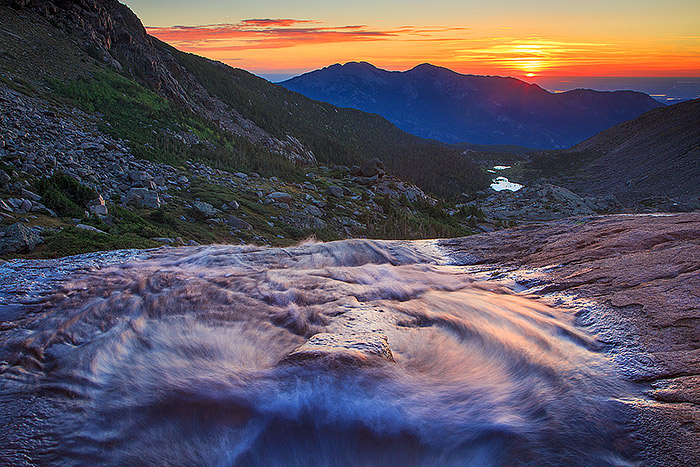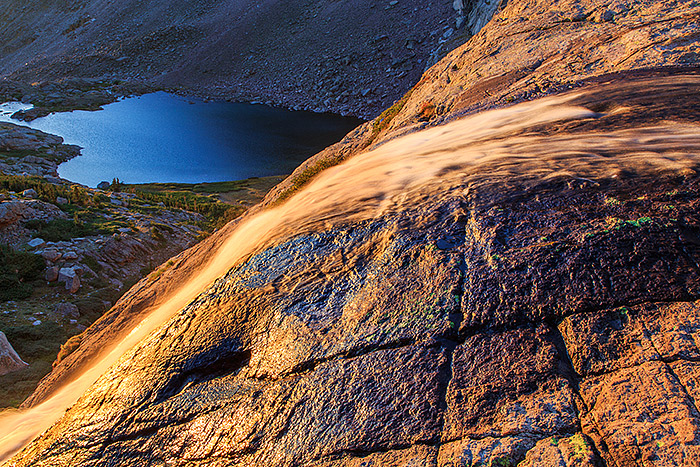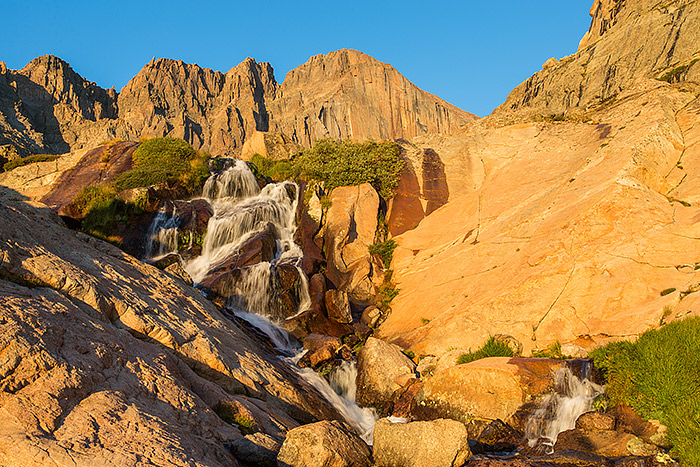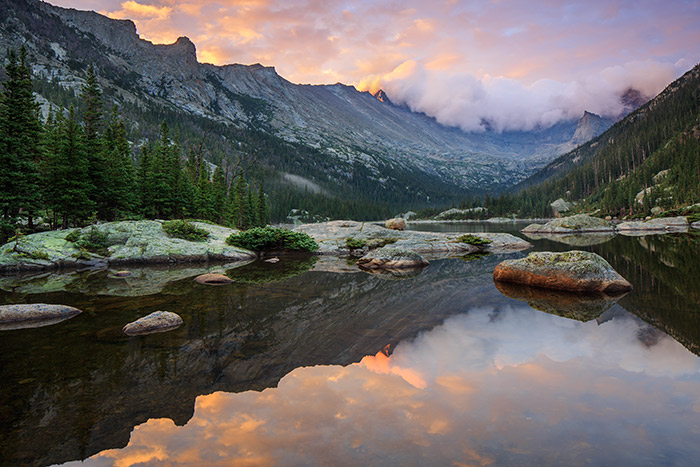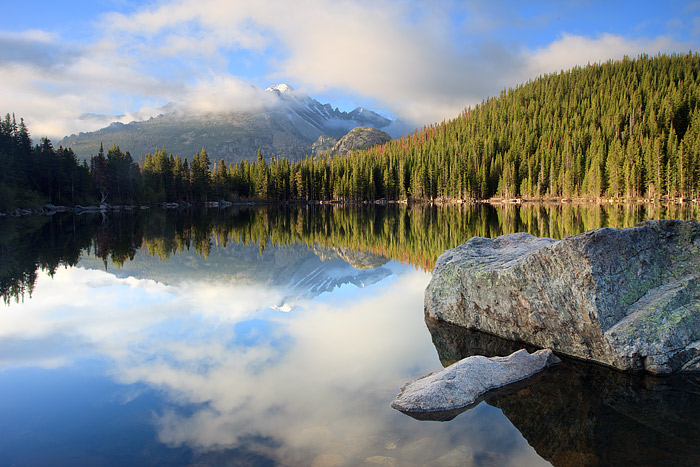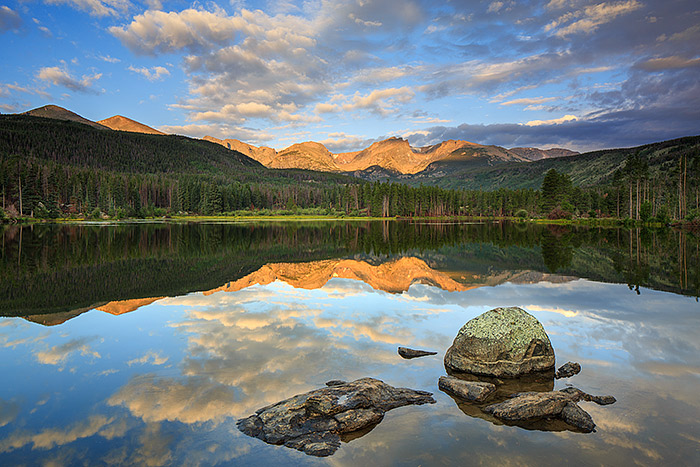
The summit of Longs Peak, Rocky Mountain National Park’s highest peak illuminates as sunrise unfolds over Glacier Gorge deep in the heart of Rocky Mountain National Park. I’ve been riding a streak of very favorable conditions in Rocky that have enabled me to capture some dramatic light over some of Rocky’s most beautiful locations. Technical Details: Canon EOS 5D Mark III, 24mm TS-E F3.5 L II
Hot streaks and slumps. Athletes all go through them from time to time, particularly baseball players and golfers. Like athletes, photographers are not immune to these circumstances either.
As photographers we’ve all had trips in the field where it seems like everything is falling in to place for us. Sunrise and sunsets are beautiful, winds are calm and we always seem to be in the right place at the right time. The opposite holds true as well. Any photographer worth their salt has spent countless hours in the field waiting for sunrises and sunsets that never materialized.
Like most athletes who are slumping, the key is to stay persistent and work through the slump. Everyday is a new day and if you keep putting yourself in a position to be successful, your persistence will pay off and your slumping ways will reverse.
I’m lucky enough to be on a streak at the moment. The conditions in Rocky Mountain National Park the last few weeks have been nothing short of spectacular. There seems to be rain showers every afternoon and evening and the additional moisture means clouds have been hanging around the peaks most mornings. Streams are still running well and the winds have been calm most of the time, a rarity for sure.
The streak continued for me as I headed up to Mills Lake in Glacier Gorge one morning last week. Typically, Mills Lake is photographed in the afternoon. In the afternoon the sun illuminates the backside of the Longs Peak and much of Glacier Gorge making it more favorable on paper at least. I’ve been planning for sometime to shoot Mills Lake in the morning when the conditions and clouds would be such that dramatic sunrise was light the sky above Glacier Gorge.
Arriving at Mills Lake I found the water smooth as glass. Fog curled over the ridge between Pagoda Mountain and The Spearhead and some hung in the valley itself. Most importantly, the clouds in the sky were looking perfect for a dramatic sunrise. A beautiful sunrise unfolded and I hiked back down from Mills Lake satisfied and still feeling the rush of the mornings sunrise.
Mornings like these make you feel blessed and when I arrived back at my truck in the parking lot, I wanted to pinch myself to make sure this was all real. A quick check on the display of my camera dispelled any chance that the morning was imagined. I’m on a good streak I thought to myself, here’s hoping that I can continue on this streak for just a little longer.
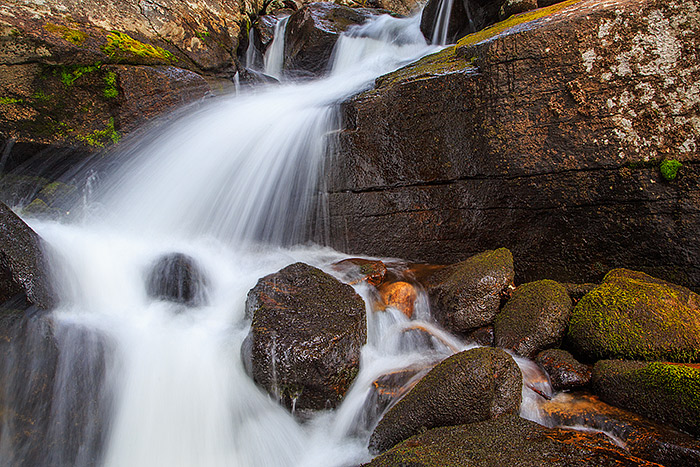
Hunters Creek tumbles over the chutes and boulders of Lyric Falls in the Wild Basin region of Rocky Mountain National Park. Lyric Falls is one of the hundreds of beautiful waterfalls and cascades found in Rocky Mountain National Park. Technical Details: Canon EOS 5D Mark III, 24-105mm F4 ISRocky Mountain National Park is filled with hundreds of named waterfalls as well as unnamed bubbling cascades. You can find these waterfalls all over Rocky from just above the meadows to high above treeline.
It’s fun to look at a topo map and try to guess what a location or waterfall is going to look like when you finally get to the location. I find these places often appear nothing like I think they will when just trying to imagine them on a map. It makes the adventure to the falls more fun and as a photographer keeps you on your toes.
One of these particular locations I’ve been eyeing on my map for quite sometime was Lyric Falls. Lyric Falls is formed by Hunters Creek just below Sandbeach Lake in the Wild Basin region of Rocky Mountain National Park. A perfect sunrise at Sandbeach Lake followed by overcast conditions made for a great opportunity to explore Lyric Falls on my hike out from Sandbeach Lake a few weeks back.
There is only a social trail which follows more or less along the banks of Hunters Creek to reach Lyric Falls. It’s certainly not difficult to locate, but as always you should be prepared when exploring off trail. Legendary Rocky Mountain National Park Ranger Jack Moomaw is responsible for naming Lyric Falls, passing it on his many adventures, rescues and climbs up and around Longs Peak.
Lyric Falls itself is a tiered waterfall that is not so much impressive in its size which is modest, but in the beauty of the cascade itself. Lyric Falls tumbles and cascades over boulders and chutes making for a beautiful symmetrical cascade. The detour from the main trail along with the exploration of Hunters Creek is well worth the effort.
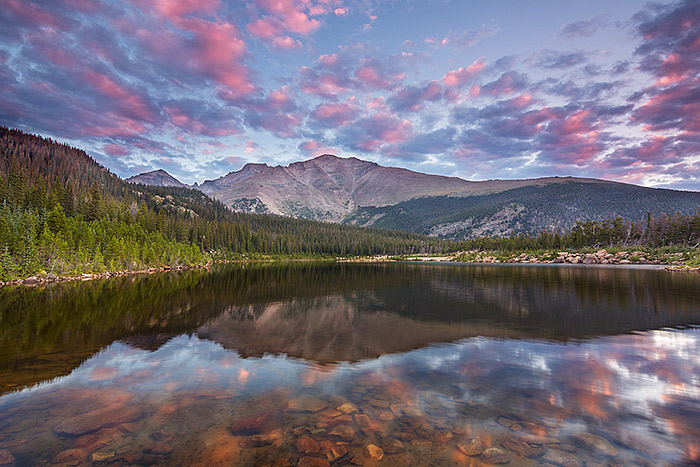
Pink clouds drift over a calm Sandbeach Lake deep in the heart of Rocky Mountain National Park. Mount Meeker, Longs Peak and Pagoda Peak can be seen reflecting in the calm waters of Sandbeach Lake. John Wesley Powell is said to have camped near this location nearly 145 years ago prior to making the first successful ascent to the summit of Longs Peak. Technical Details: Canon EOS 5D Mark III, 17mm TS-E F4 LMost would consider the center point of Rocky Mountain National Park to be Longs Peak. At 14,259 it’s massif dominates much of Rocky’s skyline. Longs Peak was also a great point of interest to early pioneers who settled and travelled through the region. Many of those early pioneers believed reaching the summit of Longs Peak was impossible, and there failed efforts only reinforced that idea.
These early pioneers were a different breed however. Failures and challenges were embraced. Obstacles could be overcome and opportunities in the pioneering west were limitless to these early explorers. Few personified these traits more than John Wesley Powell and its fitting that it would be Powell who would summit Longs Peak first.
John Wesley Powell’s ascent of Longs Peak on August 23rd, 1868 would lead him on an even greater adventure the following year. Powell would become the first American of European to discover and travel through the Grand Canyon.
Upon summiting Longs Peak with his party, Powell is said to have unfurled an American Flag on the summit of Longs Peak and then proceeded to give a speech in which he stated that the adventure of summiting a peak which the summit was thought to be unreachable was to be one of only many challenges that the future would hold.
Before summiting Longs Peak, Powell and his party setout from Grand Lake on August 21st, 1868. The night before they made their famous ascent they are said to have camped near Sandbeach Lake on the south side of Longs Peak and Mount Meeker.
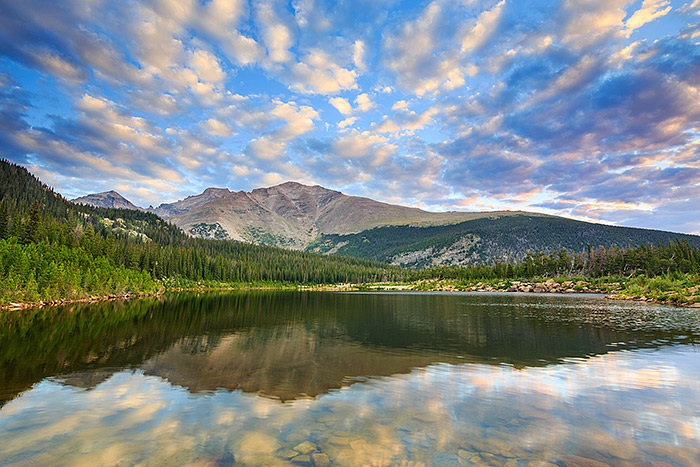
It was from the vicinity of Sandbeach Lake that one of Powell’s assistants, L.W. Keplinger found the route that would lead to the successful first ascent up Longs Peak the following day.Sunrise at Sandbeach Lake this morning was special. The clouds prevented the high peaks from lighting but the beautiful clouds and calm conditions more than made up for that. Technical Details: Canon EOS 5D Mark III, 24mm TS-E F3.5 L II
Visiting Sandbeach Lake today, it’s apparent why the area served as a base camp for the Powell expedition in 1868. Sandbeach Lake holds on commanding view of Mount Meeker, Longs Peak and Pagoda Peak. Keplingers and Powell’s first route (Keplinger Coulier) is situated in the basin next basin from Sandbeach Lake.
Sandbeach Lake is certainly a unique gem. Since Powell visited the area, It’s been damned and used as a water supply for Longmont and farmers on Colorado’s eastern plains. The Park Service has since restored Sandbeach Lake to it’s original state. It’s sandy north shore makes for a perfect beach in this mountain setting.
Like most places in Rocky, Sandbeach Lake can be very windy. That’s compounded even more by its close proximity to Rocky Mountain National Park’s two highest peaks. So I was pleasantly surprised to arrive before sunrise to find Sandbeach Lake smooth as glass. Clouds were floating over the top of Mount Meeker, Longs and Pagoda.
As a stood along the shores of Sandbeach Lake photographing a beautiful sunrise over these famous peaks I could not help but think it John Wesley Powell and his party
observed similar conditions when they conquered and climbed Longs Peak nearly 145 years ago from this date.
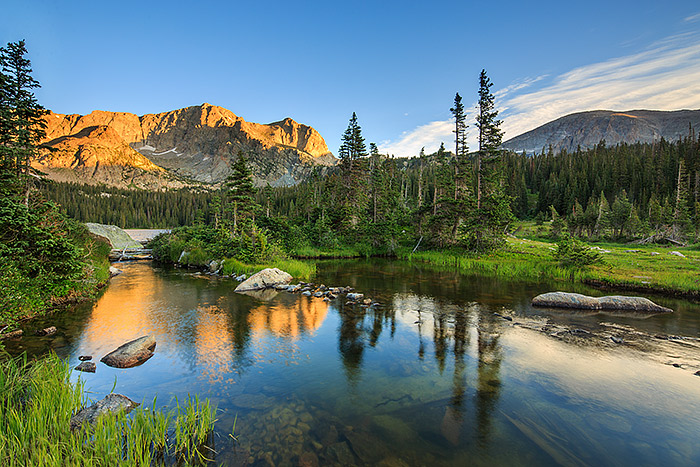
Pilot Mountain and Mount Alice catch the first rays of sun and clouds skirt over North Ridge deep within Wild Basin. Without a doubt Thunder Lake is one of the most beautiful places in all of Rocky Mountain National Park. It takes some work to get to Thunder Lake but it’s worth the effort. Technical Details: Canon EOS 5D Mark III, 17mm F4 TS-EThere are hikes in Rocky Mountain National Park, and then there are, lets just say ‘hikes’ in Rocky Mountain National Park. There’s not a lot of low hanging fruit for photographers in the Wild Basin area once you’ve photographed Copeland, Calypso, and Ouzel falls all which require hikes of less than 3 miles to reach.
Wild Basin is host to some of Rocky Mountain National Park’s most beautiful alpine scenery and mountain lakes. Wild Basin lives up to it’s name while at the same time requiring visitors to put in the time and work to witness it’s beauty.Anyone who has visited Thunder Lake has no doubt stopped to admire the idyllic patrol cabin near its shore. At the same time you have to get a chuckle from the sign attached to the front door of the cabin. Technical Details: Canon EOS 5D Mark III, 24-105mm F4 IS
All of the alpine lakes in Wild Basin require travel of over 4 miles one way to reach. Areas like Bluebird Lake, Thunder Lake and Lion Lakes require you to invest in one way hikes of at least 6.5 miles over moderate to strenuous grades.
For me, this makes these places and hikes even more special. It’s remote, there are far fewer people and the scenery is breathtaking. Most visitors to Rocky Mountain National Park wont visit places like Lion Lakes, Bluebird and Thunder Lake. I was lucky enough to spend a morning photographing sunrise from the outlet of Thunder Lake. It’s without question one of the most beautiful locations in all of Rocky Mountain National Park.
Residing at the base of Pilot Mountain and Mount Alice, Thunder Lake makes for a spectacular composition that can only begin to convey the beauty and wildness of this alpine basin. If you have the ability and time Thunder Lake should be on the top of your must see list.
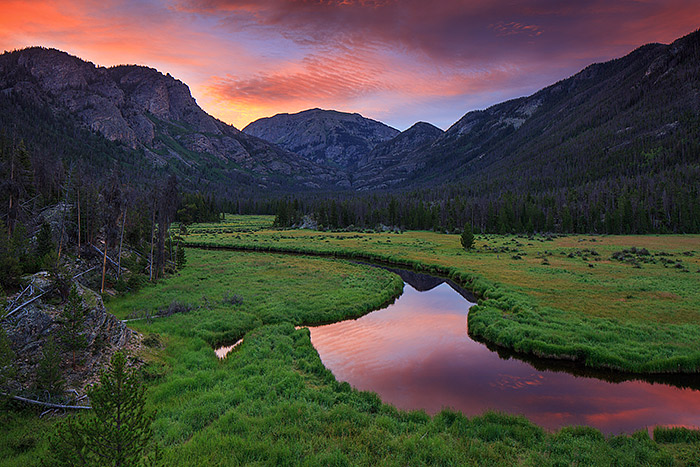
Being a morning person and all I just could not accept the fact that photographing East Meadow and Mount Craig is an afternoon only image. I had envisioned photographing this location in conditions such as these for sometime. I finally managed to get all the conditions working in my favor and came away with this sunrise image. Technical Details: Canon EOS 5D Mark III, 24mm TS-E F3.5 L III’m a morning person. Most of the time, I’ll wake up before my alarm goes off, even if it’s set for 2:00 AM. I’m energized, refreshed and ready to go when I wake up. People who like to sleep in become easily annoyed by my morning routine, just ask my wife.
The opposite holds true for me in the afternoon’s and evenings. By early evening the battery’s are running low and need a recharge. Getting up early means I have no qualms about going to bed early.
My morning routine suits my photography just fine here on the Front Range of Colorado. I’ve conditioned myself to be ready to go early and often. That works great for photographing sunrises on the eastern facing peaks that catch the first brilliant light of the day. The problem is, my ‘routine’ is not as favorable for those images that require one to be in a location at sunset or late in the day.
Case in point, the west side of Rocky Mountain National Park. I’ll admit, much of my portfolio of Rocky Mountain National Park is focused on the east side of the park. There are many reasons for this. It’s closer to home, the lighting is often more favorable, access is better, the density of photographic locations is much closer and the weather tends to work in your favor more in the morning.
This of course is nearly the opposite of what is required to photograph the west side of Rocky Mountain National Park. Access is more limited on the west side of the park and the distances required to get to many of the alpine locations which are often more accessible on the east side are much greater.
I’m trying to make it a point to get out and photograph the west side of Rocky as much as I can. I love the west side of the park. It has a vibe and a feel of wildness and isolation that many of the locations on the east side of Rocky Mountain National Park do not.
So in taking to my promise to spend more time photographing the west side of Rocky, I spent the last few days on the other side of the divide. There has been a particular image and location I’ve wanted to shoot for sometime. East Inlet flowing through East Meadow with Mount Craig (or Baldy) rising above the valley.
Of course I photographed this location not in the afternoon when the sun sets of the peaks on the west side of Rocky, but in the morning. Hey, I’m not complaining.
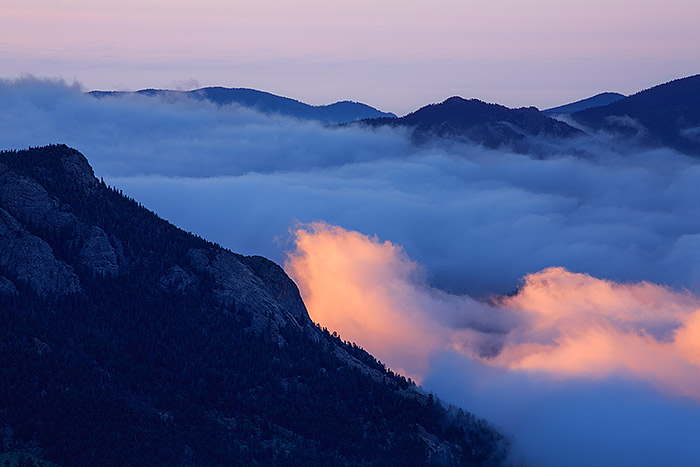
Here is a great example of conditions I encountered last week in Rocky during an inversion. Estes Park was mired in clouds, but driving Trail Ridge Road up to Rainbow Curve allowed me to get above the clouds to photograph a brief sunrise along the flanks of Deer Mountain. Technical Details: Canon EOS 5D Mark III, 70-300mm F4-5.6 L
It doesn’t happen often in Rocky Mountain National Park, but when it does occur you can bet I’m going to be somewhere in the park trying to capture it. What exactly am I talking about that will have me scrambling or driving to the highest points in Rocky?. That would be what’s known as an inversion.
Weather inversions are typically caused when colder air is trapped at lower elevations where in turn warmer air resides above the colder air below. Inversions are pretty much the opposite of how temperatures are typically encountered in Rocky Mountain National Park where normally climbing in altitude will result in cooler temperatures than at lower elevations.
Glassy eyed, some of you are probably what the heck I’m talking about and what relevance does this have to photography in Rocky Mountain National Park. My reason for babbling on is quite simple, inversions open up and create lots of opportunities for rare and dramatic photography in the park.A dramatic sunrise over the granite comprising Lumpy Ridge last week. Again, the inversion helped to trap clouds along the peaks of Lumpy Ridge while the sunrise kissed the top of the fog and clouds with some warm light. Technical Details: Canon EOS 5D Mark III, 70-300mm F4-5.6 L
In Rocky its common for it to be both windy and dry. Monsoonal moisture flows from the southwest can create opportunities for moisture in the summer. These flows typically cause late afternoon thunderstorms and rain which are triggered by daytime heating. Come sunrise, one will usually find all the clouds and rain from the monsoonal flow will have dissipated once the atmosphere has cooled overnight leaving you with our more typical clear, Colorado blue bird morning skies.
Lower pressure to the south and east of Denver is what will allow for conditions that will produce a weather inversion. Counterclockwise or as we call them here on the Front Range, ‘upsloping’ winds out of the east/northeast will often trap cooler air at the surface and suspend warmer air aloft. When this occurs, Viola!, you have nature’s cloud machine working in your favor.
During a temperature inversion, it can be easy to be fooled into thinking its just a cloudy morning. In these conditions, the best thing to do is to get as high(in altitude!) as is possible. Every inversion is a little different but I would recommend trying to climb around or above 11,000 ft, or simply drive Trail Ridge Road until you get above the inversion and cloud line. Once you get above the inversion, the possibilities for photography are endless.
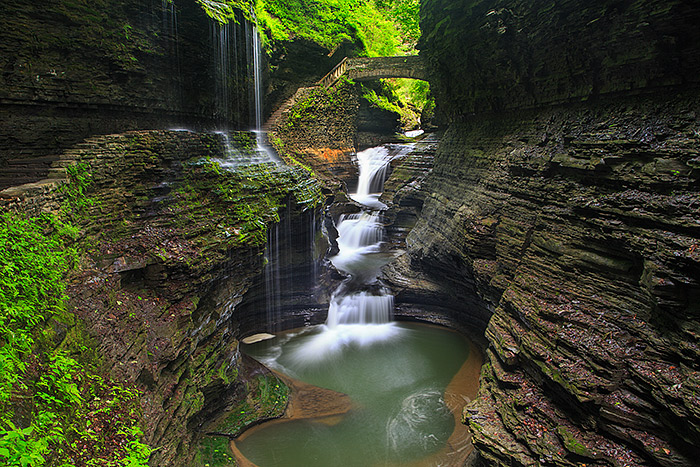
Watkins Glen is one of my personal favorite locations when photographing the Finger Lake regions of New York. Waterfalls abound in the Glen and the possibilities for photographers are endless. Rainbow Falls area is an iconic location in Watkins Glen for obvious reasons. Photographing in Watkins Glen is quite different from the normally arid locations I used to photographing out west. Technical Details: Canon EOS 5D Mark III, 24-105mm F4 IS L
Before we get too far along with summer, I’m still working on a backlog of images. Some of these images are from as far back as June. While I don’t find backlogs particularly fun to work through, it’s a good problem to have.
I spent a week in early June visiting family in New York. One of my favorite places for landscape photography when I’m back in New York is Watkins Glen. Some may know of Watkins Glen because of the NASCAR race they hold there each year, but photographers and hikers go because of the spectacular gorge baring the name.
For those unfamiliar with Watkins Glen, Glen Creek drops 400 feet through a narrow rocky gorge. The gorge, which is now as deep as 200 ft in some locations has numerous waterfalls and features which carry on for almost 2 miles. Glen Creek starts just above Watkins Glen in Seneca Lake, one of New York’s famous Finger Lakes.
For a photographers there’s an image around every corner. Compared to the more arid locations I typically photograph out west, Watkins Glen is the exact opposite. Mist and spray from the falls and rocks are everywhere. Combine that with the above average rainfall that had fallen in June and the greens were lush and practically iridescent.
In some ways Watkins Glen is reminiscent of a slot canyon from the southwest only with lots of water and greenery. It can be a challenging place to keep your gear dry but I would certainly recommend it as a must see location for photographers and visitors to the Finger Lake region.
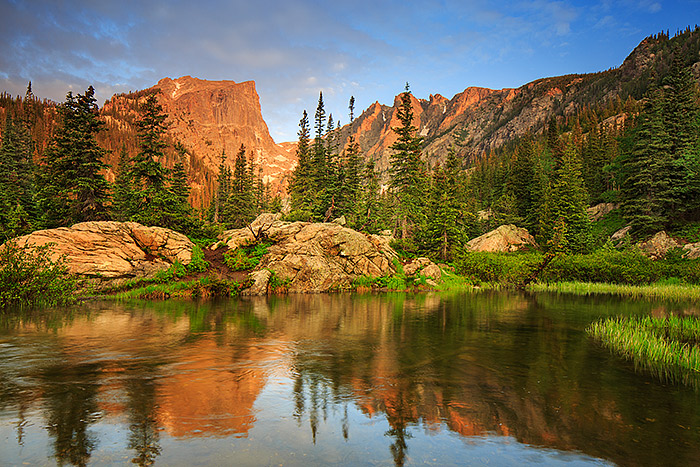
Sunrise lights Hallet Peak and Flattop Mountain from a small tarn just below Dream Lake. Hallet Peak at sunrise is iconic, and a short hike before sunrise to Dream Lake should leave photographers satisfied. Technical Details: Canon EOS 5D Mark III, 24mm TS-E F3.5 L IIAs photographers, we’ve all been there. Were visiting town on business or other personal matters but a must photograph location is nearby and beckoning to us. The problem is we only have a small amount of time to get out an photograph the said location. You do your research, study maps and keep your fingers crossed the gods of photography are on your side.
I’m a big proponent of investing time with your subjects and really getting to know a location or area. I’m a realist also. We all have busy lives and schedules and sometimes you’ve got to take the time your given and run with it. In situations like these where you just need to tune out the background noise and just get right to the meat and potatoes.
I’ll do my best here to lay out a quick, half day guide to photographing Rocky Mountain National Park that give you the best chance of success with your limited time. I’m basing these recommendations on photographing Rocky Mountain National Park during the busy summer season when access and weather are most favorable for a half day visit. I’m also basing my recommendations based on photographing Rocky Mountain National Park in the morning. Mornings in Rocky will more often than not provide favorable conditions at the locations recommended.
Just to preface this recommendation, I find all of Rocky Mountain National Park beautiful. I don’t personally have any one location that’s my favorite. Locations in Rocky are like your children. I don’t have a favorite, they are all full of limitless potential, but some are a little more receptive and productive then others.
Lets cut right to the chase. It’s one of the most popular locations in Rocky Mountain National Park for a reason. The Bear Lake Road area, and in particular the trailheads emanating from the Bear Lake parking lot will give a photographer visiting for a half a day the greatest chance of capturing Rocky in all her glory.
The Bear Lake trailheads can take you far and wide to locations around the park. For this scenario however, the most productive trail will be the Emerald Lake trail. The Emerald Lake trail will take you past Bear Lake(.01 mi), Nymph Lake(.5 mi), Dream Lake(1.1 mi) and Emerald Lake(1.8 mi) if desired. It’s a fairly short trail and moderate to easy in its climb so that out of town visitors in fair condition should be able to traverse the trail with little difficulty if they give themselves enough time.
For this scenario, the farthest most photographers will need to venture is the 1.1 miles to Dream Lake. Dream Lake is one of Colorado’s most iconic locations. Next to the Maroon Bells from Maroon Lake, I cant think of another alpine lake more photographed than Dream Lake.
Give yourself enough time to arrive at Dream Lake at least 30 minutes before sunrise. You probably wont be the only photographer at the lake and arriving to the lake early allows you to explore locations and find a nice vantage along the eastern outlet of Dream Lake. The eastern outlet area affords the nicest view of Hallet Peak and Dream Lake and is also the area of the lake most likely to have smooth water if winds are present, which is probable. The shallow water and more sheltered location on the east end of Dream Lake mean that often Dream Lake may be rippled and copy while the outlet area remains smooth. Furthermore, I would recommend you have a wide angle lens available to capture the scene. Depending on whether its a horizontal or vertical image, I find a 17mm to 24mm lens work best a capturing the peaks, sky and reflections(Full Frame DSLR equivalent).
Nymph Lake allows photographers to capture more intimate scenes of Rocky Mountain National Park. The Pond Lilies on Nymph Lake are a favorite subject of mine. Technical Details: Canon EOS 5D Mark III, 75-300 F4-5.6 L
Photograph sunrise from Dream Lake. First light over Hallet Peak and Flattop Mountain are something to behold. After first light has bathed Hallet Peak and Flattop Mountain in pink and gold, be prepared to move and explore the vicinity around Dream Lake.
Both the stream running from the outlet of Dream Lake and the small tarns the stream forms just east of Dream Lake can make for impressive views of the area. After photographing Dream Lake at sunrise one can either hike an additional .5 miles up to Tyndall Falls, or instead head back downhill towards Nymph and Bear Lake.
On your hike back down from Dream Lake, be prepared to spend sometime photographing Nymph Lake. The area around Nymph Lake has been hit hard by Pine Beatle kill in the last ten years. Even so, Nymph Lake offers terrific views of Hallet Peak and Rocky Mountain National Park’s on Fourteener and highest mountain, Longs Peak.
While Nymph Lake offers impressive views of Hallet Peak as well as Longs Peak, there is plenty of opportunity to capture more intimate scenes at Nymph. Pond Lilies bloom on the surface of Nymph Lake from late June through early August. The possibilities are nearly limitless.
You’ve now capture sunrise at Dream Lake, spent sometime photographing the views and pond lilies and your ready to complete your morning hike and make one last stop at Bear Lake.Fog rolls over the summit of Longs Peak from the northern shore of Bear Lake. Bear Lake offers great vantage points of both Hallet Peak and Longs Peak. Technical Details: Canon EOS 5D Mark II, 24-105mm F4 IS L
Bear Lake offers numerous possibilities as well. View of both Hallet Peak and Longs Peak are impressive from Bear Lake. The eastern shore of Bear Lake is a great location to capture Hallet Peak. Hike around to the northern shore of Bear Lake for equally as impressive views of Longs Peak.
Bear Lake is particularly photographic during the Autumn season. Aspen trees line the hillsides around Bear Lake making it a prime photographic destination in the fall. One could easily spend their entire morning photographing at Bear Lake alone, especially during the third week of September which typically coincides with peak fall color.
Well there you have it. These are my suggestions on how to use your limited time in Rocky Mountain National Park to increase your chances of a successful but short but productive photographic adventure.
What a way to welcome in the Fourth of July!. I had only one morning to photograph from this location in Grand Teton National Park. All the elements came together and I was able to photograph this iconic location. Even more surprising, I was the only photographer present for sunrise. Technical Details: Canon EOS 5D Mark III, 24-105mm F4 IS L
Long road trips over short periods of time usually wont produce a great return on investment when it comes to photography. These kind of trips usually lend themselves best to expeditionary roles for future adventures when you have more time to spend in the field with your subject.
I just returned from just such a road trip to Bozeman, Montana for a friends wedding. The trip which extended over the fourth of July holiday required that I be back in Denver on Saturday with only four days to travel to and from the wedding. With Bozeman being ten hours from Denver and my wife needing to be in Bozeman for the rehearsal and ceremony, my time to get out in the field was going to be very limited.
I was able to convince my wife to make a stop over for a night in Jackson Hole, Wyoming on the way up to Bozeman. To be honest, I never have to convince Holly to make a stop over in Jackson Hole as it’s one of our favorite places on earth. Needless to say the stopover in Jackson would be brief and would dovetail with the busy fourth of July holiday.
We’d only have one night in Jackson Hole and I’d have a few short hours around sunrise to photograph the Tetons. The chance of walking away with a portfolio worthy image of Grand Teton National Park with only one morning was slim. Worst case scenario meant a night in Jackson Hole checking out the sights and galleries with my wife, followed by a morning in Grand Teton. I could only hope all my worst case scenarios in life would be this sweet.
After a beautiful night of checking out the sights around town which included a few cocktails at the Silver Dollar Bar, I awoke early and surveyed the skies over Jackson. The sky above was filled with clouds. As is always the case when I see clouds in the sky, my blood starts pumping with anticipation for a potentially great sunrise.
I was on my way out of Jackson Hole by 4:00 AM for the short trip north to Grand Teton National Park. The plan was to get to Schwabachers Landing early to setup for a prime location of this iconic location. I’ve photographed Scwabachers in the past as the location is always a popular one with other photographers and often times there can be over twenty to thirty photographers lining the shores of the ponds before dawn. Being a holiday, I figured Schwabachers would be a busy location.
I was aware that the current sequester of budget funding to the Park Service had caused them to close the mile long dirt road that takes visitors to the landing and Snake River. I held out hope that the additional effort required to get into Schwabachers would limit the amount of photographers along the banks of the river and ponds this morning.
Schwabachers is not only a popular location for photographers, it’s also a very popular location for the resident Grizzly Bears, Black Bears, Bison and Moose. Having the sequester close the gate to the landing makes the experience of getting to Schwabachers before sunrise all the more primal.
I arrived at 4:30 AM on a nearly moonless night to find no other cars parked at the gate and plenty of clouds still swirling above some of America’s most majestic peaks. Sunrise was looking like it was going to be great. I grabbed my backpack, turned on my headlamp and started my hike across the sage flats down to the landing.
Because it was nearly moonless, it was very dark on the hike down to the landing. Your senses become heightened when hiking in areas popular with Grizzly Bears. On nights when the moon is out, I often don’t need a headlamp. I like to let my eyes adjust to make out shapes and silhouettes.
Dark nights like this night are more problematic. You can see with your headlamp, but you get tunnel like vision. You can only see your immediate surroundings only a few yards from where your light is shining. Turning off my headlamp just left me standing in the dark in the same predicament.
I made lots of noise on my hike down to the landing. I even had a somewhat comical moment on the hike down when I had a hard time discerning a whether or not a large sagebrush growing on the side of the road was not in fact a large mammal. To an observer, it must have been an interesting sight watching a guy try to carry a conversation on with a piece of brush.
Needless to say I may it down to Schwabachers Landing without incident. I found a great location to setup for a sunrise that looked like it was going to be magical and waited for the hoards of photographers to arrive. I had envisioned tangled tripods, tensions running high and the one guy who always has to setup in everybody else’s shot.
But this fourth of July at Schwabachers would not fulfill my expectations of a mob scene. A beautiful sunrise came and went and I remained the only photographer at this iconic location. I had to keep looking around to make sure this was indeed the case. I not only had one of my most memorable sunrises in recent memory, but I was able to soak up this spectacular location in total solitude.
I passed some latecomers on the hike out of Schwabachers that morning. The experience, hike and sunrise of this morning had left me exhilarated. While I’m sure some of the late arrivals made some beautiful images and had a great experience, I could not help to think of what an amazing morning I had just had.
Clouds glide over Longs Peak and Mount Otis as seen from the shores of Nymph Lake. This particular morning clouds filled the sky above Rocky Mountain National Park. My expectations mountains peaks and clouds in colored in fiery red light where not met. Instead, the sun mostly stayed behind the clouds on this peaceful morning. The more subtle sunrise lightly colored the skies and peaks in a more subdued pastel palette. Even though I missed out on an intense sunrise, I find the subtle nature of the light in this image to be one of my more pleasing images from Nymph Lake. Technical Details: Canon EOS 5D Mark III, 24mm TS-E F3.5 L II
Expectations go hand and hand with most endeavors. Partaking in landscape photography, one is certainly not immune to expectations. For most of us, pursuing landscape photography is endeavor that requires us to have lots of ‘skin in the game’. It’s a double edged sword that can fuel our passion, or cause us to miss out on our own unique expressions of subjects.
Landscape photography requires study in the field with your subjects, miles upon miles of travel both on the soles of our feet as well as our vehicles. It requires some level of competence with a camera and hopefully some form of personal vision and expression. Most importantly for many of us it requires a time commitment which is finite.
Expectations are what drive many of us out into the field in search of images. Expectations can be the root driver behind many of our explorations and travels to certain locales. Expectations can drive us to areas far and wide at all hours of the day and night to create images.
Expectations also can act as blinders. They can cause us to overlook the sublime, the subtle, the not so sexy. Expectations can cause us to dismiss locations and subjects. We quickly move on to places where we perceive more potential while leaving less interpretation for our own unique vision.
I’m in no way immune to the power of expectations. They have benefited me both positively and negatively as a photographer. Personally I find my most rewarding images are created when I let loose of my expectations.
Serendipitous images are my favorites. By their very nature they are exploratory, unique and creative. This kind of images make strong statements about the person behind the camera, not the camera itself or the subject. Embrace serendipity and leave your expectations behind. I think you will find the rewards outweigh the detractors.