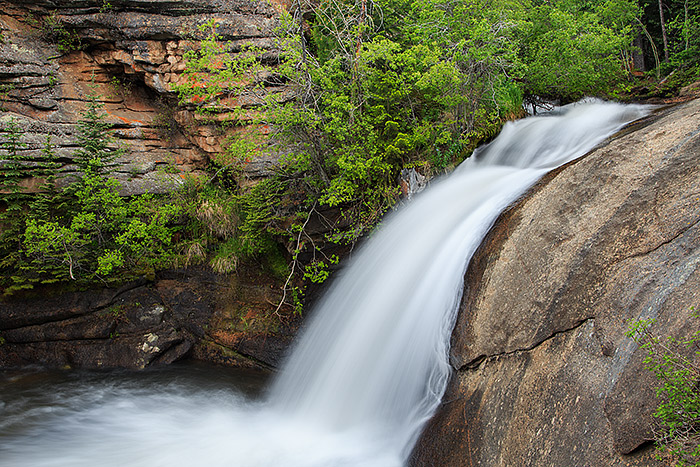
The upper section of West Creek Falls tumbles over the granite walls along West Creek. This was my first visit to West Creek Falls and the location did not disappoint. If your looking for a quiet, out of the way location to photograph waterfalls in Rocky Mountain National Park, this certainly is a great place to visit. Technical Details: Canon EOS 5D Mark III, 24-105mm F4 IS
Having just spent a week back on the east coast where I immersed myself in waterfall and stream photography, this past week saw me continuing that trend.
While I’ve been antsy to get out an photograph mountain peaks and alpine lakes, this past week saw mostly bluebird clear sunrises combined with haze and smoke from the wildfires burning across Colorado and the west.
Since it was unlikely I was going to be able to capture any portfolio worthy images of peaks and mountains with the smoke, haze and clear blue skies, I figured water features would be the most productive way to spend my time.
Over the last fifteen years, I have photographed many of the waterfalls in Rocky Mountain National Park. Even so, I still have a huge list of falls and locations I have yet to visit and photograph. Rocky is big, and getting to each and every waterfall in the park requires lots of dedication and effort.
I had never visited West Creek Falls prior to last week. I’ve spied it on my topo maps many times but it’s somewhat out of the way location has kept me from passing by it or making it the sole purpose of and expedition.
West Creek Falls lies just inside the eastern boundary to Rocky Mountain National Park. Much of the actual hike into West Creek takes place outside Rocky Mountain National Park. Starting at McGraw Ranch, and traversing the North Boundary Trail through the Comanche Peak Wilderness area you eventually come to a spur trail that leads you on the hike up to West Creek Falls.
West Creek Falls is located in the West Creek Research Natural Area. Besides the small spur trail to the Falls, the West Creek Research area is essentially a trailess, little visited section of Rocky Mountain National Park tucked within the Mummy Range.
Like many locations in Rocky now, fallen trees and deadfall can present a problem in capturing unhindered views of locations. West Creek has its share of deadfall, but with some careful placement of my tripod and camera I was able to photograph the beauty of West Creek Falls.
West Creek Falls is a beautiful, secluded spot in Rocky Mountain National Park. I’m definitely planning on visiting the falls again most likely in the fall which looks to be promising.
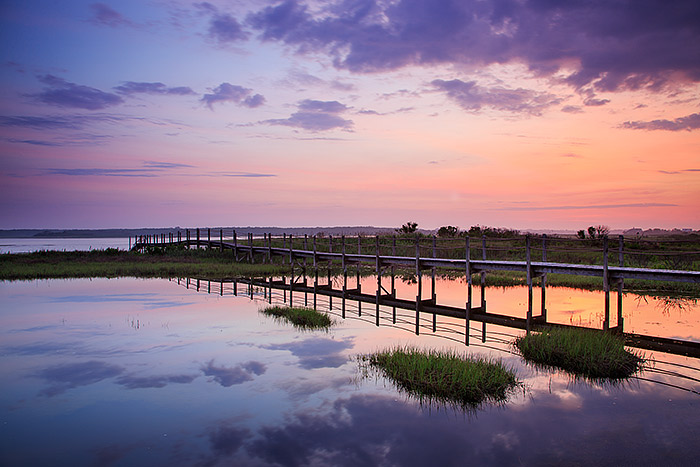
I just returned from a week long jaunt to New York State. Compared to my usual stomping grounds in Colorado, water is plentiful. While it rained much of the trip, I was able to capture a few sunrises in between weather systems. Pastel colors light a private dock along the shores of Shinnecock Bay in Southampton, New York. Technical Details: Canon EOS 5D Mark III, 24-105mm F4 IS LI spent all of last week traveling through and around New York State photographing some of my favorite places in the Empire State. One word comes to mind whenever I leave Colorado and head back east and it’s water.
The contrast between the arid and dry climate of Colorado, compared to the moisture laden areas of the east coast is always striking to me. In New York you are always near, around, in, or over some sort of water it seems. Colorado, not so much.
When I’m out photographing locations in Colorado, I seek out water. Small lakes and bodies of water become destinations for photography because of the impact they bring to landscape photography in a dry climate. When photographing locations in New York, water becomes almost an afterthought. It seems to always be part of the landscape and location.
Neither situation is better or worse. To me they are just part of the makeup of the unique locations and it’s the contrast is climates that continues to make these different destinations so much fun to shoot.
So even though I expect to be photographing lots of bodies of water and water features when I travel through New York, heavy rain helped to keep already green and saturated areas even more vibrant and green than I could have expected.
In fact while an average June typically see about 5.5 inches of rain the entire month, nearly 9 inches of rain fell last week alone. Even with the rain it was a great week of photography and being in a different environment is always a great way to keep the creative juices flowing.
Even still it’s good to be back in Colorado and will be even better to get back up into Rocky to see how our snowmelt and thaw out is progressing in our thin dry air.
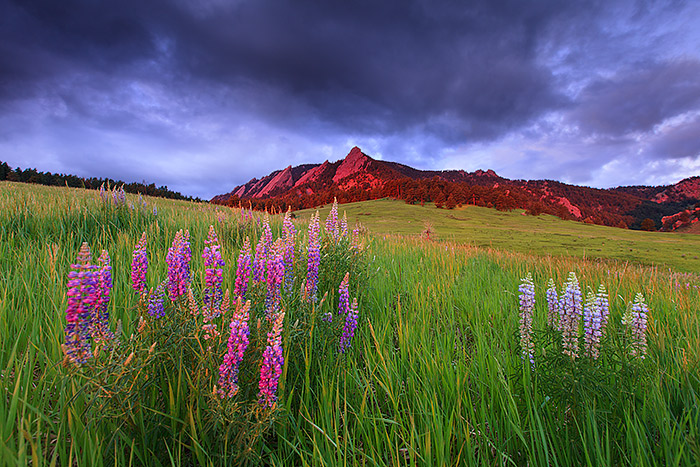
Just enough drop under light illuminates the Flatiron formation at sunrise in Boulder. Silver Lupines blooming in Chautauqua Meadow combined with the dark ominous clouds made for a brief but awesome morning of photography with the help of a little storm lighting. Technical Details: Canon EOS 5D Mark II, 16-35mm F2.8 L IIThe parade of wildflowers continues in Chautauqua Park in Boulder. Are wet spring is providing enough moisture to keep the meadow green and the flowers blooming. Currently the flavor of the day in Chautauqua Meadow is Silver Lupines and if things go as they usually do, I would expect the Sweet Pea to start blooming just west of the Ranger cottage shortly.
As I’ve stated before in my blog, I’m a sucker for storm light. Pretty much any subject looks good in storm light, including fast food joints, garbage cans, and even proverbial eyesores like strip malls and cell phone towers.
Some may wonder what exactly constitutes storm light. Clouds of any sort always help to add depth and perspective to landscape photography. Having clouds in your image alone does not constitute storm light photography. For true storm light we need a little bit more than just some wafting and drifting clouds in the sky.
For true storm light we need ominous dark clouds swirling above or around our subject. Dark ominous clouds alone are not enough. We then need the special ingredient of some ‘drop under’ light. There needs to be a small break or opening in those ominous clouds that allows just enough of the sun’s magical first or last light of the day peak through and bathe our subject with intense, colorful, long angle lighting.
Storm lighting is short lived and fleeting. Your only going to have a few seconds or minutes to take advantage of the conditions. This was the case when I photographed the Flatirons from Chautauqua Meadow last week. I had a little over 2 minutes of light this particular to make this image work. It was a fleeting moment, but the storm light over the Flatirons this morning more than made up for the duration of light. Now where are those fast food joints, cell phone towers and strip malls!.
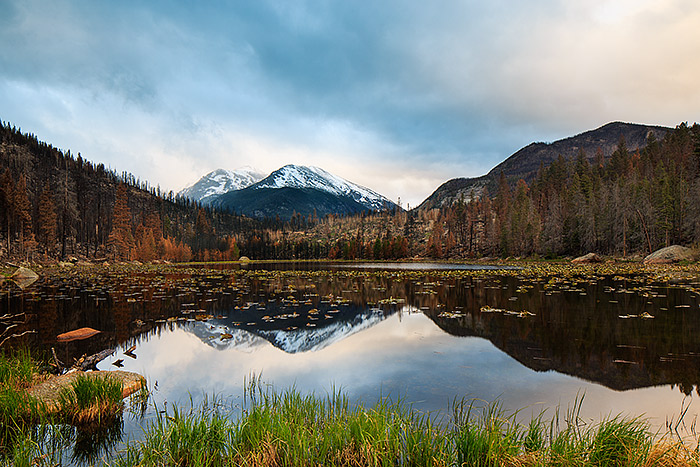
Sunrise at Cub Lake. This was my first visit to photograph Cub Lake after the Fern Lake Fire. The scenery has changed since the fire but Cub Lake remain a place of beauty. Even in destruction, beauty remains in nature. Technicial Details: Canon EOS 5D Mark III, 24mm TS-E F3.5 L IIColorado and Rocky Mountain National Park have been feeling the effects of a prolonged drought for over a decade now. Combine that with the pine beetle outbreak that has been ravaging are evergreen forests and you quickly comprehend the powder keg our forests and Rocky are sitting on.
Up until October 9th, 2012 it had been not a question of if a major forest fire, but when. Significant fires had broken out in close proximity Rocky Mountain National Park prior to the 9th of October but the park had been spared from a large fire within its boundaries.
Everyone’s fears were realized on October 9th, when what is believed to have been an illegal campfire on the rocky ledges above The Pool and Big Thompson sparked what would become known as the Fern Lake Fire.
The fire spread quickly through the rocky and difficult terrain just west of Moraine Park in Forest Canyon. While the fire was the most significant blaze in Rocky Mountain National Park since the ‘Ouzel Fire’ was sparked by lighting on August 9th, 1978 burning almost 1100 acres in the Wild Basin area of Rocky. The vestiges of the Ouzel Fire are still very evident even today in Wild Basin, nearly thirty five years later.The charred remains of a spruce tree make for and interesting subject for photography near Cub Lake. The metallic like sheen and patterns made for a reptillian like resemblence. Technicial Details: Canon EOS 5D Mark III, 100mm Macro F2.8 L IS
While the thought of the Fern Lake fire burning in Rocky was disturbing, most of us figured it’s start so late in the season would cause it to be quickly extinguished by the early snows that typically cover the high country by October.
The snows remained absent through much of October and November but firefighters had been able to keep the Fern Lake fire contained. Some hot spots remained here and there in the rocky crags of Forest Canyon but everyone was confident the snows would soon be coming to finish the firefighters work.
By December 1st the Fern Lake fire had mostly become and afterthought. High winds during the night raked Rocky and the Estes Valley on December 1st. The nearly dormant Fern Lake Fire exploded once again with the help of the high winds.
Within a few hours the fire had sprinted through Moraine Park and had made it all the way to Bear Lake Road. If the fire jumped Bear Lake Road, there was nothing to stop it from running outside the park boundaries and right into the town of Estes Park.Another photographic study of the side of an evergreen near Cub Lake. The outer bark has been charred by the fire and mostly flaked off exposing the redish hue of the inner bark of the tree. Technical Details: Canon EOS 5D Mark III, 100mm Macro F2.8 IS L
Fortunately, Bear Lake Road acted as a natural fire break. Firefighters were able to setup a fire line at Bear Lake Road and prevent the fire from moving any further east. The snows eventually came and although the Fern Lake Fire smoldered in small areas late into winter, it was finally put down by heavy spring snows.
3500 acres later, the Fern Lake Fire stands as the largest wildfire to burn through Rocky Mountain National Park in modern times. The damage from the fire is significant in the Forest Canyon, Cub Lake and Moraine Park area of the park.
Like all things in nature, wildfires are part of the cycle and though destructive are a necessary means to refresh and renew old forests. The burn area will not look the same during our lifetimes. In the long run however, the burn areas will be healthier and will eventually return to their former beauty.
Last week I took my first hike up to the Cub Lake post fire. I wasn’t exactly sure what to expect, but I knew the area around Cub Lake had taken on some serious fire damage. Cub Lake has always been a favorite place in the park to photograph for me. The last few years however, the area around Cub Lake had been inundated pine beetle damage. To be frank, the trees around Cub Lake were already in transition before the fire burned through the area and Cub Lake through still spectacular has lost some of its beauty due to the loss of many of its trees. Wildfires have a positive effect on the areas they burn out. They act as a fertalizer and help to renew the soil, grasses and trees. The blackened soil in Moraine Park is already producing vibrant green grasses and wildflowers will be budding through the burn area in the next few weeks. Technicial Details: Canon EOS 5D Mark III, 70-300mm F4-5.6 L
As I neared Cub Lake, the fire damage became more evident. Pines and aspens were scorched along the creek and trail near the outlet to Cub lake. Arriving at Cub Lake it was humbling. To look upon the landscape and see the burnt tree’s and ash all around the lake and hillsides felt almost like being on another planet.
I took some time to wander around the lake and within the forest just before sunrise. Sad as it was to see the changes that had occurred due to the wildfire, I could see beauty in what was left behind. Fascinating patterns had formed on the burnt out trees, and the charcoal stumps and logs flittered with metallic like colors and patterns.
After shooting sunrise at the lake, I headed up into the hillsides to photograph the shapes, textures and patterns along left over from the fire. Change is difficult, but it only took a little while before I was enjoying the experience and documenting the changes.
Change is part of mother nature’s bigger picture. I certainly wont see the area around Cub Lake rejuvenate in my lifetime, but I feel privileged enough to have witnessed both the before and after effects of the fire. Cub Lake is still a beautiful location to visit and photograph just make sure to keep an open mind when wandering trailside.
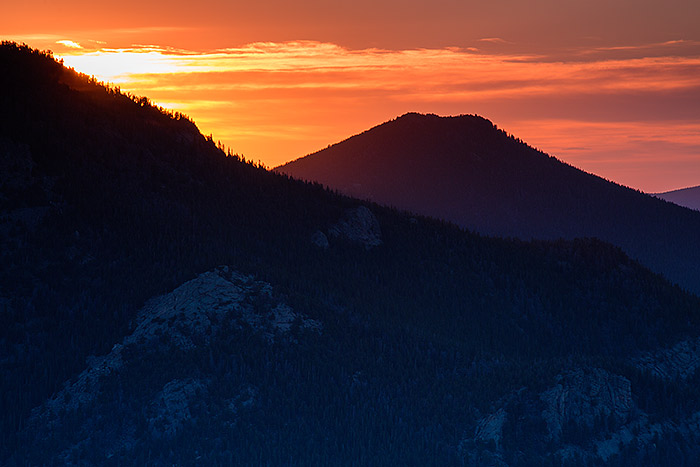
A muted sunrise illuminates the skies over Dark Mountain and Lumpy Ridge. I was able to photograph this view of Rocky from Rainbow Curve along Trail Ridge Road which is now open for the season. Technicial Details: Canon EOS 5D Mark III, 70-300mm F4-5.6 LWith Memorial Day past us and the unofficial start of Summer underway, the excitement and anticipation of great adventures and explorations builds. Typically I have a ‘to-do’ list of locations in Rocky Mountain National Park that I would like to explore and photograph.
The list is not rigid. I don’t set dates or deadlines with it. I just use it as a general guide. It’s helps to jog my memory and keep me focused. Experience has taught me that without my list I tend to drift, lose focus and end up too many times caught up in the no mans land of creativity and photography.Lime green spring aspen trees bud out along Lumpy Ridge and the Gem Lake trail. Technical Details: Canon EOS 5D Mark III, 70-300mm F4-5.6 L
Even with Summer just around the corner, I have yet to complete my list. Not that the list is ever completed, but it still needs some additions. There are just so many places in Rocky to photograph and explore that it times is seems a monumental task.
With that said, you have to start somewhere and new possibilities are opening up in the park which each passing day. Trail Ridge Road opened on Friday and each day the lakes unthaw a little more, and snow recedes to higher elevations along the trails
Our cold spring which was very much just and extension of winter has most areas of the park two to three weeks behind a typical year. It’s causing some fits and starts for me and my to-do list as some of the usual locations are not quite ready for primetime yet.
So I’ve been wandering around exploring both known and unknown locations the last few weeks. It’s resulted in a few flops and some surprise gems. Regardless of the outcome, the experience and adventure of being out in Rocky trumps all.
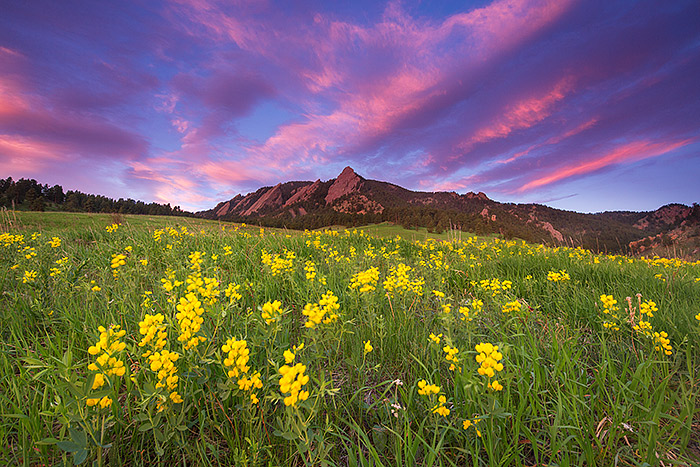
What’s better than this after a long winter?. It’s be a long wait, but worth it for images like these. The sky errupts with color over Chautauqua Park and The Flatirons of Boulder on a beautiful spring morning. Golden Banner fills the meadow below the iconic rock formation. Technical Details: Canon EOS 5D Mark III, 17mm TS-E F4 LThere are few more iconic and beautiful locations in Colorado that Chautauqua Meadows at the base of the Flatirons in Boulder. It’s a beautiful location anytime of year and a place that has a magical quality about it.
Spring in Chautauqua Meadows is particularly special. Flowers bloom in the meadow and the sweet smell of the Ponderosa pines that line the hillsides fills the warming air.
It’s almost as if Chautauqua Meadows puts on slow motion show of changing displays of wildflowers and colors. The Golden Banner will cede to Silver Lupine, which will regress for Wild Iris, then finally the pink, reds and purples of the Sweet Pea as the days warm and summer settles in.
After a spring that has been masquerading as winter, it’s nice to finally have some warm weather and to watch things finally begin to green up. Were at least a good two weeks behind the norm in Boulder as far as the foliage goes so I’ve been eagerly awaiting the first flower blooms in Chautauqua Park.
In a typical year, Golden Banner is the first significant bloom to propagate Chautauqua Park in the spring. That’s true of this year as well.
With nice healthy clusters of Golden Banner sprinkled throughout Chautauqua, I was treated to a spectacular sunrise over the Flatirons last week. Spring has been slow to the party but the wait was well worth it.
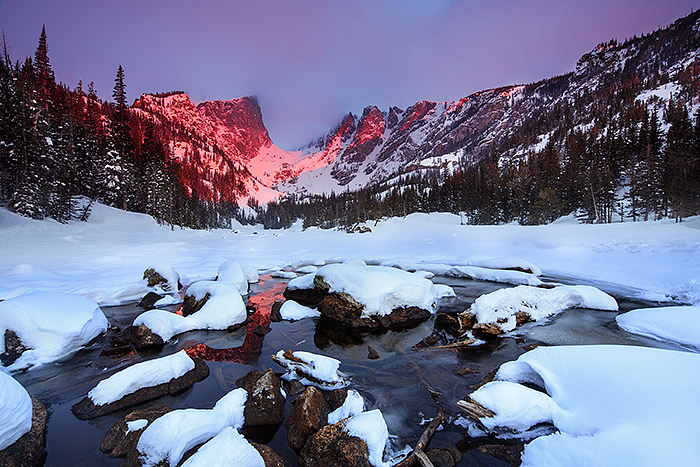
Spring sunrise on Dream Lake. It’s been a long cold spring in Rocky Mountain National Park. I took this image of Dream Lake the first week of May. The outlet to Dream Lake had just begun to thaw out allowing for me to capture a slight reflection of Hallet Peak in the icy waters. Technicial Details: Canon EOS 5D Mark III, 17mm TS-E F4 LI’ve been getting a few emails regarding the current condition of Rocky, what lakes have opened up and how much snow there is yet to melt off. I expect conditions to change fairly quickly in the next few weeks as it looks like a longer stretch of warm more temperate weather is about to settle in for at least a week.
I expect this warm up to have a pretty significant impact on melting and opening up of some lakes in the park. That being said we have a long way to go. There is a lot of snow in the higher elevations in Rocky right now.
In the fifteen years I’ve been photographing Rocky, I personally cant remember a year where there was this much snow present so late into the spring. I’d suggest that everybody get used to the fun of post holing when hiking for at least the next few weeks.
The two images included in this post are from the last two weeks. Conditions will change quickly and everybody needs to be prudent and safe when walking near frozen and thawing bodies of water. It’s often difficult to tell whether your standing on snow along the shoreline, or snow on top of soft, unstable ice.This is how Bierstadt Lake looked just a few days ago. The ice has yet to melt from it’s surface and its already the second week of May. Technicial Details: Canon EOS 5D Mark III, 17mm TS-E F4 L
Moraine and Horseshoe Park are free of snow. The meadows are just starting to green up and both Fall River and the Big Thompson are starting flow at a good pace. I’m eagerly awaiting the wildflowers in Moraine Park this year as the combination of heavy moisture and the revived soil from the Fern Creek fire could make for an interesting display.
Sprague Lake is completely free of ice now. The last little bit of ice on Sprague melted off at the end of last week. Bierstadt Lake was still covered by ice as of this weekend. The edges had just begun to thaw out and I expect Bierstadt to open up quickly from here on out as it was apparent the ice sheet is very soft.
Bear and Nymph lake still remained buried under the heavy snowpack. Dream Lake’s outlet has begun to thaw out and there is open water to be found.
At this point, lakes at about 10,000 ft or higher in Rocky Mountain National Park are going to be frozen well into June. The higher lakes are buried under considerable snow so it’s going to take a lot of energy to thaw them. Until then, the lakes, streams and waterfalls at lower elevations should keep photographers busy.
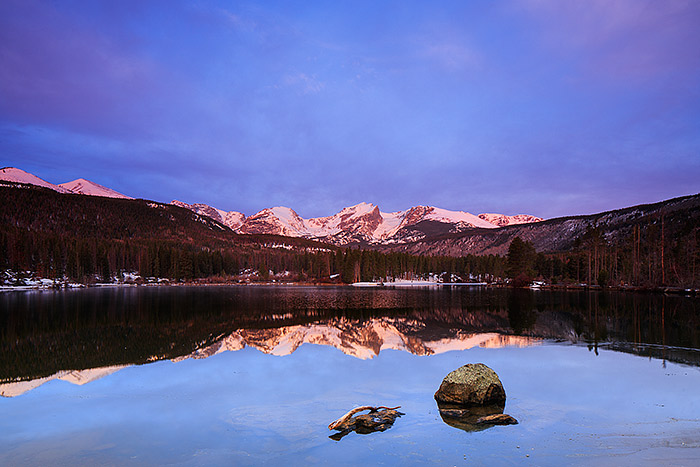
Sunrise illuminates Otis,Hallet and Flattop Mountain on a perfect spring morning in Rocky Mountain National Park. Sprague Lake has finally thawed and spring is finally making it’s appearance in Rocky Mountain National Park. Technicial Details: Canon EOS 5D Mark III, 24mm TS-E f3.5 L IISay that three times fast!. In what seems like a winter season that just wont end, finally are signs of spring throughout Rocky Mountain National Park. Don’t get me wrong, there are still plenty of signs of winter in the park to go along with all the snow, but progress is being made.
The exceptionally snowy and wet spring we’ve had is a blessing for sure. Rocky needs every little drop of moisture it can get before the hot and dry summer season settles in.
Monday morning at Sprague Lake had all the elements of spring melding together. Sprague Lake is nearly free from ice. The resident Mallards of Sprague were busy quacking in protest at my presence and the ever so subtle smell of pines could be detected over the frosty air.
It’s the subtle things like the return of the ducks and the organic and earthy smells of tree’s and plants the foretell the coming of summer. It’s being able to stand lakeside and watch a sunrise unfold in the chilly morning air and not feel cold. All in all it’s a pretty good place to be on a Monday morning
As we trundle through a long spring that has felt much more like winter in Rocky, warm weather has me eagerly looking forward to summertime adventures in Rocky Mountain National Park. Mornings like this one on Trail Ridge are epic and I cant help to daydream about this summers possibilities. Technicial Details: Canon EOS 1Ds III, 17mm TS-E F4 LWe finally had what seems like our first spate of warm weather this spring. Temperatures in the 70’s had me daydreaming about possibilities and adventures planned as the high country finally begins its thaw out.
The summer season in Rocky Mountain National Park is always too short. Just when you feel like your hitting your stride, cold weather settles back in and one’s left to contemplate all the places you did not have enough time to visit.
Therein lies the beauty of being on the cusp of summer. The possibilities and adventures are endless. I wont even scratch the surface of the adventures I conjure up in my head, but the excitement and anticipation is palatable.
Who knows what this summer will bring. Which lake in Rocky will I be out this summer as an epic sunrise unfolds over the beautiful peaks of the park?. I cant wait to find out. For now it’s time to take the dog out for a walk on another pleasant morning. That’s because if you didn’t hear, we’ve got heavy snow moving in again tonight!.
Is this Alaska or Rocky Mountain National Park?. It’s quickly nearing the end of April in Rocky but you wouldn’t know it by looking at this image of Moraine Park. Moraine Park is covered in over a foot of new snow and the Big Thompson river is completely iced over. Technical Details: Canon EOS 1Ds III, 17mm F4 TS-E LNormally I would expect for the Big Thompson river to be flowing at a steady pace this time of year. The winter melt off in the high country would have begun and the streams around Rocky would be thawing and filling with this winters snowmelt. The end of April is a transitional season, the end of April this year seems to have us transitioning back towards January.
Rocky Mountain National Park and Estes Park desperately need all the moisture they can get. April has helped to get the area nearer to normal levels. Bear Lake recorded 32 inches of fresh snow at the end of last week. All this moisture should go a long way to help mitigate the fire danger and provide a beautiful display of wildflowers through June, July and August for us photographers.
Finding running or open water anywhere in the park last week was a challenge. In fact it was mostly impossible. The best I could do is find some areas of open ice along the Big Thompson in Moraine Park to reflect this beautiful sunrise after trudging through the a few feet of snow in Moraine Park to get to this bend.
The warm weather, thawed lakes and snow free trails are just around the bend. I just need to keep reminding myself of this fact and keep the winter gear handy for a little while longer.